The first fully electric Range Rover Sport arrives with 550 HP, 850 Nm of torque, and up to 609 kilometers of WLTP range. But beyond the figures, the truly interesting thing is to see how it behaves when the road disappears. We tested it in exclusive at Goodwood and could confirm that electrification has not dulled one bit its off-road capabilities.
For the first time, the Range Rover Sport is available with completely electric propulsion, and it does so while keeping intact one of the defining traits of this model: its ability to combine performance, comfort and dynamic behavior with off-road capabilities that are far beyond what you would expect from a luxury SUV of its size.
And precisely proving that capability remains intact was one of the objectives of the test I carried out last July at Goodwood, during an exclusive experience with the new Range Rover Sport Electric. There we did not limit ourselves to driving it on asphalt. We put it to the test on stairs, dirt areas, slalom, load transfers and various obstacles, in addition to starring one of the most spectacular trials: driving through the fuselage of a passenger aircraft, entering one end and exiting the other.

All of that even before knowing all the production model’s final figures, which have now finally been unveiled.
A Range Rover Sport that changes a lot more than it seems
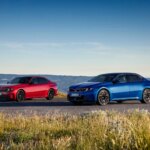
At first glance, the new Range Rover Sport Electric does not aim to revolutionize the model’s aesthetic formula. Its silhouette remains perfectly recognizable and maintains the proportions and presence that have made the Sport one of the most characteristic models in the Range Rover family.
The differences lie mainly in the details. A new, more closed and aerodynamic grille or wheels specifically designed for this version help identify the electric model, while also contributing to improve its efficiency. In fact, according to official data, these solutions can contribute up to 16 kilometers of additional range when cruising at highway speeds.

But the really important thing is under that bodywork. The Range Rover Sport Electric uses a 118.5 kWh lithium-ion battery and two electric motors of 260 kW, one associated with each axle. The result is 550 HP and 850 Nm of peak torque, the highest torque figure seen in any Range Rover Sport to date. With Dynamic Launch mode activated, it can accelerate from 0 to 100 km/h in just 4.5 seconds.
It is a figure that puts it directly into the territory of high-performance combustion sport SUVs. But if there is a figure that helps explain why this car can behave differently from other Range Rover Sports, it is the structural rigidity.
The body is 61% stiffer than that of the Range Rover Sport PHEVs and the center of gravity sits 73 millimeters lower. They are not numbers easy to appreciate just by looking at the car, but they have a very clear consequence when you start driving: the Sport Electric feels more planted than one would expect from a SUV of this size.
The challenge: making it weigh less than it weighs

The Range Rover Sport platform was developed from the outset to support an electric version
One of the challenges of any large electric SUV is ensuring that the weight of the battery does not overly condition the dynamic behavior, especially in a model that already has combustion versions on the streets for comparison.
In the Range Rover Sport Electric, the engineers’ answer has been to work deeply on the chassis. It features Dynamic Air Suspension, twin-valve shock absorbers, Adaptive Dynamics, Electronic Active Roll Control, and four-wheel steering. The Adaptive Dynamics system monitors up to 100 parameters 500 times per second to control the vehicle’s body movements.
And you can feel all of that at the wheel. In Goodwood I had the chance to test it especially in the slalom zones. This is where a SUV of these dimensions should start to show its limits: quick steering inputs, mass transfers, and a tall body that normally requires a lot of effort to restrain body motions.

However, the Range Rover Sport Electric responds with surprising agility. It doesn’t feel like you’re driving a small car, obviously, but it does convey a sense of control and precision far greater than you would expect for its size. Four-wheel steering helps reduce the sense of volume and makes the car change course with much more ease.
The body remains remarkably controlled and the active roll stabilization keeps body movements very contained. It’s probably one of the first things that stand out when driving it: it feels smaller than it really is.
550 HP arriving with almost no noise

The other major difference compared to the Range Rover Sport as we know it lies, logically, in the way power is delivered.
The 850 Nm appear immediately and without the delay you’d expect from a combustion engine. In a launch from a standstill, the shove is strong and very linear, to the point that the stated 4.5 seconds to reach 100 km/h is not hard to imagine.
But what’s curious is that Range Rover hasn’t limited itself to letting silence be the car’s only acoustic trait.

The Sport Electric incorporates a specific sound design that blends different tones to enhance the driver’s interaction with the various driving modes. The brand itself explains that they have worked to create an acoustic signature that sits somewhere between music and engineering.
It doesn’t aim to artificially imitate the sound of a V8, thankfully. Its objective is different: to provide information and character to a driving experience that, by the very nature of an electric car, would be much quieter.
And in a vehicle capable of such forceful acceleration, having some acoustic reference helps build the sense of connection that Range Rover has sought.
And then comes the staircase

But if there is one moment in this test that helps understand what Range Rover is really aiming for with this car, it is when you leave the asphalt.
Because an electric Range Rover Sport could have been conceived simply as a high-performance luxury SUV with zero local emissions. Yet the brand wanted it to be something more than that.
The Goodwood test included various obstacles designed to test the control of the two electric motors, mimicking some of the challenges Range Rover Sport has faced in the past. One of them was a staircase, which lightly simulated the Dragon Challenge that took place on China’s Tianmen Mountain Road a few years ago.

Climbing a staircase with a SUV of this size always impresses from the outside. From the driver’s seat, the most striking thing is how easily the car progresses. The instant torque allows precise progression and, above all, avoids the need for a combustion engine to maintain a certain RPM to generate the required force.
What I was most focused on was the perimeter camera system to avoid stepping off the platform, since the car is very wide and there was a risk of doing so.
The traction management system distributes torque between both axles and among the wheels as needed. The brand talks about a virtual all-wheel drive, accompanied by an Intelligent Traction Management system specifically calibrated for this model.

And that enables something especially interesting in off-road driving: the ability to precisely control what each wheel does.
Crossing an airplane with a Range Rover
If climbing a staircase was a demonstration of control, driving through the fuselage of a passenger airplane was directly a show-stopper, but perhaps more impressive than the previous.
The challenge was to thread the Range Rover Sport Electric through one end of a passenger airliner’s fuselage, move through its interior, and exit at the opposite end.

From the outside, the image is spectacular. But from the inside, there is another takeaway: the car must advance with precision in a narrow space while also overcoming surface changes and obstacles along the route.
And here again appears one of the most surprising features of the Sport Electric: its ability to make all that technology work in a way that is virtually transparent to the driver, aided by the camera system designed to pass through very tricky off-road spots in practice.
You don’t need to constantly think about which wheel has grip or how much torque should reach each axle. The system takes care of it and you simply have to concentrate on choosing the trajectory.

That ease is precisely what makes the result so convincing and the photo such a keepsake.
A true off-roader
The electrification hasn’t forced Range Rover to lower its off-road expectations when it comes to driving off the pavement. The Sport Electric can wade through up to 900 millimeters of water and climb inclines of up to 45 degrees. These figures clearly place it in true off-road territory rather than simply SUVs with some off-road capability.
In fact, the car’s development program included tests in especially demanding conditions. The latest development scenario was the Carrara marble quarry in Italy, with slopes up to 45 degrees and surfaces ranging from polished marble to ultra-fine marble dust layers.

It’s a particularly interesting scenario because it forces a blend of two traits that don’t usually go together: precision and traction capability.
At Goodwood, although conditions were obviously more controlled, the different challenges allowed precisely testing that traction management capability. And the conclusion after trying it is clear: the fact that it has two electric motors instead of a combustion engine hasn’t turned the Range Rover Sport into a less capable off-road SUV.
In fact, in certain situations, the instant and extremely precise response of the electric motors can become an advantage.
A massive battery and surprisingly fast charging

The battery has a capacity of 118.5 kWh and operates on an 800-volt electrical architecture. It is one of the largest batteries you can find in a road car today.
With it, the Range Rover Sport Electric promises up to 609 kilometers of WLTP-certified range, while the brand’s real-world estimate sits at around 537 kilometers. Obviously, in this kind of test we couldn’t analyze this aspect with precision; for that, we’ll have to wait to test it calmly when we have a unit for a full week.
But as important as range is charging speed. Using a DC fast charger capable of delivering the maximum power the vehicle accepts, it can recover up to 220 kilometers of range in just 10 minutes. The 10 to 80% step takes approximately 22 minutes.
Those figures are especially relevant for a vehicle of this size and with a battery of this capacity. Additionally, Range Rover has developed a thermal management system called ThermAssist, designed to optimize electric performance and keep the battery in the right conditions.
The battery, incidentally, comes with an eight-year or 160,000-kilometer warranty, because surely there will be comments along those lines.
The most tech-savvy Range Rover Sport

The technology doesn’t stop at the propulsion system. The car features a Battery Digital Twin that enables more predictive maintenance and takes advantage of JLR’s over-the-air updates. There is also a new Range Rover app from which you can locate and schedule charging sessions.
Externally, besides the new grille and the specific wheels, the objective has been to keep the Range Rover Sport’s personality intact.
The range will be available in Dynamic SE, Dynamic HSE, Autobiography and First Edition trims, in addition to various customization options through the Range Rover Bespoke program. The First Edition, for example, is distinguished by its Zadar Grey finish with Satin Wrap, contrasting black roof and 22-inch wheels.
Is it still a Range Rover Sport?

After driving it at Goodwood, that is probably the most interesting question. The answer lies in how Range Rover approached electrification.
It hasn’t simply replaced a combustion engine with two electric motors and a huge battery. It has leveraged the possibilities offered by electric propulsion to modify the center of gravity, increase structural rigidity, improve body control, and achieve a much quicker response.
And at the same time, it has paid special attention not to sacrifice what defines a Range Rover, since from the birth of this generation a electric version was planned, so the platform was already prepared for it.

The result is an SUV that impresses more by its ease than by its spectacle. The 550 HP and 850 Nm look impressive on paper, but it is the way the car manages to use them that really makes the difference.
On the road, the lower center of gravity and the control of body motions make it feel much more agile than its dimensions would suggest, but that is something that also happens with the combustion versions.
In technical off-road zones, the two motors allow traction to be managed with enormous precision. And off the pavement, the off-road capability figures demonstrate that we are not dealing with an electric SUV that had to give up part of its DNA.

The Goodwood test had precisely that objective: to prove that a Range Rover Sport can enter the electric era without stopping being a Range Rover Sport.
After climbing stairs, doing slalom, overcoming obstacles, and crossing the fuselage of a passenger plane, the takeaway is that they’ve done it.
The Range Rover Sport Electric does not aim to merely be the electric alternative of the Range Rover Sport for those seeking an electric option. It aims to harness electricity to take the Sport concept a step further, keeping intact the off-road capability that has accompanied the Range Rover name for decades. And most importantly, it will not replace the PHEV, gasoline or diesel versions of this model, which will remain on the market.

Looking for your next electric car and feeling overwhelmed by so many options? It’s normal.
More than 45,000 readers have already tried it. And you?
Advice offered by the brand