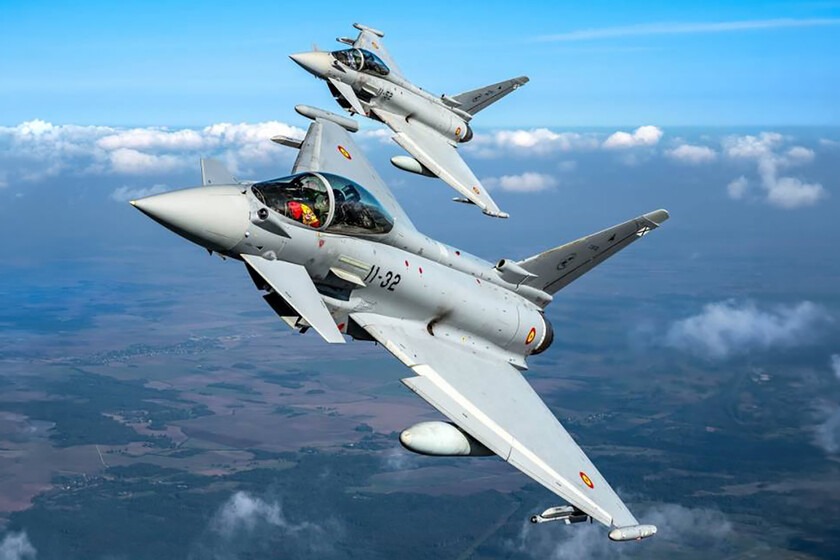
More than 400,000 people crowded Salou’s beaches (Tarragona) for the ‘Festa al Cel’, one of Spain’s largest aviation festivals. Among aerobatics with historic aircraft or parachutists from across half of Europe and the deployment of all kinds of aircraft, the most anticipated display was undoubtedly the Spanish Eurofighter Typhoon C.16.
The European fighter jet is a true symbol of the role that Spain has assumed in recent years in the premier military aviation industry, joining the elite of the few countries that design and produce fifth-generation fighters.
h2
In the late 1980s, the idea that a Spanish engineer would participate in the design of a fighter aircraft seemed like science fiction. The country knew how to build and maintain transport aircraft, such as the excellent CASA CN-235, but designing a fighter remained the preserve of a handful of aerospace powers. The Eurofighter program changed everything.
Born thirty years ago from a collaboration between the United Kingdom, Germany, Italy and Spain, the consortium has become the largest defense program ever undertaken in Europe. Today, every Eurofighter Typhoon that takes off carries a right wing manufactured in Spain; the left comes from Leonardo, in Italy. This contribution matches Spain’s investment in the program. In other words, the industrial return is proportional to the investment.

Money stays in the country that funds it, but the technology circulates among the partners, and each one receives workload and patents in proportion to its contribution. A model inherited from the Tornado program, now regarded as fearsome in its effectiveness.
It may not seem like much, but Spain had to compensate for a notable technological lag when joining the project, with no prior experience in fighter design. The former CASA, now part of Airbus, had never designed a combat aircraft.
It learned from contact with the British firm British Aerospace, which became BAE Systems; with the Germans of DASA, which went through EADS before joining Airbus; and with the Italians of Alenia, today Leonardo.
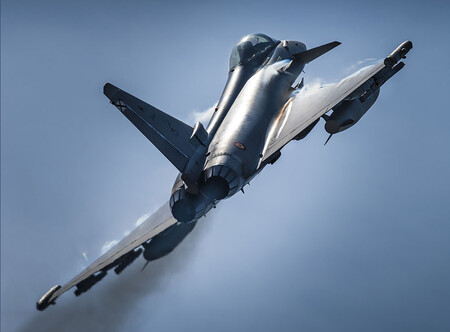
That enhancement of capabilities gave rise to an entire industry. Indra is the most striking example; starting from almost nothing, the company has become a worldwide reference in radar and the program’s main avionics supplier, capable of competing with Leonardo or the German Hensoldt.
ITP Aero, created specifically for the Eurofighter, manufactures highly prized turbine parts. MTorres has established itself in tooling and composite materials. Around that core revolve Tecnobit, CESA, Amper, the OESIA group and about fifty subcontractors, sustaining around 26,000 direct and indirect jobs.
Forty years on, more than 600 aircraft have been built, and five countries outside the consortium (Saudi Arabia, Oman, Qatar, Kuwait and Austria) have purchased the Typhoon. Turkey ordered twenty new units in 2025 and is negotiating another twenty second-hand ones.
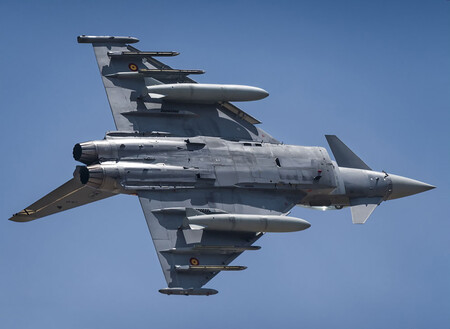
The order book stands at 769 units against a target of 1,000, with production running through 2034 and the fleet in service until 2065.
Spain operates its Eurofighters from three bases, Gando in the Canary Islands; Los Llanos in Albacete; and Morón in Seville. It holds 13% of the industrial program. A misleading figure: between 70% and 80% of the maintenance of Spanish aircraft is performed on national soil, a significant economic advantage, considering that the maintenance of a fighter aircraft over its lifetime costs three to four times its purchase price.
Technically, at 16 meters in length and built with around 70% carbon fiber and glass, the Eurofighter houses two Eurojet EJ200 engines so powerful that they give it a thrust-to-weight ratio of 1.6 when empty, versus about 1.5 in the case of the Rafale, according to Eurofighter GmbH and Dassault Aviation.
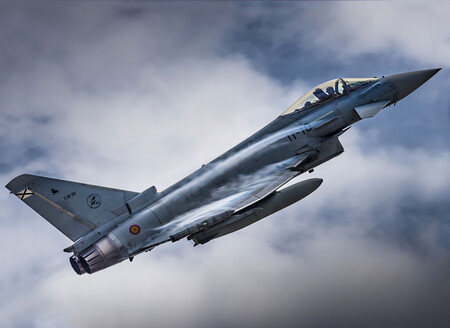
Thus, the thrust of its engines exceeds the weight of the aircraft. A passenger jet, to give an idea, operates with thrust at only about 25 or 30% of its weight. This means the Eurofighter can ascend vertically literally like a rocket, without depending on its wings, where other aircraft would lose speed as they climb higher.
The Halcón I (2022) and Halcón II (2024) programs have allowed Spain to acquire 45 additional aircraft for around 6.6 billion euros, raising the national fleet to 114 units in the coming decade.
These aircraft will carry the Meteor missile, the Brimstone, the Striker helmet and later the Striker II with integrated night vision, and, from 2030, an electronically scanned radar E-Scan developed by Indra, Leonardo and the German Hensoldt, improving the current radar capable of detecting air and ground threats at more than 100 kilometers.
While the future sixth-generation European fighter remains in limbo after the Paris-Berlin split over the issue, the Eurofighter is not a stopgap; it forms the backbone of Spain’s air defense for the coming decades. And all of this with an industry that forty years ago simply did not exist.
Images | Aircom, Airbus, David Álvarez López, Sergio Ruiz González