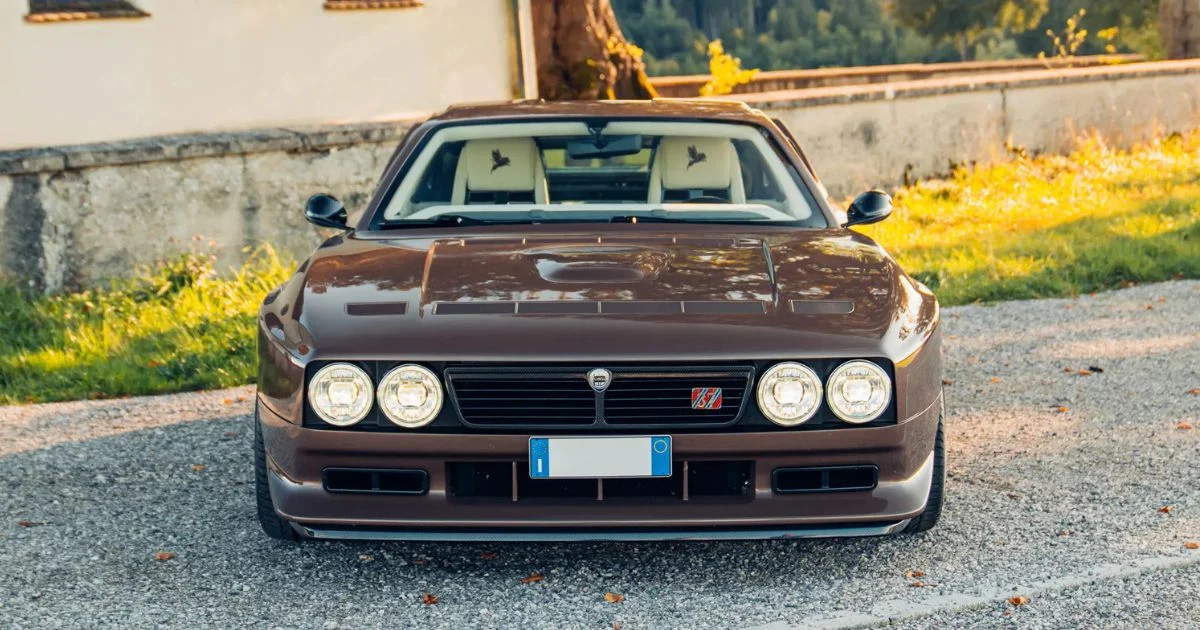
What if one of the most speculative supercars of the moment wasn’t wearing a Ferrari or Lamborghini badge, but carried the mark of a small, little-known Italian maker. With its Group B-inspired silhouette and performance figures that would make many contemporary GTs blush, this creation drawn from the Lancia 037 has not only captivated rally enthusiasts. It’s now drawing in a different crowd: the kind that weighs price tags as much as tachometers, because the next unit to hit the market is expected to top the seven-figure mark.
Behind this familiar outline lies the Kimera EVO37, a restomod launched in 2021, produced in only 37 units and initially offered at €450,000 (roughly $512,000). Five years on, unit number 18, completed in early 2025, is poised to go under the hammer at a Broad Arrow auction with an estimate between $1,081,000 and $1,309,000, i.e. roughly €1.0–1.2 million. All of which could transform this nod to the Lancia 037 into a highly sought-after asset, and pose a simple question: how did this “fake” Lancia accumulate so much value, so quickly?
From the Lancia 037 rally car to the Kimera EVO37 at over a million
To understand the fever, it’s essential to return to the real Lancia 037, crowned World Rally Champion in 1983 with Walter Röhrl and Markku Alén, after achieving the feat of dethroning Audi Quattro with all-wheel drive. A legendary car, a symbol of the Group B era, whose image remains incredibly potent among motorsport fans. Kimera Automobili saw an opportunity: to offer a modern, road-legal interpretation that captures the 037’s spirit while delivering contemporary performance.
The Kimera EVO37 is therefore more than a mere visual homage. The small Italian builder brought in two pivotal figures from the Lancia era: Sergio Limone, the engineer behind the original 037, and Claudio Lombardi, Lancia’s rally-engine chief. Their involvement lends technical legitimacy to the project and reassures collectors who were spotting a brand with little history. When it debuted in 2021, the €450,000 price tag may have seemed steep for a badge-less car, but Kimera nailed it; to the point that the reveal of the EVO38, a sharper evolution shown in 2024, did little to dampen the frenzy around the first 37 units, some of which saw their price jump from around $600,000 (about €560,000) to nearly $1.16 million (about €1.08 million) in just a few months, a rise that makes you stop and think.
Mechanical and configuration of this Kimera EVO37 at auction
Under its rear deck, the Kimera EVO37 hides a 2.1-liter inline-four engine that is both supercharged and turbocharged, delivering 498 hp and 550 Nm of torque. Power is sent to the rear wheels through a six-speed manual gearbox, reinforcing its unabashedly analog character in an era of widely automatic transmissions. The numbers speak for themselves: 0–60 mph in around 2.9 seconds and a top speed of about 193 mph (310 km/h). The car isn’t just a straight-line rocket; Brembo carbon-ceramic brakes and an Öhlins double-wishbone suspension place the chassis on par with the best contemporary GTs, on both road and track.
The #18 example, heading to Broad Arrow Auctions next month, stands out for its meticulously tuned specification. Its bodywork is finished in a metallic brown named Kimera Luci del Bosco, a shade inspired by the legendary Lamborghini Miura, paired with bronze-colored alloy wheels that amplify its retro-sport stance. The design stays closely aligned with the Lancia 037, but with a sharper edge, notably thanks to a substantial rear ducktail that sets the tone. Inside, the cabin blends luxury with race-inspired cues: pervasive beige leather, carbon-fiber racing seats, a Sparco three-spoke steering wheel wrapped in Alcantara, and expansive carbon-fiber surfaces. And for buyers not yet seduced by this brown-and-beige palette, Kimera says it can tailor paint and interior to the next owner’s preferences, leaving ample room for other configurations that could further stoke auction fever.