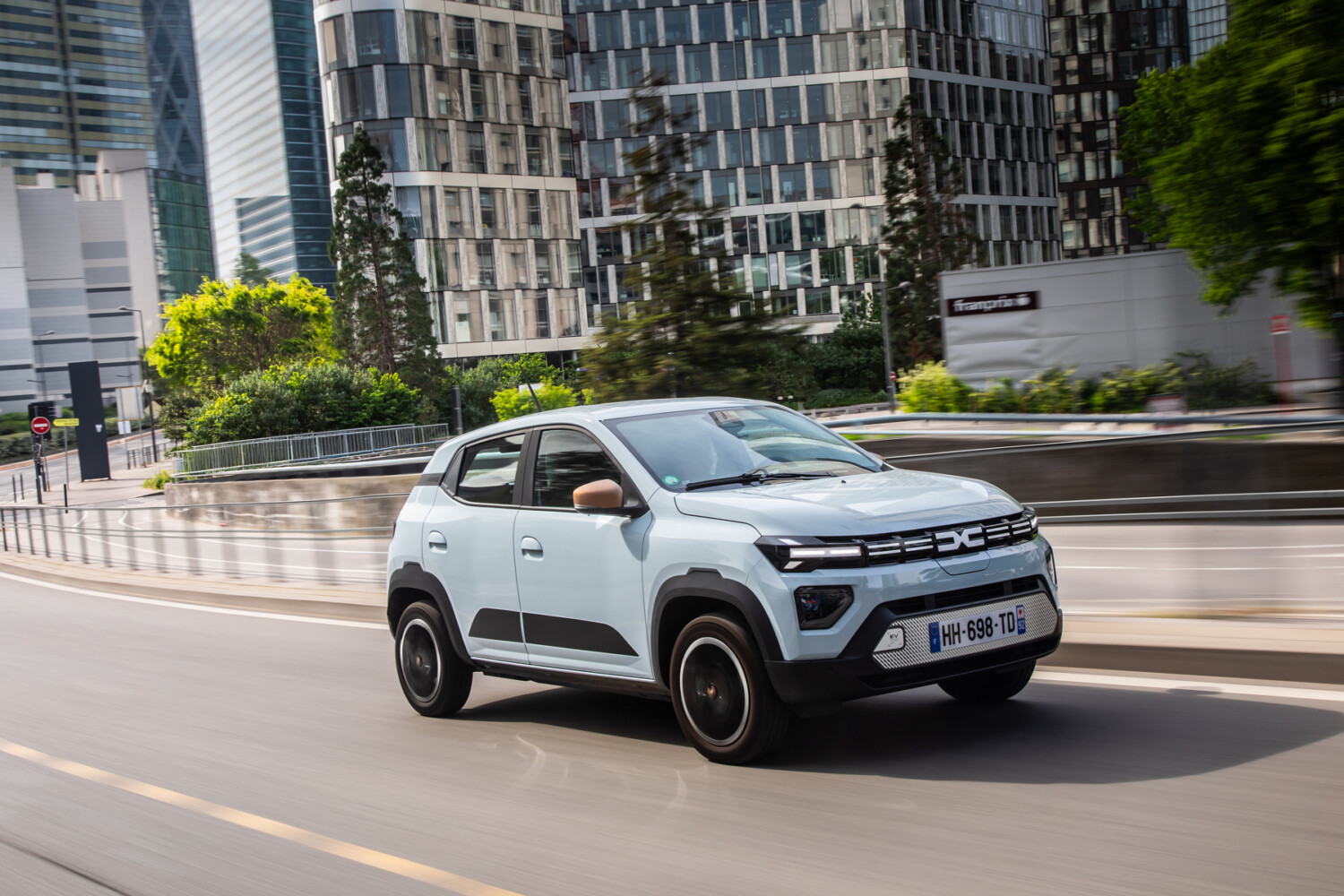
Just ten years ago, owning a brand-new city car remained within reach for many households. Models like the Twingo, Panda, the C1, 108, Aygo, or the Smart Fortwo filled showrooms. They were simple, compact, with modest equipment but sufficient for daily use, often priced under €10,000 or €12,000. In a decade, this entire family of mini‑city cars has nearly vanished, supplanted by heavier, pricier SUVs. For many drivers, especially young people, a new car has again become a distant luxury.
This reality is starting to worry capitals such as Brussels, at a time when the electric transition is stalling. Electric vehicles still account for only about 15.6% of new registrations in the European Union. The mid‑range and entry‑level segments remain the big forgotten sectors, caught between costly standards and expensive batteries. Hence the idea of a cheap electric car, conceived for Europe, simple, light, and produced locally. The European Commission even mentions an “E‑car” around €15,000, drawing inspiration from the Japanese kei cars. Behind this project lies the stated aim of restoring simple and affordable cars, as in the old days. The ambition is to adapt them to the city of tomorrow’s electric world without driving prices back up.
Why the simple, inexpensive small cars nearly disappeared in Europe
For a long time, the A‑segment was the playground of European manufacturers. We saw smart fortwo, Kia Picanto, Citroën C1, Peugeot 108 and Toyota Aygo. The Fiat 500 and Panda, Volkswagen Up!, Skoda Citigo, or SEAT Mii completed the mini‑city car lineup. These cars stayed modestly powered, with limited tech offerings but already more than in the 1990s. Then things got complicated with the stack of Euro 6 norms and the arrival of many advanced driver assistance systems. The push toward higher trim levels, driven by competition, added more costs. Manufacturing costs exploded, worsened by the microchip crisis, logistics disruptions tied to COVID, and inflation.
As a result, brands performed their accounting and many concluded that these small models no longer yielded enough profit. Consequently, numerous manufacturers abandoned the thermal A‑segment, already stripped of diesel since 2018. Between the late 2010s and the mid‑2020s, mini‑city cars priced under €15,000 collapsed. Demand shifted partly toward micro‑cars akin to quadricycles, such as the Microlino or XEV Yoyo, but these remain marginal. Meanwhile, compact SUVs captured most of the market, with far more comfortable margins for producers.
How Europe is preparing the return of affordable small electric cars
In this context, the forthcoming European category of small electric cars openly draws on the famous Japanese kei cars. Like them, these models would target a compact footprint around 3.80 meters and a weight close to one ton. Power would stay modest, with use focused on city life and the nearby hinterland. This simplicity would allow relaxing some technical constraints. The essential equipment for buyers would remain, starting with air conditioning and basic safety systems. Electric cars also benefit from better packaging. The wheelbase would lengthen, the cabin would become more spacious, and the trunk would gain volume. We already see A‑segment cars approaching 300 liters of trunk space and B‑segment models surpassing 400 liters. By combining this architectural advantage with batteries of reasonable capacity, Europe aims to keep costs in check. The goal is to offer a cheap electric car that no longer carries the same space drawbacks as yesterday’s mini‑city cars. To push brands to participate, Brussels is also preparing CO2 “super‑credits.” These would be reserved for small cars produced in Europe.
On the manufacturer side, the strategy centers on massive platform and plant sharing. The Novo Mesto plant is a clear figure of this logic. Here, a common base is used to assemble the Renault Twingo E‑Tech, the new Dacia Spring, and the future Nissan Pixo. A similar principle appears in the B‑segment, with the Renault 5 E‑Tech serving as a pivot model. It is meant to underpin the Alpine A290 and the next Nissan Micra, and possibly other derivatives. At Volkswagen, a project ID. Up derived from the concept ID. Every1 is intended to deliver a true entry‑level electric city car. This base could then be adapted into Skoda or CUPRA variants. By contrast, Chinese groups like BYD, Geely, or Leapmotor already offer compact electric cars such as the Dolphin, E2, or T03. These models rely on highly integrated powertrains that reduce the number of parts and cables. Manufacturing becomes simpler, with fewer modules to assemble and thus lower costs. To defend their positions, European brands are preparing plainer entry versions. They may drop large screens, built‑in GPS, or certain advanced driving aids, while keeping air conditioning, safety, and user‑friendly ergonomics. Today, a Dacia Spring starts around €16,900. A Renault Twingo E‑Tech or a Citroën ë‑C3 sits closer to €20,000. A BYD Dolphin Surf lists at €19,990 on our market. With public subsidies, these amounts can fall to about €14,000 or €15,000. Models produced in Europe are often the best served by these schemes. What comes next will also depend on national and local policies. If the strongest subsidies target small electric cars and compact footprints, the calculation will tilt in their favor. European streets could then fill again with simple, rational, and affordable cars, but this time silent and free of tailpipe exhaust.