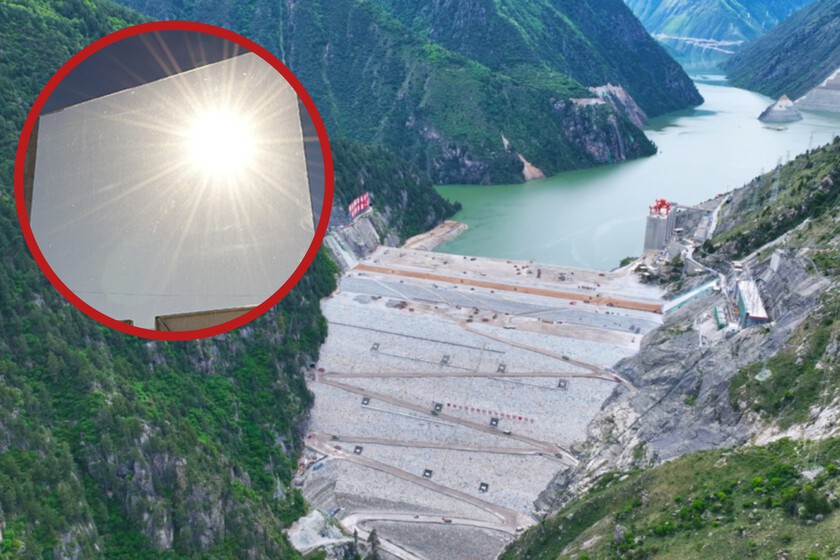
In a remote mountain region, at the eastern edge of the Tibetan Plateau and in Sichuan province, China is constructing the tallest dam on the face of the Earth. It rises more than 2,000 meters above sea level, in an area marked by extreme cold. Each winter, engineers race against time: they have barely a month to push the project forward. And the subfreezing temperatures freeze the material used to build this dam.
The solution is as ingenious as it is unlikely: almost 30 large intelligent mirrors on the mountain track the Sun, reflecting its rays onto the construction zone to heat the material. With this technique they manage to gain a few extra hours of work each day. This dam is a key component of the Shuangjiangkou hydroelectric plant: it is still under construction, but the plant has already begun generating electricity.
An immense wall of 315 m of rock, sand and clay
Currently, the tallest dam on the planet is also in China: Jinping-I, likewise in Sichuan province. Standing at 305 m, it surpasses the Eiffel Tower by 5 m and is almost twice as tall as the Three Gorges Dam, the longest conceived to date. But soon it will lose its Guinness World Record, which it has held since 2012: this Shuangjiangkou dam will overtake it when finished, rising to 315 m.
The project leaders boast that designing it is like building a “giant mountain” out of rock, sand, and clay. Beyond those 315 m in height, it stretches nearly 640 m in length, and the material required to build it exceeds 46 million m³. Such a size is not for show: it responds to a need, as it must hold about 2.9 billion m³ of water in the reservoir.
Construction of the Shuangjiangkou dam began in April 2020, and it now reaches 260 m in height. It has grown at an average pace of about 1 m every two days. It isn’t exactly fast, considering that China typically raises colossal infrastructures in record time. The reason is that its construction is extremely complex, due to the dam type and the location where it rises.
27 mirrors to warm the heart of the dam
The Dadu River, in Sichuan province, winds between immense mountains and deep valleys, with peaks over 7,500 m such as Mount Gongga. Winters are especially harsh, with many days of subzero temperatures. This directly affects the materials used to build this dam.
Shuangjiangkou is a rockfill or embankment dam with a low-permeability core. As Li Yonghong, the project’s chief engineer, explains, it resembles a giant “sandwich cookie” because it is designed in multiple layers. The exterior consists of large rock blocks, up to 2 m, while the interior uses progressively finer materials, like sand, clay, or small stones. This core, the “heart” of the dam, is responsible for retaining the water, Li Yonghong notes.

And here lies its Achilles’ heel. In winter, the surface temperature of the dam can drop to -20 ºC, causing the core to freeze and form hard blocks that cannot be compacted properly. Hence, during the coldest months, the effective working window is reduced to about 30 days. In a year, the filling days total around 200.
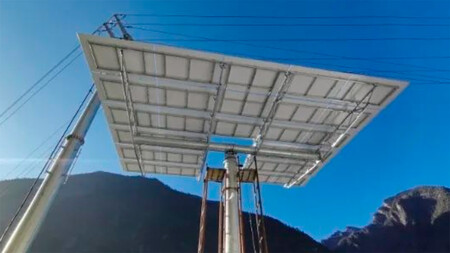
To speed up the process, engineers have devised a system formed by a network of 27 mirrors. These are heliostats, large orientable mirrors that, like giant sunflowers, can follow the Sun and reflect radiation to the dam’s core area where work is underway. They claim this raises the material temperature to up to 5 ºC, allowing an extra 3.5 hours of work per day.
“Do not underestimate these three hours; they are enough to fill 2,000 m³ of earth,” explains Wen Qingwen, a representative of the Shuangjiangkou project’s construction company.
And this nearly thirty-strong array of mirrors isn’t the only engineering solution that bends conventional wisdom at Shuangjiangkou. It also posed a major challenge to carve tunnels some 150 m underground of the plant, extending more than 80 km. This network of galleries generates high stresses in the rock, increasing the risk of rockfalls in an area also prone to seismic movements. To stabilize it during construction, engineers designed nanofiber meshes that function as a kind of “bulletproof vest” for the rock.
Clean energy for 3.3 million homes
While work continues on building the immense Shuangjiangkou dam, the plant has already begun operating. On June 26, 2026, the first of the four turbines, 500 MW, came online. And a little less than a month ago, the third turbine, after surpassing 72 hours of the latest test. There are thus three units already in operation with a combined capacity of 1,500 MW. The fourth and final one is still in the testing phase, and the plant is expected to be running at full capacity by the end of the year.
As of September 15, this hydroelectric plant had already generated 1.025 billion kWh. But once it reaches 2,000 MW with all four turbines active, it is said to produce about 7.7 billion kWh annually, added to the 6.6 billion kWh from the other hydroelectric plants in the cascade that make up the Dadu river network. It is believed that this enormous amount of energy will cover the annual needs of 3.26 million homes in the region, all from renewable sources.
Shuangjiangkou joins China’s vast renewable energies push. China already has 1,286 GW of installed solar capacity and, in July 2026, for the first time surpassed the installed capacity of coal-fired plants. In the first half of 2026, renewable sources already accounted for more than 61% of the country’s electric capacity. This enormous dam, therefore, will be another component of China’s expanding hydroelectric sector, which currently represents 14% of its electricity generation.
Images | People’s Daily, Csiro, CSP Plaza