An aircraft carrier, symbol of power and naval supremacy of the United States, which cost the equivalent of 2.5 billion dollars in today’s money, and hundreds of millions more to remodel, ended up sold for a mere 1 cent. Laugh at the depreciation of luxury cars.
This story, worthy of a Netflix script, was real and happened just five years ago. And although it may seem unbelievable, it was actually a good deal for the U.S. Navy. As if that weren’t enough, this aircraft carrier also starred in an episode in which China put the United States to shame.
An enormously expensive giant of 319 meters
The USS Kitty Hawk was a gigantic 319-meter-long aircraft carrier, capable of housing a crew of 4,500 and between 80 and 90 aircraft. It gave its name to its class: four giants conceived in the 1960s that could sail at speeds exceeding 55 km/h. Legend has it it served as a filming location for ‘Top Gun’, but that wasn’t the case. Although this behemoth did appear in several Hollywood productions in the 1960s and 1980s.
Back to reality, the Kitty Hawk took part in several deployments during the Vietnam War. It was also present in operations during the War in Afghanistan. And it was the centerpiece of the U.S. naval presence in the Western Pacific: it spent a decade, from 1998 to 2008, off the coast of Yokosuka, Japan.
Commissioned in 1961, the USS Kitty Hawk cost 264 million dollars at the time, equivalent to about 2.5 billion dollars today. Moreover, in the late 1980s, the United States invested 785 million dollars in its modernization. A bill that represents a huge gap compared to the price for which it was sold later.

The day a Chinese submarine passed right in front of its nose
While roaming Asian waters, specifically during exercises in the East China Sea, the Kitty Hawk likely experienced the most embarrassing day of its history: October 26, 2006. That fateful day exposed an extreme vulnerability: a Chinese Song-class submarine surfaced only 8 km away from this aircraft carrier, having slipped in right before its eyes undetected.
In a real battle scenario, it would have been at the mercy of torpedoes from the enemy submarine: a silent diesel-electric submarine had managed to slip in front of one of the United States’ greatest symbols of naval power. It also did not reflect well on its escorts: during maneuvers, several warships, an attack submarine and antisubmarine helicopters surrounded it. None detected the Chinese sub.
To be fair, the vulnerability of the veteran American aircraft carriers had already been demonstrated in other tests: during exercises with the Swedish submarine HSwMS Gotland, it had been shown that a small conventional submarine could pose a risk to the safety of these giants: the Gotland managed to approach undetected and achieved several simulated hits on the aircraft carrier.
Sold for a single cent
Officially, that episode had nothing to do with its retirement. But three years after the East China Sea incident, in 2009, the USS Kitty Hawk was retired. After all, it was nearly 50 years old and belonged to the last generation of conventional aircraft carriers of the Navy: the U.S. already had more advanced nuclear-powered carriers.
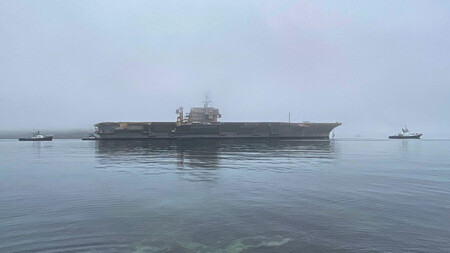
The Navy kept it stored in Bremerton, Washington and almost saw an honorable ending: several veterans who had served aboard this ship raised funds to turn it into a museum in Long Beach, California, next to the Queen Mary. Unfortunately the 5 million dollars they raised for the cause were not enough: it needed decontamination and readiness work, and the bill was much higher.
The Navy ultimately rejected the project, relegating it to a far harsher fate: scrapping. In 2021, it was sold to International Shipbreaking Limited for that price that sounds entirely unbelievable: a cent. The same amount was paid for its sister ship, the John F. Kennedy. A figure that highlights the enormous depreciation of these military giants when their service life ends.
Profitable business. But in fact, it was a fantastic deal for the U.S. Navy: towing and scrapping these titanic ships is tremendously expensive. In fact, the Navy paid the same company 3 million dollars for the scrapping of the USS Constellation, another of the four Kitty Hawk-class aircraft carriers. And since no nation was interested in taking on the services of both giants, getting a cent instead of paying millions for their recycling was certainly a good deal.
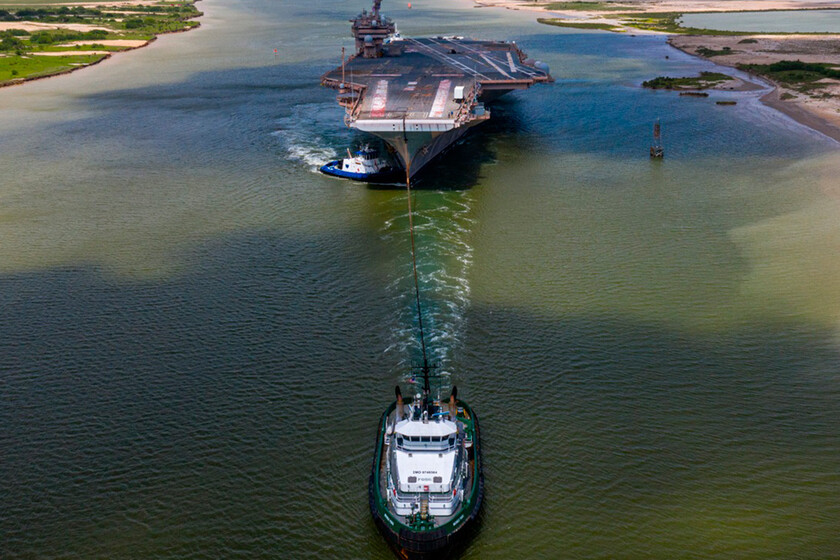
In January 2022, the Kitty Hawk, with engines no longer operational, was towed on a colossal loop from the Pacific to the Atlantic, as it was too large to pass through the Panama Canal: it traced the coasts of Latin America, rounded Cape Horn, and ascended the Atlantic to Brownsville (Texas). Its final 19,000 miles were covered in a slow five-month journey to disappear forever.
Images | Creative Commons, Wikimedia, US Navy