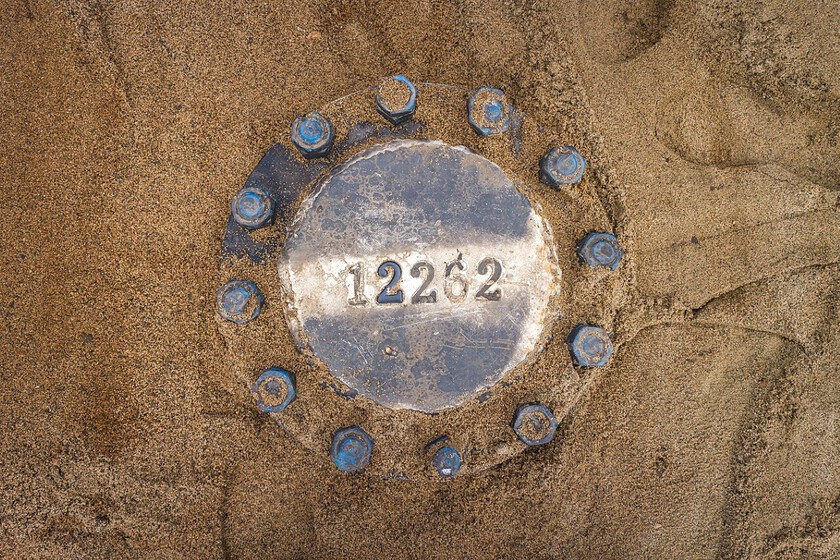
We know more about the surface of Mars than about what lies beneath our feet on Earth. And although it may seem an exaggeration, drilling a few kilometers into the Earth’s crust has been one of humanity’s greatest technical challenges. That’s why, when the Soviet Union announced in 1970 that it intended to dig a 15 km deep well, the project seemed closer to science fiction than to engineering.
The initiative, code-named SG-3, was developed on the Kola Peninsula, very near the border with Norway. What the USSR sought was not oil, nor gas, nor minerals… They only wanted to go as deep as possible, to what no one had reached before, in order to study directly the Earth’s interior for the first time in history; it was a race to reach where, literally, no one had reached before.
What They Found Surprised the Scientists
All of this happened in the context of the Cold War, fought in space, in the oceans and even underground. Because, while the US looked to the sky with Apollo, the Soviets did the opposite: look downward to study the Earth’s subsurface because their scientists were convinced that drilling would allow them to test geological theories that until then could only be studied through calculations and seismic waves.
Kola was no accident; the Soviets studied and knew that there lay some of the oldest rocks on the planet, which gave them the opportunity to study unique layers of the Earth’s crust, practically inaccessible. They wanted to reach 15,000 meters; no one had ever attempted something like this.

And naturally, as they descended into the borehole, the difficulties grew exponentially. During the 1970s a huge 74-meter-tall drilling rig was brought into operation, designed specifically for the project. The crew had to work with kilometers and kilometers of pipes subjected to extreme pressures, and only the drill string weighed more than 200 tons.
Just extracting and inserting the equipment took up to 18 hours, and still, nothing guaranteed success. By 1984 they reached 12,066 meters, and then a fault caused the loss of thousands of meters of pipe inside the borehole. Recovering it was impossible, so the engineers abandoned part of the drilling and started a new one several kilometers away.
Despite that, going so far had given the Soviets unique and unexpected information; they discovered that some widely accepted geological theories did not fit the reality observed at depth, such as certain layers believed to be basalt turning out to be very different, and fractures full of fluids appeared in rocks that were considered impermeable.
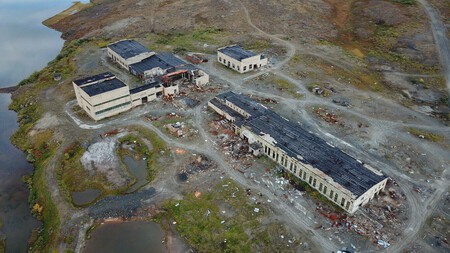
The most surprising were the microscopic fossils of plankton six kilometers deep, which forced a rethink of some ideas about the geological evolution of the area. They also discovered that temperatures rose much faster than expected, and at 10 kilometers depth they were already around 180 °C, while at 12 they were 200 °C. In those conditions, some rocks stopped behaving as rigid materials, and instead of fracturing, began to deform slowly under the immense pressure found at depth.
The Earth Was Trying to Close the Wound
Of course, that changed the game: every time the drillers opened a new segment, the walls of the borehole tended to shift inward slowly, but steadily. The drilling did not stop because there was an unbreakable rock, but because the hole itself was trying to disappear.
As they went deeper, the higher the temperature, the greater the pressure, and the harder it became to keep the conduit open. So the Soviet engineers realized that the real challenge was not so much drilling, but preventing the Earth from closing the path.
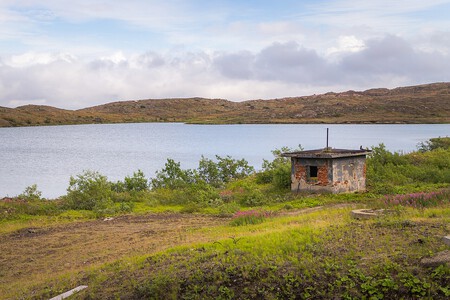
Lago cercano al pozo superprofundo de Kola
The end? It was 12,262 meters deep, far (but not that far) from the initially planned 15 kilometers. Today it remains the deepest vertical hole ever drilled by humankind. In 1992, the Soviet Union had already disappeared and attempts to continue descending came to an end. The thermal and mechanical conditions made continuing unviable.
Images | Alexander Nokinov, Wiki Commons