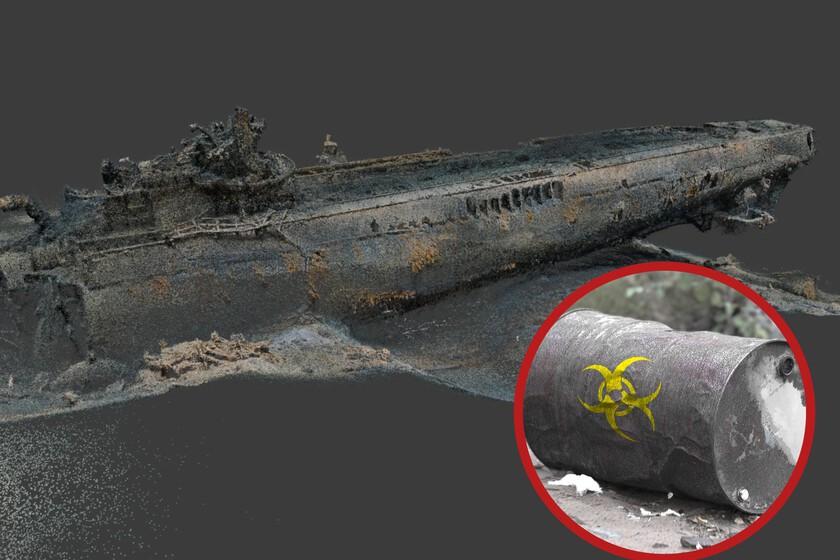
It was in the spring of 2003 when fishermen spotted something unusual: a sunken vessel at about 150 meters beneath the North Sea, in front of the island of Fedje. It was the U-864, a German World War II submarine that had been sunk in 1945 by another submarine, the British HMS Venturer, while both were submerged.
The trouble is that the U-864 was carrying military equipment bound for Japan in what was called Operation Caesar. Specifically, it was supposed to carry 67 tons of mercury, distributed across nearly 1,900 steel containers intended for the production of Japanese weaponry. Now Norway must decide what to do with this ticking time bomb.
When something nobody could imagine actually happened: it was sunk by another submarine that was also submerged
The U-864 was a Type IXD2 submarine, a new series designed by the Kriegsmarine to surpass the earlier IX. It measured 87.58 meters in length and displaced 1,610 tons on the surface and 1,799 when submerged. It was armed with six torpedo tubes, 24 torpedoes, the standard deck gun and two anti-air machine guns, and it entered service in 1943 under the command of Captain Ralf-Reimar Wolfram.
But the day the German submarine was en route to transport the mercury to Japan—passing by Norway—something extraordinary occurred: Venturer, a British V-class submarine, intercepted the German plans and attacked U-864 while the latter was still submerged. One of the torpedoes shattered the German submarine in two, sending it to the sea floor, and its 73 crew members died instantly.
What it was carrying is still there, slowly seeping out
The fact that its two sections ended up separated has complicated efforts to secure the area off Norway, and fishing has been prohibited because the mercury can persist in the environment for decades, even centuries, accumulating in the food chain.

An analysis revealed that the steel bottles in which the mercury was stored are corroded and lose about four kilograms each year, a finding that has led to a fishing ban in the area.
A submarin expedition to figure out how to proceed
In 2025, Norway’s coast guard authority Kystverket ordered a survey of the wreck using remotely operated underwater vehicles. Although no documents detailing the cargo have ever been found, it is estimated that the submarine carried, among other things, 67 tons of mercury, distributed across nearly 1,900 steel containers intended for the production of Japanese weapons.
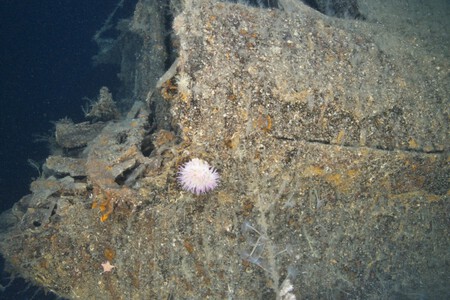
In fact, it is believed that many of these containers were destroyed when the submarine was torpedoed, and there has been documented mercury contamination on the seabed around the wreck. The most recent sightings of the wreck, as well as a photogrammetry-generated 3D model, enable a visualization of both the seafloor and the sunken vessel itself.
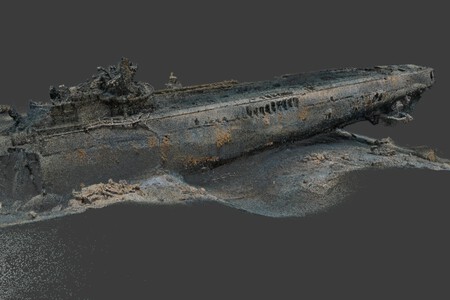
This expedition was requested by the Norwegian Parliament to determine what steps should be taken and to reach a decision that will not be easy to implement: the government has decided that the remains of the wreck will be covered. Now the task for the Norwegian Coastal Administration is to explore the possibility of removing the mercury before concealing them.
The next phase of the project will test methods and equipment capable of reaching the wreck’s keel and the mercury-containing containers, with the aim of assessing their condition.
Images | Wikipedia/NormanEinstein, Pexels, Kystverket