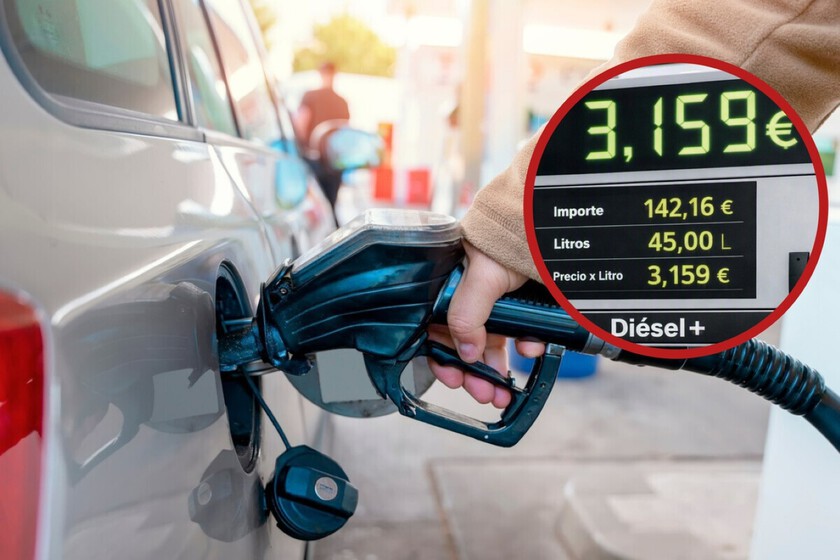
Refueling is becoming, day by day, an increasingly costly operation across much of Europe. One of the most striking cases is Germany, where the average weekly price yesterday stood at 2.27 euros per liter of gasoline and 2.43 euros for diesel, according to ADAC, while some stations have topped 3 euros.
To prevent the climb from continuing, Berlin has decided to intervene again: from October 1 to December 31, Germany will cut 14 cents per liter the tax on gasoline and diesel. By adding the VAT that is not applied to that amount, the tax relief will be about 17 cents per liter. But it will not be cheap for the state coffers: the measure will cost 2.5 billion euros, shared between the federal government and the Länder.
Filling a 50-liter tank will have 8.50 euros less in taxes
For a car with a 50-liter tank, those 17 cents amount to around 8.50 euros in savings, and for one with a 60-liter tank it would be about 10.20 euros. The German government already used a similar formula between May and June, but that relief ended and prices climbed again.
The ADAC calculates that the price per liter of diesel reached 2.446 euros on April 7, its highest since prices began to be tracked, while E10 gasoline averaged 2.191 euros that day. In August, moreover, the average monthly price of E10 was 2.145 euros and that of diesel 2.223 euros.
This German move comes as Europe shows huge differences in the final price of fuel. As shown by the European Commission’s latest bulletin, published on September 24, with prices across the 27 member states: as of September 21, gasoline 95 cost an average of 1.925 euros in Spain versus 2.219 euros in Germany, while diesel stood at 1.918 euros in Spain and 2.461 in Germany. At the lower end, Malta registered 1.340 euros for gasoline and 1.210 for diesel.

Spain, moreover, is already applying its own tax relief, though the timetable is very different from the German one. The government approved for 2026 a reduction of the Hydrocarbons Tax of 15 cents per liter in July, 10 in August and 5 in September for unleaded gasoline and diesel. For general-use diesel, a direct subsidy was added that raises total support to 20 cents per liter during these three months.
The household scheme ends on September 30, unless the automatic clause is triggered if prices spike again. After that, there is no general rebate equivalent to the German one approved for October.
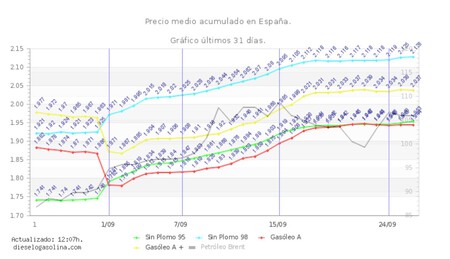
But cutting taxes does not necessarily mean the pump price will fall by the same amount: part of the tax relief may be passed on to the driver, but the final price also depends on the international pricing of oil products, distribution costs, and the margins of the supply chain. Therefore, a tax cut helps ease the price, but it does not allow the government to set exactly how much the driver will pay at the pump.
This is where the difference lies with what Germany is preparing for 2027: the October tax discount reduces the amount paid in taxes, while the price cap Berlin wants to negotiate with oil companies intends to directly affect the maximum price per liter. The German government wants to have it ready no later than January 1, 2027, taking as reference the models of Luxembourg and Belgium, but it has not yet specified what the limit would be.
For Spain, the situation is different. The government has already shown that it can temporarily reduce the Hydrocarbons Tax and the current scheme ends on September 30. Therefore, technically it could approve another tax cut, but there is currently no measure approved for October. Additionally, if the goal were to directly control the maximum price per liter, another mechanism would have to be used.
The European framework sets minimum levels of energy taxation, though it allows for certain exceptions and temporary reductions within the conditions envisaged by EU rules.
France has chosen another path: on September 22 it announced the expansion of its aid for the so-called “grands rouleurs” and a new rule to ensure that additional tax revenues derived from the rising costs of fuels are directed toward support measures. The French package is estimated to cost 450 million euros, and Germany will spend 2.500 million to gain three months of relief at the pump.
If nothing changes, for the moment Germany is betting on a general tax cut and is studying direct intervention in the price later, while Spain faces October without a newly approved general rebate and France concentrates its aid on certain drivers… But the price of fuels continues to offer no respite.
Images | Unsplash, Dieselogasolina, ADAC