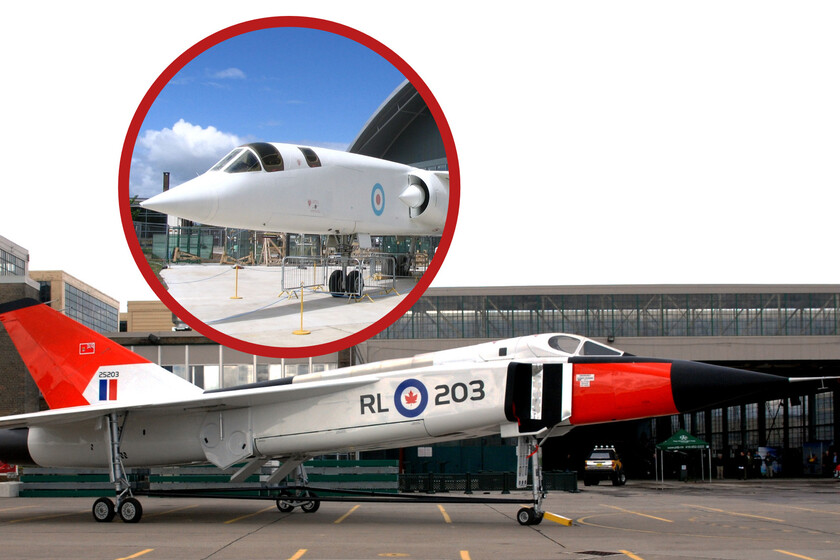
In the midst of the Cold War, the United Kingdom and Canada were poised to possess two of the world’s most advanced fighter aircraft, or so they promised, because they could never prove anything.
Both aircraft were canceled and those decisions sparked a major controversy in both countries. The controversy still resonates to this day.
Born at the wrong time… and in the wrong places
We could say that geopolitical tensions are stronger than ever, but the truth is that they aren’t. Although the current situation is very complex, there have been moments in recent history that were even more difficult, such as the Cold War era.
After World War II, the world split into two blocs: the Western and capitalist bloc led by the United States, and the Eastern and communist bloc led by the Soviet Union. For nearly 50 years, these two blocs faced off, and both feared a nuclear attack from the other side, so they prepared for that hypothetical nuclear conflict.
Thanks to this, some of the most impressive military vehicles in history were created, and aircraft played a special role because they were crucial for both launching a potential military strike and defending themselves.
But there was also a heavy “marketing and publicity” campaign. Propaganda was intense on both blocs with the aim of reassuring the population and, above all, making clear that they had superiority over the enemy. The problem is that this propaganda distorted reality a lot, even misleading experts, as happened with the British TSR-2 and the Canadian CF-105 Arrow interceptors, the most mythologized and mourned of the Cold War.
Both aircraft were developed in the context of the Cold War arms race to have more capable vehicles than the other bloc. The TSR-2 was a project of British Aircraft Corporation (BAC) to give the United Kingdom one of the most advanced tactical bombers and one of the world’s most advanced reconnaissance aircraft by the mid-1960s.
Truth be told, technically and on paper it promised a lot: the ability to launch nuclear armaments at any time of day and in any weather, photographic reconnaissance at medium and low altitude, blind bombing capability and, of course, the launch of conventional weapons and missiles.
But the TSR-2 was canceled in April 1965 by the new British Labour government of Harold Wilson, under the pretext of rising development costs. Socially, this cancellation was seen as a mortal blow to the UK’s aerospace industry, and from that moment the TSR-2 was idealized, unfairly.
Probably the TSR-2 would not have dominated the world, as the project promised, because it was already outdated before it was born. Almost all of the aircraft relied on purely analog technology, precisely when the electronic revolution of microchips and digital computers was taking place, so if it had entered service, it would have been completely behind from that moment. It was not up to its era.
In parallel, something similar happened with Avro Canada’s CF-105 Arrow. It was designed in the late 1950s under the promise of being the world’s leading frontline supersonic interceptor and it was said that it would be capable of halting a hypothetical Soviet missile apocalypse.
But one thing is theory and another is making it possible. In this case, the aircraft was not financially sustainable, plus it was too large and heavy; it also sparked an intense political debate in Canada, as happened with the TSR-2 in the United Kingdom, but, ultimately, on February 20, 1959 it was canceled, although in this case five units were built, with a sixth 93% complete. Its cancellation led to the disappearance of Avro Canada, and the manufactured units were destroyed.
Decades later, military analysts are far from few who continue to lament the cancellation of these two aircraft and who keep idealizing them, despite the fact that they never managed to prove anything, neither for good nor for bad.
Images | Wikipedia