Everyone knows the great successes of Adrian Newey before his move to Aston Martin in 2024. The British engineer first lifted Williams to the top, then helped McLaren win, and finally carried Red Bull to the summit. With Aston Martin he hasn’t managed to replicate that feat. But what many people don’t know is that Newey’s beginnings in Formula 1 were somewhat murky.
There was a fourth phase of Adrian Newey in Formula 1, and it was called Leyton House. A shady team led by a Japanese billionaire who fired Newey for focusing too much on aerodynamics and vetoing Porsche engines, and ultimately ended up in prison along with all its partners.
Leyton House, the team that fired Adrian Newey for not wanting Porsche engines
Before tasting the glory of Formula 1 with Williams, McLaren, and Red Bull, Adrian Newey had to wade through the mud of Formula 1. His first steps as technical director in the big circus were at the end of the ’80s with the March team, a historic backmarker that Newey managed to lift back onto the podium and even lead a race.
At that time the sponsor of March was Leyton House, a brand with not a particularly concrete purpose: one moment they sold clothing, the next trips or hair dyes. Behind the empire stood Akira Akagi, a Japanese billionaire who saw in those March podiums the perfect showcase to push his brand onto a worldwide stage.
So Akagi bought March and transformed it into Leyton House for the 1990 season. Technically it was the same team with a different name, and Adrian Newey remained in his role as technical director, playing with airflow, unaware of the era’s maxim that “aerodynamics is for those who can’t make engines”.

Newey at that time was already doing wonders with aerodynamics. The car’s cockpit was so narrow that the drivers complained they could not even change gears (back then the shift was still done with a lever), but Newey insisted on making it even smaller to improve the airflow underneath the car.
But after the relative success with March, Leyton House’s arrival to Newey was turning into a hurdle. The results were terrible, the car sometimes didn’t even qualify for races, and nothing Newey proposed worked. “I tried to simplify everything, even at the cost of downforce, but it didn’t help”, the genius recalled years later in his book.
Meanwhile, Leyton House was crumbling. Ian Phillips, the team boss, contracted meningitis, so it was the finance director—someone with no racing experience—who took over. On his side, Akagi, the owner, desperate for better results, was in talks with Porsche to use their engines.
The problem was that it was basically two old TAG turbo units welded together. “I quickly realized that engine had no chance of working, but Akagi wanted to keep it simply for the prestige of the Porsche brand“, Newey recounted in his book. The British engineer wanted to fit a less pompous but more useful Ilmor instead.
Meanwhile, Newey discovered why his ideas weren’t working: the Leyton House wind tunnel was poorly calibrated, to put it mildly. The truth was that they were using wooden dowels and tape to fix the model in the tunnel, so the data came out completely distorted.
With the faults corrected, Newey hurriedly prepared a package of upgrades to arrive in time for the French Grand Prix, and on the other hand he secured a deal for Leyton House to run Ilmor engines the following season. In parallel, Newey had received an offer from Williams that he was weighing.
But there wasn’t much to think about. When Newey went to Leyton House’s headquarters to meet Akagi and tell him about Williams’ offer, he was met with a surprise: “They had fired me!”. The obsession with aerodynamics at Leyton House was not only hindering improvement but had also caused them to lose a Porsche engine, according to the owner.
So Newey packed his bags, went to Williams, and the rest is Formula 1 history. But… what happened to that upgrades package Newey had prepared? Well yes, Leyton House had no trouble fitting it for the French Grand Prix, even though Newey was already out of the team. And the result was surprising.
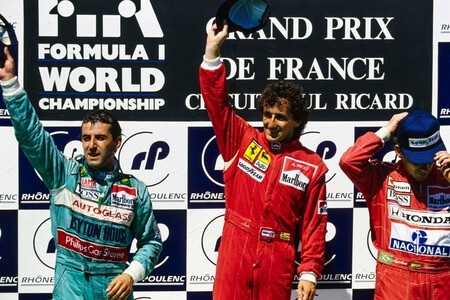
On lap 53, both Leyton House cars led the French Grand Prix without making a single pit stop, as the new car hardly degraded the tires. The engine left Mauricio Gugelmin stranded a few laps later, but Ivan Capelli crossed the finish line in second place, only behind Alain Prost’s Ferrari and without stopping in the pits.
Of course Leyton House could not benefit much from the legacy Newey had left them, because shortly after Akira Akagi and three other partners were arrested for Japan’s largest banking fraud in history, they received five years in prison and the Leyton House Formula 1 team was sold, almost given away, back to March.