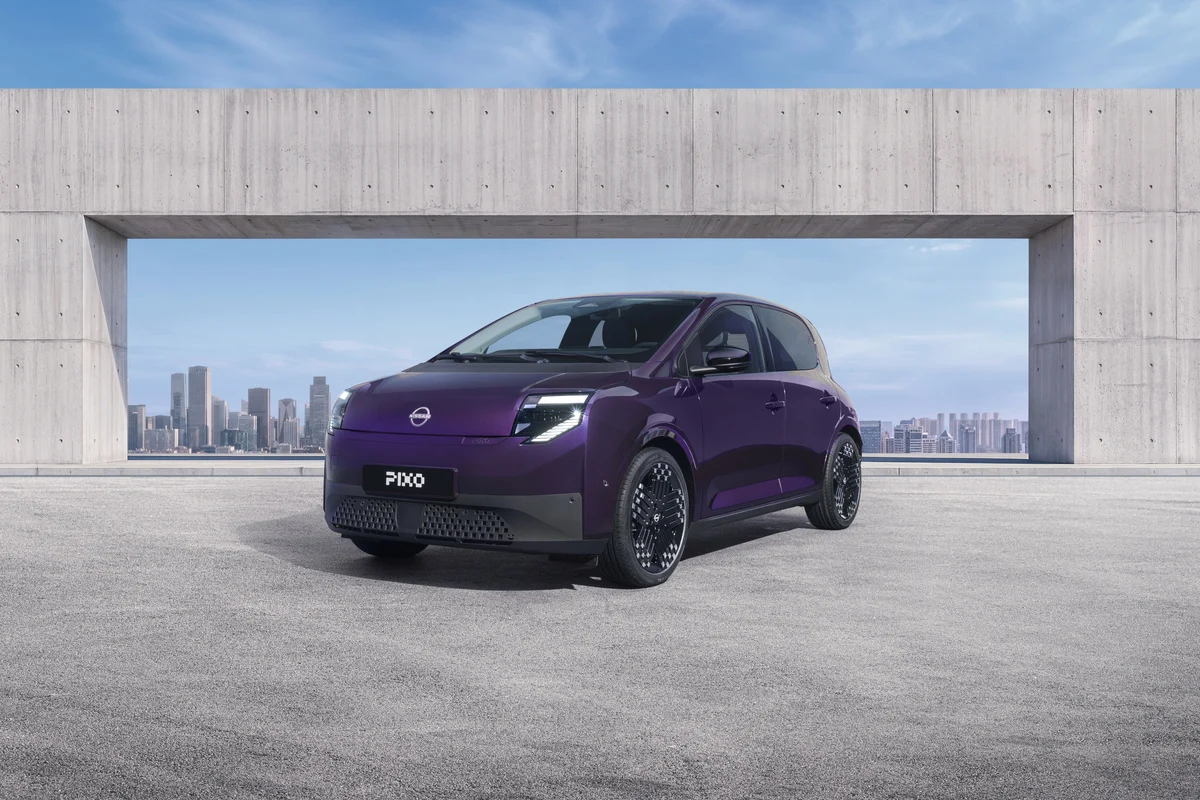
Nissan renews its electric vehicle lineup. After the Micra built on Renault 5 tech and the Leaf using Renault technology, the small city car Pixo returns, closely derived from the Renault Twingo. Yet the styling of the Japanese car is notably different from the French one, and a few technical choices differ between the Twingo and the Pixo. Here’s what you need to know about the Nissan Pixo.
The Return of Nissan’s Small City Car
The Japanese brand returns to the A-segment with the Pixo. The model may not be the most well-known in its class, but Nissan has previously sold this micro city car in Europe from 2009 to 2013. A brief career for this affordable petrol city car.
Thirteen years later, the micro-city segment nearly vanished under the pressure of manufacturing and development costs that automakers face. But electric propulsion gives this market a second life, with European and Chinese offerings. Nissan seizes the opportunity to reintroduce the Pixo, though its origins are distinctly French.
A Twingo Slightly Redesigned
Like Dacia’s reuse of the Twingo base for its Spring, Nissan reveals its adaptation of the Twingo a few weeks later. While Dacia took a very direct route, heavily reshaping the Twingo to create the Spring, Nissan’s approach is more restrained.
The front and rear bumpers are different, and the headlights have been updated as well, but the overall silhouette still reveals the Twingo lineage. The hood is less plunging, yet it remains closer in style to the Twingo than to the Dacia Spring. The length remains identical to that of the Twingo, at 3.79 meters (about 12.4 feet).
Nissan applies the same strategy as with the Micra: take Renault’s base, this time the Twingo, and modify mainly the headlights and bumpers. The Renault identity isn’t erased; it’s simply tucked away. On one hand, this isn’t a problem: it yields a new, affordable city car on the market, countering Chinese competition in favor of a Japanese automaker, while also indirectly supporting Renault, which builds this Pixo in Novo Mesto, Slovenia.
A Slightly Redesigned Interior
Where the Micra almost entirely borrowed the Renault 5’s cabin, the Pixo moves a bit further away from the Twingo’s interior. Nissan redesigned the top of the dashboard and offers it in color. However, it loses the body-colored door-panel inserts that the Twingo features inside the doors.
Nevertheless, the two screens are the Twingo’s, with a 7-inch instrument cluster and a 10-inch central display running a version of Android Automotive with Gemini AI. The climate controls are also the Renault-supplied ones.
Regarding practicality and interior space, the Pixo still benefits from the sliding rear bench. The boot capacity is listed at 356 liters, including 50 liters of storage in the lower portion of the trunk.
Up to 259 km of Range
On the technical spec sheet, everything largely mirrors the Twingo. The Nissan Pixo uses a 27.5 kWh battery with an 82-horsepower motor, yielding a WLTP range of 259 km (about 161 miles). It’s modest, but it remains comparable to the Twingo, as both are designed for urban and peri-urban use.
However, the Pixo appears slightly more versatile than the Twingo, as it comes with standard 50 kW fast charging, allowing a 15–80% top-up in around 28 minutes. Fast charging exists for the Twingo as well, but only as a €500 option.
So, is the Nissan Pixo better than the Renault Twingo? That will depend on price, because in terms of driving feel and interior space, they’re basically the same.
Nissan has not yet announced pricing for its electric city car, the Pixo. The order book is set to open in December, with first deliveries slated for early 2027.