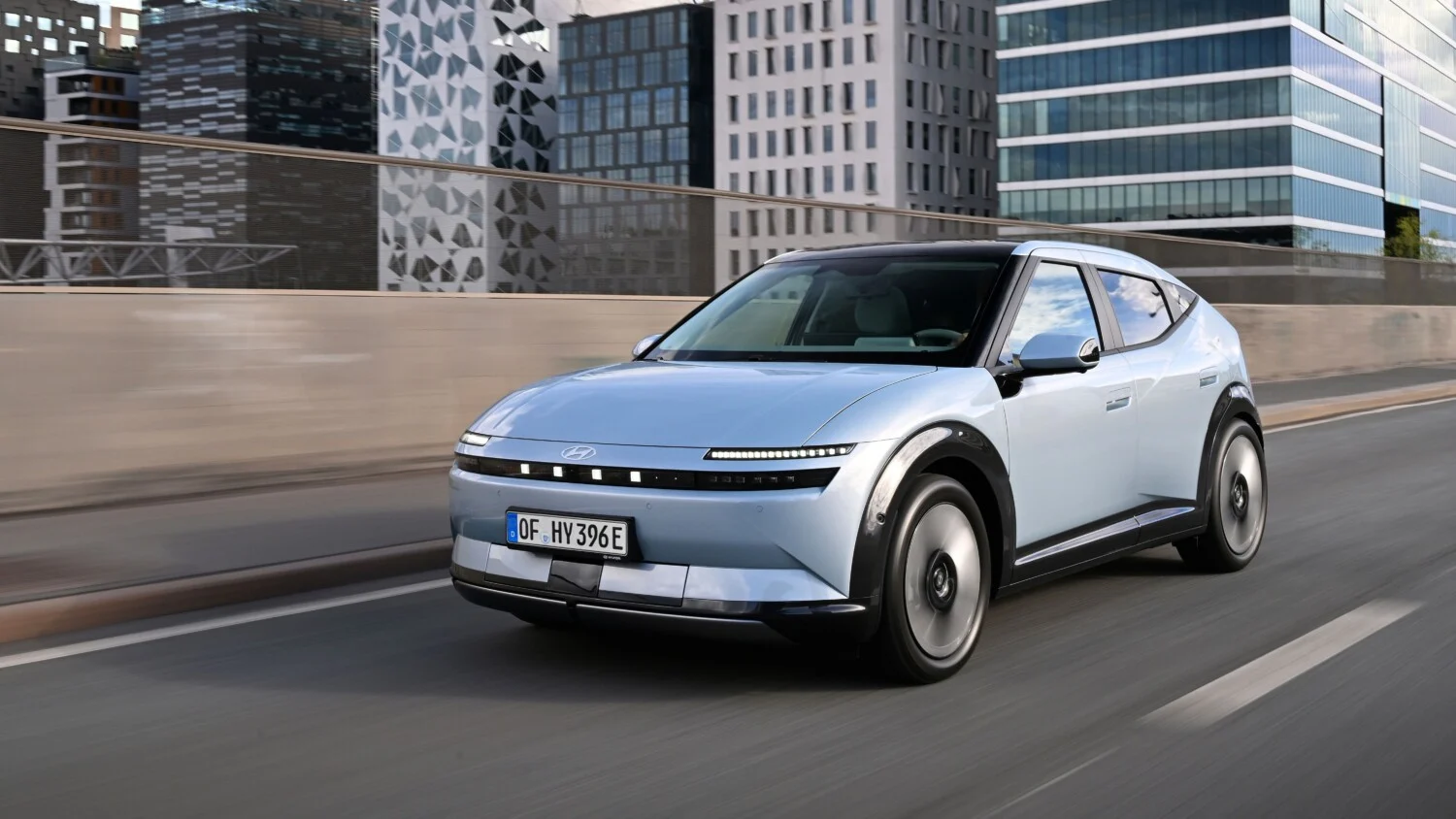
The Korean automaker Hyundai is stepping up its electric push with the unveiling of a compact electric car: the Ioniq 3. This model’s distinctive styling has just earned an eco-score, a win for bringing the vehicle to the French market where buyers will be able to take advantage of the eco bonus, reducing the purchase price by several thousand euros.
Up to 6,000 euros in incentives
The Hyundai Ioniq 3, Hyundai’s compact electric car, has just earned an eco-score. The publication in the Official Journal on September 17, 2026 confirms the car’s eligibility for the “CEE boost” (the new eco bonus). Thus, the Hyundai Ioniq 3 will receive between 3,600 and 6,000 euros in incentives depending on the household’s income.
It is one of the rare cars from a non-European automaker to benefit from the eco bonus. The production site in Turkey, at Hyundai’s Izmit plant, facilitates eco-score validation. The Hyundai Inster already manages to validate the eco-score despite its production in South Korea.
Less than 24,000 euros
With the CEE boost, the little Korean becomes available from 23,995 euros. The catalog price is 29,995 euros, minus 6,000 euros eco bonus. At that price, this is a base Select trim with the small 42.2 kWh battery giving 344 km of range. It’s equipped with a 144-horsepower motor, the most powerful in the lineup.
It includes features such as keyless entry, adaptive cruise control, and blind-spot monitoring, which add to automatic climate control and the mandatory equipment required by the GSR 2 standard.
For those who want more range, the 135-horsepower version houses a larger battery, with a 61 kWh capacity. It then offers 497 km of WLTP range. This version starts at 33,995 euros, or 27,995 euros with the CEE boost. The top-of-the-line N Line finishes at 43,595 euros, or 37,595 euros with the most generous incentive. The entire Ioniq 3 lineup is therefore eligible for the CEE aid. It also features a panoramic sunroof.
Regarding charging, the small battery tolerates 119 kW and the large battery 110 kW. The charging time is 29 and 30 minutes, respectively.
With the eco bonus, the Hyundai Ioniq 3 becomes a bridge between larger electric compact cars and city cars. All the more so as its price approaches that of a compact electric hatchback, boosting the appeal of the Hyundai Ioniq 3.