Ford aims to reboot its European presence and move past the previous direction that had led the brand to stop replacing the Mondeo, Fiesta, and Focus. The plan unveiled last spring outlines the contours of a new strategy for Ford in Europe through a network of collaborations and alliances with other automakers.
Ford struggles on a declining European market
In the first half of 2026, Ford sold 192,370 cars in Europe, down 15% compared with the same period in 2025. Those volumes had reached 513,300 during the first six months of 2019. Since that reference period, the European automotive market has certainly been unsettled, but the drop of 62.5% in cars sold and a loss of 3.5 percentage points in market share are spectacular. In France, the trend is similar: Ford moved 18,800 cars in the first seven months of the year (−19%), for a market share of 1.9%. The blue oval brand now trails Kia and Hyundai in our market. The situation is more favorable for light commercial vehicles, where Ford sits in fourth place in France, behind Renault, Peugeot, and Citroën. In France, Ford sells as many light commercial vehicles as passenger cars, a unique case among traditional mass-market brands. Across Europe, Ford has actually led the light commercial vehicle market for ten years.
A lineup of passenger cars today in the doldrums
This split between passenger cars and commercial vehicles hinges on a major explanation: the product lineup offered to customers. Ford has maintained a broad range that serves all professional use cases, while the consumer-oriented offerings have withered in recent years, notably for the brand’s best-selling and most emblematic models: the Fiesta was pulled from the lineup in June 2023 and the Focus disappeared two years later. Since then, Ford has been absent from nearly half of the French market, covering 33% of the Ka and Fiesta segments and 12% of the Focus. Obviously, volumes fell. In May last year, Ford Europe, now led by a new president, Jim Baumbick, announced a new direction. Building on partnerships with Volkswagen, Renault, and most recently with the Chinese Geely, the brand will rebuild a range of cars that meets the needs of European markets. From this blend of national influences, Ford’s lineup will be somewhat composite in the coming years, especially if you add a few vehicles from across the Atlantic, which are rare on our roads due to penalties and tariffs, as well as the influence of Ford of Britain in the development of light commercial vehicles.
Renewal expected… starting in 2028
This patchwork forms the core of a plan intended to give Ford a stronger foothold in Europe. Yet its initial effects won’t be visible until the start of 2028 for French buyers. Indeed, in a little less than eighteen months, Ford will re-enter the B-segment with a car conceived on the platform, suspension, and electric powertrain of the Renault 5 E-Tech. This Ford will feature a unique body shell, its own suspension and steering tuning to give it a “Ford personality,” the company says. The car will be produced by Renault in the Hauts-de-France region. The same blueprint will yield a B-segment electric crossover as well.
With Geely in China, a win-win agreement?
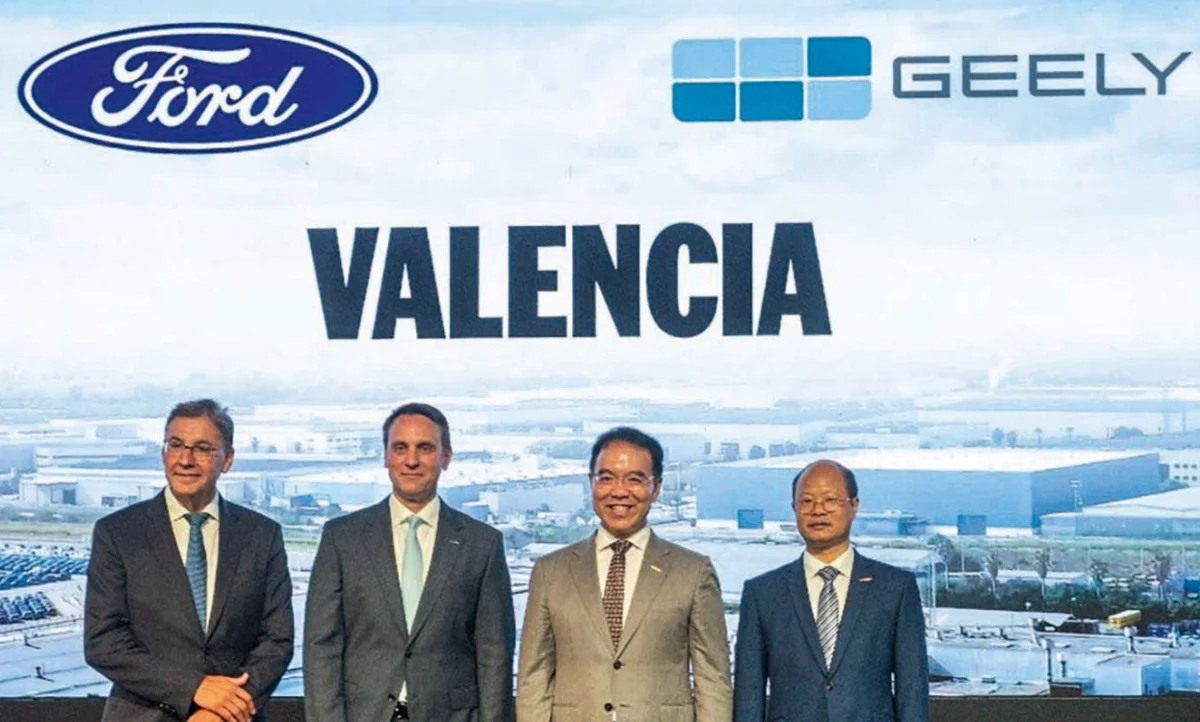
On paper, the answer is affirmative, and Ford can thank the European legislator for raising the tariff issue with Chinese automakers. These pressures accelerated their plans to localize production in Europe. Ford, for its part, sought to assemble cars at its Valencia, Spain plant since the end of Mondeo, Galaxy, and S-Max production; only the Kuga is assembled there now. About 100,000 units rolled off the lines in 2025, a site with an annual capacity of 450,000 vehicles. The partnership takes the form of a joint venture, 66% owned by Ford and 34% by Geely. Geely gains access to a competitive factory on a tight timetable, while Ford preserves its plant and can leverage Geely technology. Geely is not a stranger to Ford, having acquired Volvo from Ford in 2010. Jim Baumbick believes this Geely partnership will benefit all parties: “Together, we will be able to produce in a world-class plant with a skilled, experienced workforce at very competitive costs.” Moreover, recall that Geely and Renault are partners in developing gasoline and hybrid powertrains within their Horse joint venture, with Spain serving as a strong industrial base thanks to Renault’s engine plants. Could this pave the way for a deeper alliance among Ford, Renault, and Geely in Europe?
A denser, but somewhat disparate lineup
Beyond the two cars arising from the Renault collaboration, along with the all-electric Ford Explorer and Capri, Ford will round out its lineup with a compact multi-energy SUV linked to the Bronco family in 2028 and two multi-energy crossovers the following year. By that point, today’s Puma and Kuga will be nearing the end of their lifecycles. Aside from the badge, what will these vehicles share? Ford intends to give its cars a common identity that evokes sportiness. A front end featuring daytime running lights reminiscent of the additional rally headlights from the 80s and 90s will be standardized across the range. This rally-inspired styling aims to create a link between the new Ford generation and Europe’s varied and demanding roads. As Jim Baumbick puts it: “We will have a new vehicle lineup inspired by the world of rallying. Models designed and developed specifically for Europe’s ‘perfectly imperfect’ roads.”
Additionally, this rally nod comes as Ford returns to the pinnacle of motorsport, this time on circuits rather than rallies, with a Le Mans hypercar in 2027 and, since the start of 2026, as a partner of Red Bull Powertrains in Formula 1.
The Universal Electric Vehicle: a product‑process revolution
Beyond the European strategy, which remains to be coordinated into a clear identity, Ford has unveiled the first model from its Universal Electric Vehicle program, or UEV. The project centers on a three-part platform—front, center, and rear—with LFP batteries integrated into the central cradle. Once assembled, the platform can accommodate a wide range of bodies: pickup, SUV, or sedan. The electric motor(s) can be mounted at either the front or the rear. Ford has also redesigned vehicle production by building the three sections—front, center, and rear—on three parallel lines, with final assembly at the end of the line. For the entire project, Ford has invested nearly $5 billion in the United States. This modularity offers a significant economic edge, and Ford promises that the first UEV-based vehicle, the electric Fathom pickup, will carry a price below $30,000. Additional vehicles will follow on the same base, and some of them could eventually find a place in the European market.
What results can we expect?
Financially, even though Ford does not disclose its results, we can say the brand is losing money in Europe. In the first half of 2026, the Model e division—covering electric vehicles—posted a loss of $1.7 billion, a sizable portion of which occurred in Europe. Moreover, with 50% of the European market absent, Ford can only anticipate better days ahead. The year 2027 will be long, as it lacks meaningful new models.
The view from L’Auto-Journal
The rebound for Ford hinges on broader market coverage with the 2028 arrival of the electric B-segment car designed in partnership with Renault. Returning to this category will reposition the distribution network. But Ford will have to meet three challenges: give a unique identity to a lineup formed from multiple partnerships, reclaim volumes in a market under growing pressure from new Chinese brands, and ultimately map out a mid-term plan for 2035–2040 in Europe.
Find our investigation into Ford’s European commercial strategy in L’Auto-Journal issue 1216, dated 09/03/2026.