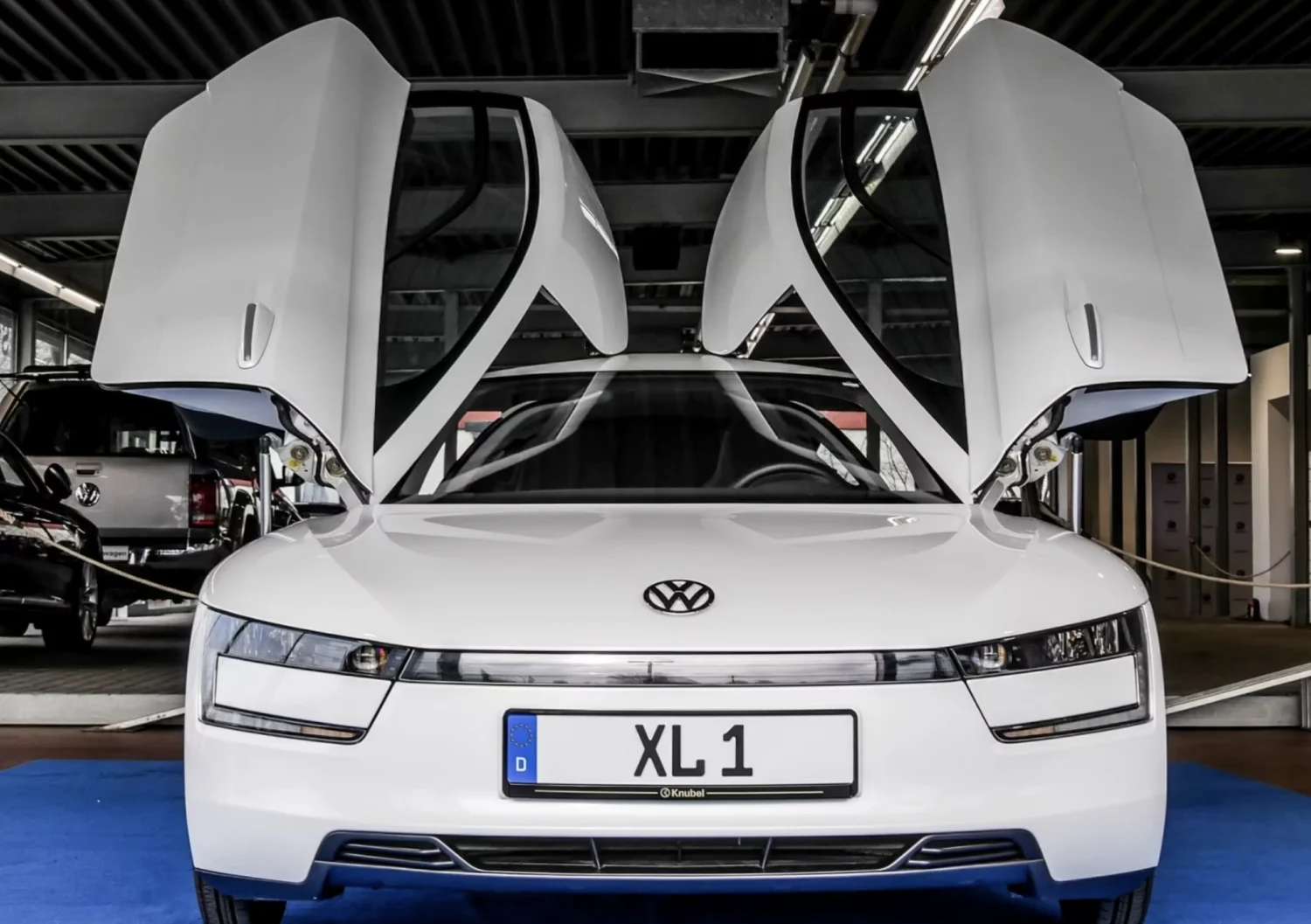
A used Volkswagen listed at €139,000, paired with a diesel engine that makes just 48 horsepower? The ad might sound far-fetched. Yet the model in question isn’t your everyday VW. It’s an XL1, a genuine technology testbed produced in a very limited run and designed around a radical objective: to sip less than a liter of diesel per 100 kilometers. The example currently on the market in Germany also comes with a major standout feature: just 71 kilometers on the odometer.
A nearly new Volkswagen XL1 for sale
This Volkswagen XL1 is being marketed today by a dealer based in Beckum, Germany. First registered in August 2018, it would appear to have had only one owner.
But it’s the mileage that most clearly catches the eye. Over eight years, this Volkswagen would have covered merely 71 km. The seller naturally presents it as a collectible item. He also notes that the car is maintenance-recorded, accident-free and will come with a fresh technical inspection.
The specimen is coated in an Oryx White Pearl Metallic paint. It features LED headlights, navigation, air conditioning, and Alcantara seats. The usual exterior mirrors have been swapped for cameras, another spectacular feature of the XL1.
The XL1 was never developed to chase horsepower records. Volkswagen aimed to push the boundaries of efficiency far beyond conventional limits. To achieve that, the brand used a carbon-fiber composite monocoque and numerous body components made from carbon-fiber-reinforced plastic. The rear wheels were faired to improve aerodynamics.
A genuine rolling laboratory
Result: the Volkswagen XL1 weighs just 795 kg (about 1,755 lb) and has a drag coefficient of only 0.189. Those remarkably low figures directly contributed to the quest for minimal consumption.
The mechanics are just as unusual. Mounted at the rear, the internal combustion engine is a small 0.829-liter turbo-diesel two-cylinder delivering 48 horsepower. It works in tandem with an electric motor of 27 horsepower.
The plug-in hybrid system can deliver up to 69 horsepower, transmitted via a seven-speed DSG transmission. With that modest amount of power, the XL1 accelerates from 0 to 60 mph (0-100 km/h) in 12.7 seconds and is electronically limited to a top speed of 160 km/h (about 100 mph).
The point, of course, lay elsewhere. Volkswagen touted at the time a consumption of only 0.9 L/100 km according to the NEDC cycle. The car could also travel up to 31 miles (about 50 km) purely on electricity.
Incidentally, the German automaker has revisited the concept recently. But this time, with an electric model under the Mission Efficiency name.
A €139,000 price tag for this Volkswagen XL1
Artisanally crafted in Osnabrück starting in 2014, the XL1 was already extraordinarily expensive when new. Its carbon fiber monocoque, magnesium components, ceramic brakes, and limited production pushed the price to €111,000. Production ended in 2016.
The currently offered example now asks €139,000, i.e., about €28,000 more than its original new price. Its exceptionally low mileage obviously helps justify its collectible status.
One caveat to note before signing: with so little use, the health of the lithium-ion battery should be checked carefully. The listing provides no recent information on its battery health.
This Volkswagen XL1 thus brings together several ingredients likely to appeal to collectors. An extraordinary design, ultra-limited production, unusual technology, and just 71 km on the odometer. Now it’s a matter of finding an enthusiast willing to shell out €139,000 for one of the most singular Volkswagens ever brought to market.