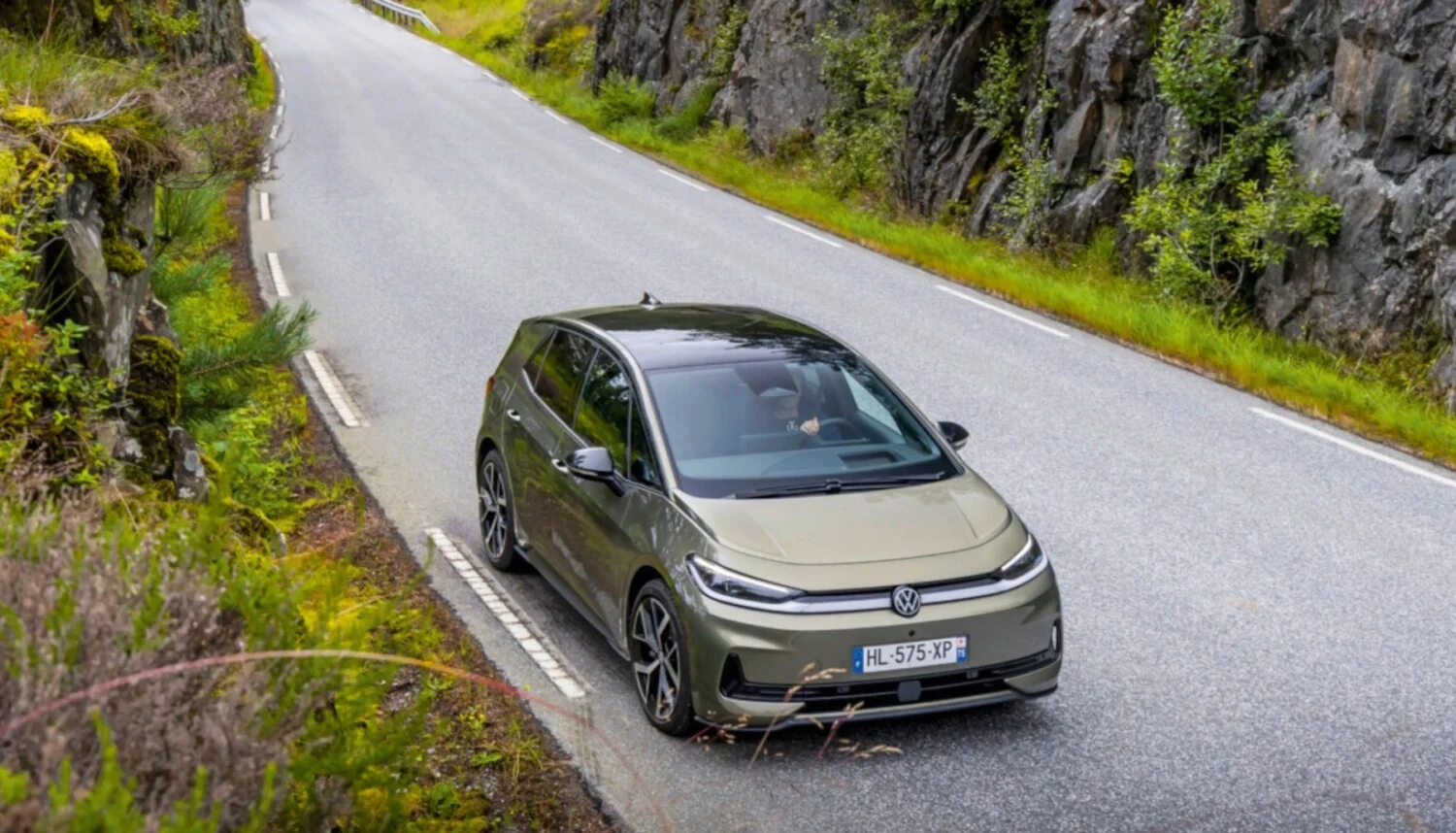
It could almost have been called “ID. Golf”! After all, the ID. Polo kicked off the idea and the ID. Tiguan is in the works… Just keep following it and you’ll see that with its tailgate now fully painted in body color—much more chic!—or with its three-quarter rear, it has a little Golf vibe. Yes, but the Golf is the Golf!
The electric model that would steal its name hasn’t been born yet. It will have to prove itself, to innovate, to rely on a brand-new platform, on 800-volt technology and more. It will come. Inevitably. But this isn’t (yet) the right moment. Too soon. Especially since when it comes to pacing, the car that launched the “ID” label in 2020 and was, in a sense, Volkswagen’s first “real” electric has already given plenty.
Going into the arena during the Covid era took guts: the faith of pioneers, even if it wasn’t planned. The beginnings weren’t easy for it. Yet, it is well born. Perhaps a touch too early, and above all betting on changes that were a little too radical. Some, such as the extremely minimalist instrumentation and fully touchscreen setup or a perceived dip in perceived quality, didn’t pass muster. To the point that a first update—almost a second launch—arrived in 2023. Too timid this time… But as the saying goes: only those who do nothing won’t make mistakes!
Volkswagen ID.3 NEO 231 hp / 79 kWh* Style: The Changes Are Here
As its little sister ID. Polo lands, the ID.3 needed to reassert itself to stay in the loop against increasingly dense and battle-tested competition. That certainly deserved a new name to underline that, behind a style that evolves rather quietly, the changes are real.
The new powertrain combinations could, however, pass under the radar on a quick glance at the spec sheet. Yet, solid work has been done! The entry-level version still makes 170 hp. But it’s indeed a new motor dubbed “APP 350” (standing for Axial Parallel Position and the torque rating) that replaces the old APP 310. Its advantage? Besides a higher torque, its efficiency. It is paired with a 50 kWh battery (instead of the 52 kWh previously). The 204 hp variant that could be paired with 58 and 79 kWh packs makes way for two variants of 190 and 231 hp, powered by packs of 58 and 79 kWh respectively.
But the real change lies in the fact that the 50 kWh and 58 kWh packs are now LFP (lithium-iron-phosphate) and no longer NMC (nickel-manganese-cobalt), a chemistry kept only for the 79 kWh. I won’t detail the pros and cons of the two technologies here, but in short: LFPs are cheaper, have longer life, but don’t like cold weather and are heavier because they have lower energy density. End of story!
Volkswagen ID.3 NEO 231 hp / 79 kWh* Style: The Consumption Doesn’t Vary Much with Power
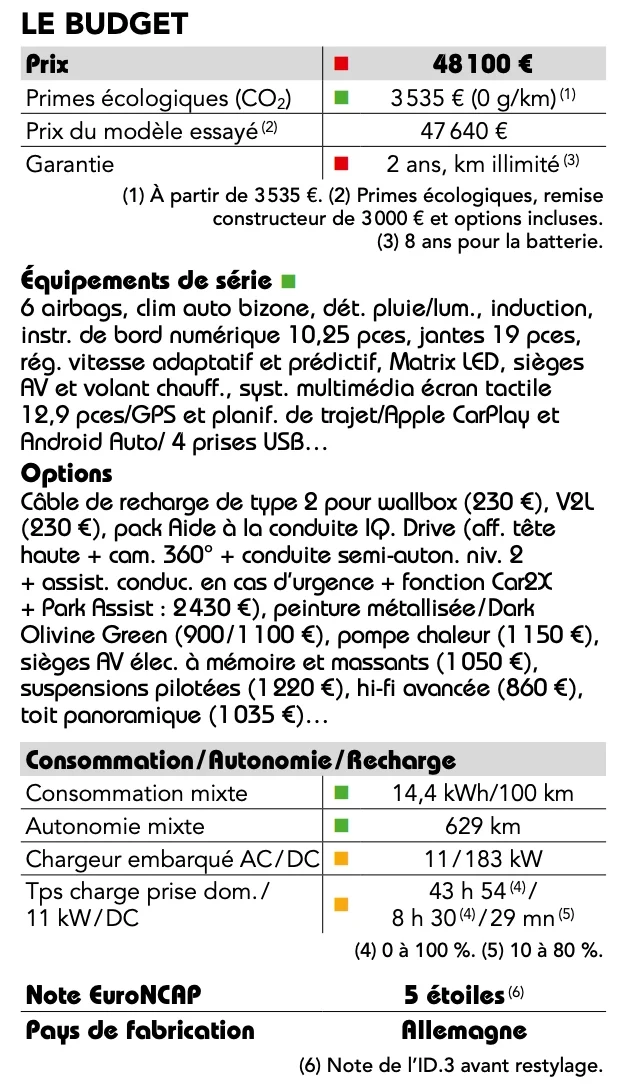
By focusing on motor efficiency, which VW says doesn’t vary much with power, the ID.3 Neo would gain around 30 miles of range. On this first test run on the roads of the world’s most electrified nation, Norway (96% of new cars sold are electric), with the most powerful ID.3 Neo at the wheel, we consumed 15.1 kWh/100 km: not bad! That’s a touch higher than Volkswagen’s promise (14.4 kWh/100 km), but it does leave room to flirt with roughly 600 km of range before draining the 79 kWh battery. It still charges quite rapidly at a fast charger: 183 kW.
They aren’t yet legion in doing better in the category. On the other hand, a minor caveat for the two other versions: their DC charging speed drops to 105 kW (down from 143 kW previously). Promise, sworn: Volkswagen assures that the charging curve is smoother and that charging time is ultimately the same. Eh…
Count on us to verify that on our tests come fall. All this is fine and dandy, but honestly, it doesn’t shout from the driver’s seat. Not too bad—the ID.3 already offered a very good compromise between comfort and handling. The Neo continues that tradition. Sure, it doesn’t aggressively exploit its propulsion architecture, to the disappointment of some, but that isn’t what it’s asked to do. Its steering feels a touch artificial and it even leans a bit in corners.
But it truly does steer short—very handy in the city—and its front end isn’t lazy. It’s a true Volkswagen: solid, reassuring, balanced, quiet, and comfortable despite somewhat firm responses at very low speeds. With 19-inch wheels, you don’t escape that!
Volkswagen ID.3 NEO 231 hp / 79 kWh* Style: What Really Changes Inside
The real game-changer is what happens inside the cabin! Because yes, a layout and ergonomics that serve driving have nothing to do with the old setup. And Volkswagen heard the criticisms. So long to the tiny screen behind the steering wheel. Instead, a digital instrument cluster sits ahead on a broad 10.25-inch display, with a wide array of display styles to choose from.
Farewell to the small touch-sensitive buttons and the all-touch approach to mimic Tesla. The ID.3 Neo adopts physical controls. The “brutish” volume button that sits on the center console is the best example. And after all, it’s either a concession or an improvement if it introduces a touch of traditional tactile feedback into the cabin.
Fingers regain familiar sensations when pressing the controls, and everything simply flows. Of course it takes a bit of time (more and more with each update) to grasp the functions available from the central screen—so many!—but the menus are organized in a fairly intuitive way.
You can now check the real wear state of your battery (the infamous SOC; previously you had to go to a dealership) or adjust the strength (two levels) of the new One-Pedal mode, accessible via the gear selector (B). The good news isn’t as abundant for the rear-seat crowd, but they weren’t complaining about the comfort or the reasonably generous interior of the ID.3, which posts a body-in-space ratio (4.27 m) and interior space worthy of a… Golf! Indeed…
Volkswagen ID.3 NEO 231 hp / 79 kWh* Style: Its Pluses
- Ergonomic progress
- Roominess and comfort
- Smooth, intuitive controls
Volkswagen ID.3 NEO 231 hp / 79 kWh* Style: Its Minuses
- Fairly firm ride in town
- Charging times on base trims
- Prices climb quickly
Auto-Journal Verdict: 4/5
The ID.3 Neo makes its interior revolution to offer a driving position that’s more intuitive, easier to grasp, and more enjoyable. It also refines its “mechanics” to stay in the race for range and adjusts its pricing to counter Chinese competition.
Volkswagen ID.3 NEO 231 hp / 79 kWh* Style: In Numbers
Read our first test of the Volkswagen ID.3 NEO 231 hp / 79 kWh Style in Auto-Journal issue 1215, August 20, 2026.