The space race in the Cold War was the other major pillar of the long-running marathon that pitted the Soviet Union and the United States against each other. On the Soviet side, the most ambitious and costly project in its entire history was the Burán program. Its cornerstone was a 100% autonomous space shuttle, requiring no pilots and lacking its own main engines.
To put it into orbit, it demanded a colossal infrastructure, including building the world’s largest cargo aircraft or the planet’s most powerful rocket at the time. After billions of dollars spent, the whole endeavor ended in nothing: its legacy consists of two abandoned relics in a hangar in the Kazakh steppes.
Two Giant Relics Trapped in Time
Baikonur is today the oldest and largest active cosmodrome. It remains administered by Russia, which pays a hefty annual rent to Kazakhstan to maintain control of this strategic enclave until 2050. Inside it lies a hangar that embodies the ruins of the Burán project: a Soviet relic and time capsule with two gigantic spacecraft inside.
It is Hangar MZK, in area 112A of Baikonur. Within it lies OK-1.02, or Ptichka, which was the second space shuttle built for the program, nearly finished. It never flew, as did its sibling: the OK-1.01. And beside it sits OK-MT: a test vehicle for trials and operations. These two behemoths have been locked away there for decades.

The Burán launchers, conceived in the 1980s, were created to rival the American Space Shuttle. Externally they bore a striking resemblance, but the Soviet versions stood out for incorporating more advanced solutions. They could fly and land entirely autonomously, without crew aboard. They also didn’t require large main engines like the Shuttle since, to reach orbit, they relied on the Energía rocket, which was the most powerful ever built at that time. And Energia could be used independently to launch other heavy payloads into space, such as a space station.
A colossal infrastructure for a doomed project
The Burán system was designed to be cheaper than its American counterpart, but it was far from cheap. Largely, this was due to the logistical infrastructure that this Soviet space program required to operate.
For example, the USSR created the Antonov An-225 Mriya, which remains the largest cargo aircraft ever built. Its mission was to transport the Burán space shuttle, as well as components of the Energia rocket, from manufacturing sites to Baikonur. Doing so by land would have been as slow as it was complicated, given the weight and dimensions of such loads. This orbiter measured over 36 m in length and weighed 62 tons.
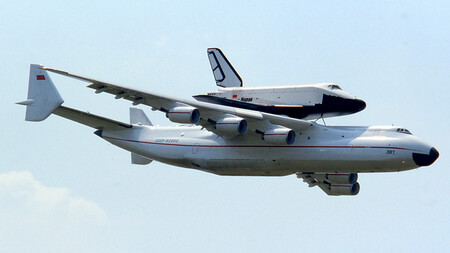
The figures for the An-225 Mriya are equally staggering: 84 m long, an 88 m wingspan, and a payload capacity of 250 tons. Its notable feature was also remarkable: it could carry the shuttle on its fuselage, secured by a dedicated anchoring system. Imagine such a giant with another giant perched atop it. Unfortunately, it wasn’t ready in time, and for the first transport two strategic bombers had to be repurposed, becoming the Myasishchev VM-T Atlant.
And once at Baikonur, they had to be moved to the launch platform. To do this, the Soviets built a colossal railway system, with enormous carrier platforms capable of moving both the shuttle and the gigantic Energia rocket. The assembly traversed the rails slowly from the assembly building to the pad. It was an exceptionally complex logistical operation that was used only once: the lone Burán that went into orbit was OK-1.01, in 1988. It completed two orbits, and landed and lifted off entirely autonomously, with no crew aboard. And it did so successfully.
€64 Billion and Two Abandoned Vessels
The Burán program was officially canceled in 1993, as the collapse of the USSR left it unfunded. Moreover, with the end of the Cold War, the space race had lost much of its purpose, and maintaining such infrastructure became impossible amid an economic crisis. And this space project was a true money-burning machine.
By January 1991, the USSR had spent 16.400 billion rubles developing the system, according to Rostec, the state technology conglomerate. But it still required even more to complete: estimates were 27.000 billion for R&D, plus 4.700 billion for new infrastructures. A revised financial projection places the total expenditure at around 17.800 billion rubles, equivalent to about 74.000 billion dollars at current rates, or 64.000 billion euros at the exchange rate.
That is why Ptichka was left unbuilt, remaining around 95% complete. And why both this shuttle and the OK-MT ended up abandoned since then inside Hangar MZK. Thirty-three years have passed while dust has accumulated on the fuselages of these gigantic spacecraft, which still stand there in the facilities.
Today, both relics are among the favorite destinations for urban explorers: the exploration of abandoned places. Hangar MZK lies in a restricted area of the Baikonur cosmodrome, and UrbexStorm markets expeditions of around 1,300 euros that include a 30–40 km foot trek across the steppe to the facilities. There are also less extreme options: Urbex Travel offers organized visits that, with the appropriate permissions, permit access to the hangar.
Images | Urbexstorm, Panikovskij