Watching a street turn into a river, cars left perfectly dry the night before now soaking up to the windows… For a car owner, a flood, even a brief one, is enough to condemn electronics, upholstery and often the car itself, especially on newer models and heavy electric vehicles. In Japan, sudden floods are multiplying, and during the latest episodes around Nagoya water rose to hip height, enough to derail trains and turn parking lots into open-air wreck yards.
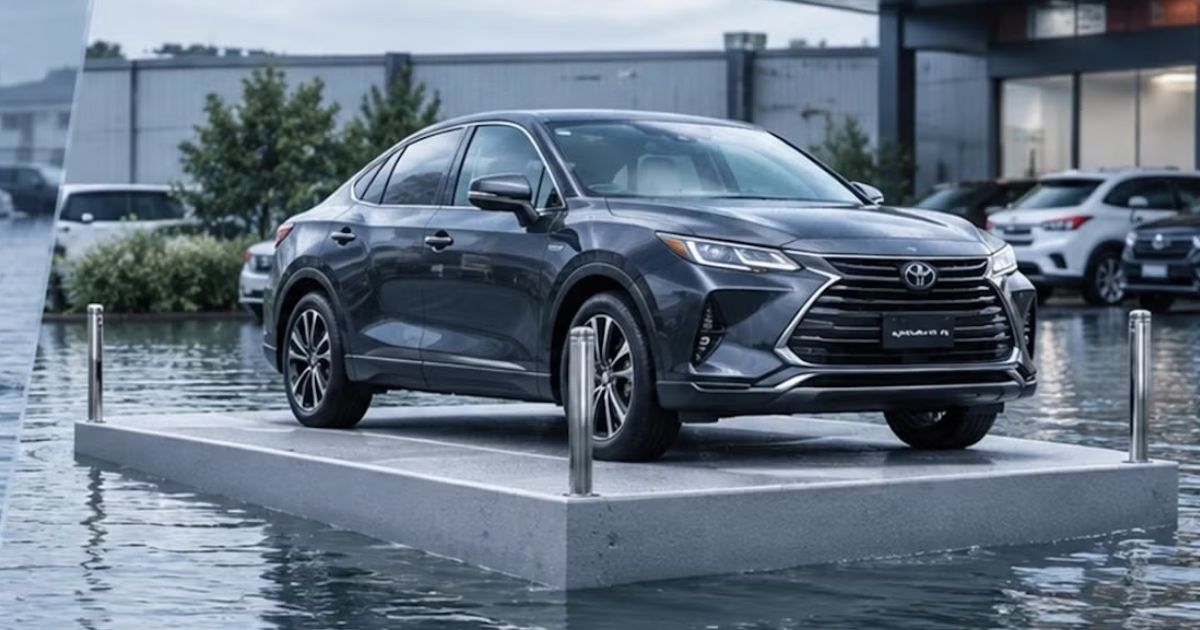
In this context, an idea born in the Land of the Rising Sun has been getting a lot of talk: a flood-proof floating parking that simply tracks the rising water, car included. Named Monarte Floating Floor, this system promises to protect your car from floods without electricity, without a hydraulic jack, without a motor, and without sophisticated sensors. A routine parking space in daily life… that can transform into a raft the day everything overflows, thanks to a few foam blocks and four steel posts.
When floods sweep thousands of cars away in Japan
The recent episodes hit hard: in August, in Chiba Prefecture, about 2,500 cars were damaged on the roads by torrential downpours in a matter of hours. Early September, in the Nagoya region, water flooded streets up to hip height, forcing trains to stop and submerging public parking lots, private garages, and dealership lots. For motorists who weren’t tucked away in higher places, moving their vehicles in time was impossible.
A modern car that gets water all the way to the floor often ends up economically unreparable. Even some electric vehicles designed to float briefly can be swept away or slammed into obstacles by the currents. It’s precisely to answer these sudden flash floods that Monarte conceived its floating parking space. At the Tokyo motor show, the device was described as “one of those simple and elegant devices that makes you say: ‘Why aren’t we doing this sooner?'”, according to Car and Driver. The principle: rather than trying to float the car itself, you float the ground beneath its wheels.
Monarte Floating Floor: a floating parking that works without electricity
Concretely, the Monarte Floating Floor appears as a large high-density foam slab, clad in a waterproof polyurethane coating. A module typically measures about 2,580 mm wide, 6,100 mm long and 280 mm thick, roughly the size of a large parking space. This slab sits on the ground in everyday use, like any ordinary spot. Four sturdy steel posts, planted at the corners, guide the platform so that it rises vertically when water arrives.
As soon as the water level starts to rise, the buoyancy lifts the slab, and it begins to float with the car resting on top. No motor, no pump, no hydraulic cylinder: the only energy used is buoyancy. The claimed capacity is about 6,600 pounds, or nearly 3,000 kg, enough to carry a large SUV or a heavy electric vehicle. The maximum height depends on the length of the posts—each installation is sized according to the potential water depth, current speed and debris that could strike the structure, as Monarte notes.
In everyday use, this space remains a conventional parking spot for a dealership, a corporate fleet, a collector’s garage or a home in a flood-prone area. If a flood hits unexpectedly, even at night with a power outage, the platform automatically rises, keeping the car above the waterline as long as the posts permit. The system is currently marketed exclusively in Japan, with pricing assessed on a case-by-case basis, depending on site and the number of spaces.
Behind this invention is Monarte, a subsidiary of Tajima Motor Corporation, known for its founder Nobuhiro “Monster” Tajima and his Pikes Peak hill climb history. While the parent company spans competition and small electric vehicles, Monarte focuses on flood and disaster-prevention solutions. It could someday pave the way for floating parking that protects high-value vehicles in coastal zones or flood-prone valleys, starting in Japan today… and perhaps elsewhere tomorrow, if floods continue to disrupt drivers’ routines.