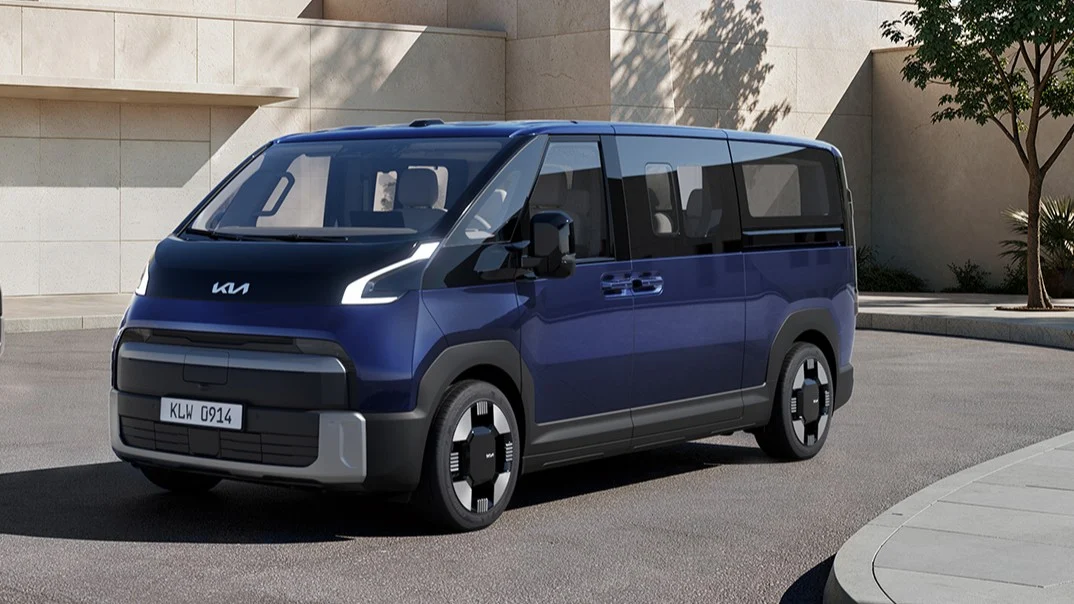
Little by little, Kia continues to broaden its PBV lineup, launched in 2025 and dedicated to electric vehicles designed for transporting people or goods.
A van for professionals… and for everyday buyers
Following the PV5, here comes the PV7, a large van that steps up to its younger sibling at the top end of the segment. Same philosophy, the same bold lines, but with dimensions greatly revised upward between the two: in long-wheelbase form, the PV7 measures 5.35 meters in length with a 3.50-meter wheelbase. That should appeal to two very different audiences. To compare it with models more familiar in Europe, the PV7 is to the PV5 what a Master is to a Trafic, a Ducato to a Scudo—a big van, not a compact van. The lineup is split into two distinct models. On one side, the Cargo version targets tradespeople and pros who need space: up to 8 cubic meters of usable volume and a payload capacity climbing to 1,200 kg depending on the configuration. Three bodystyles are planned, from the compact to the largest with a raised roof capable of carrying up to three Euro pallets. Kia has thought of day-to-day details, like an electric sliding door that automatically closes when the driver walks away with the key, or a drive mode that adjusts the vehicle’s behavior when loaded to the max. On the other side, the Passenger version turns the PV7 into a genuine minibus, capable of seating up to nine occupants here in the United States.
460 kilometers of range and express charging
To make the modularity workable day-to-day, Kia designed a system of long rails allowing seats to slide, rotate, or even be removed as needed. The cabin also received special attention compared with the Cargo version: rear climate control, USB-C outlets, storage, etc. The finish is also meant to be more refined than on the Cargo version, with two-tone accents and ambient lighting. Under the floor, the PV7 sits on Kia’s E-GMP.S platform, the brand’s electric commercial-vehicle architecture. Two battery capacities are announced, 71.5 and 96.2 kWh, for power up to 272 horsepower. Front-wheel drive will be offered first, with a four-wheel-drive version coming later. Kia remains tight-lipped about the WLTP-certified range, but already cites approximately 460 kilometers for the long-range Cargo version, an ambitious figure. Another technical novelty is that the electric architecture moves to 800 volts, up from 400 volts on the PV5. In practical terms, that means much faster charging: just over 25 minutes to go from 10% to 80% on a 350 kW charger. That’s the new Kia PV7, which will reach Europe only in the second half of 2027. Final prices and configurations are yet to be announced.