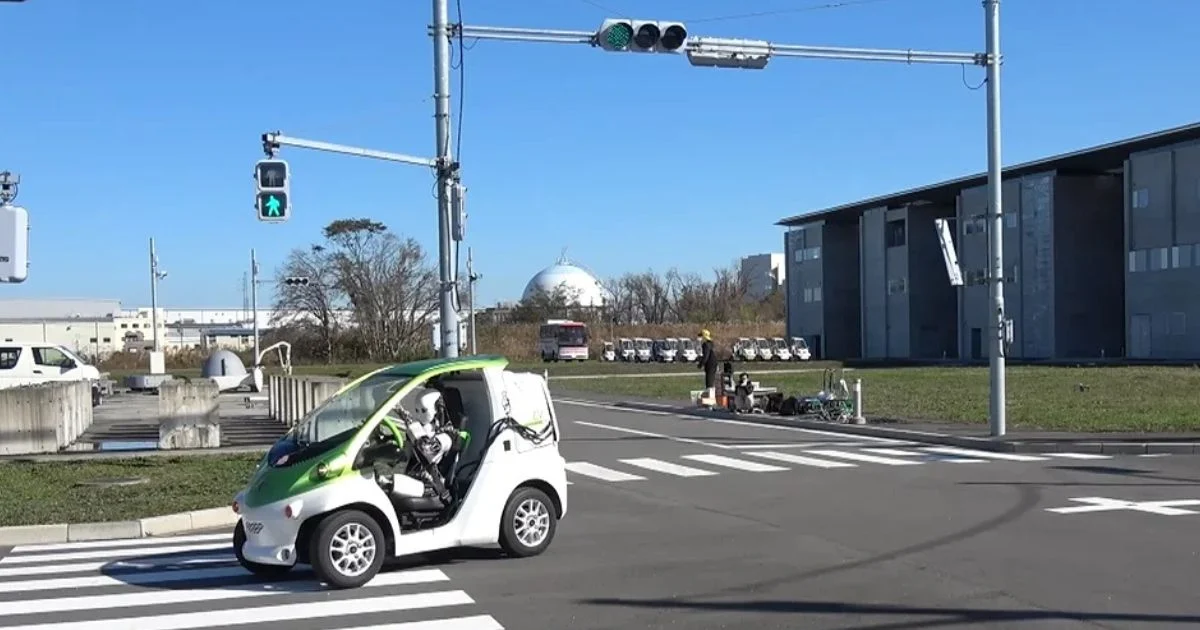
A robot sitting behind a steering wheel, braking, turning, signaling, and obeying red lights. It still sounds like the premise of a science-fiction movie, yet a very real humanoid learned to drive a car in 2024, based on work carried out in Japan. And this first test may not be just a lab gadget, but a sign of a future where seeing a robot behind the wheel becomes almost commonplace.
Meanwhile, autonomous cars are already cruising without a human in the driver’s seat in several major cities, from Austin to London. Robots, for their part, are creeping into every corner of industry: on car assembly lines, in some police units in China, or at the heart of logistics warehouses. The question is no longer whether a humanoid driving robot is a wild idea, but when this vision will become ordinary. And with Musashi, the University of Tokyo’s robot, the future is already warming up in the passenger seat.
Musashi, the humanoid robot that really learned to drive
At the University of Tokyo, a team of researchers built a humanoid designed from the outset as a substitute driver. Named Musashi, this robot adopts a human-like form, with a musculoskeletal structure, numerous joints, and a torso capable of leaning to reach the controls. The goal is simple: to sit in a conventional seat, reach toward a standard steering wheel, and place the feet on the pedals of a car designed for you and me.
The Japanese engineers equipped it with hands capable of gripping a steering wheel, feet precise enough to modulate the accelerator and brake, and even the coordination needed to operate the turn signals. A detail that brings a smile, since some human drivers still have not mastered this reflex. In its first public trials released in 2024, Musashi did not exceed 3 mph, about 5 km/h, on a small electric car in a controlled environment. It remained far from highway use, but the point was elsewhere: to prove that the humanoid could truly sequence the gestures of a human driver.
A limited prototype, but already closely watched by industry
These early test spins were only a stepping stone. A scientific paper published more recently by Kento Kawaharazuka, Kei Okada and Masayuki Inaba confirms the technology is still advancing. The authors explain that the robot “successfully recognized traffic signals, actuated the pedals using a dynamic body schema with the vehicle’s speed as input and output, and steered the wheel to cross intersections,” the team notes in Advanced Intelligent Systems. In other words, Musashi no longer just cruises straight ahead: it is starting to autonomously handle a simple intersection.
The limits are clear. Speed is very low, tests take place on a campus, and no real traffic disturbs the robot. The researchers also point to difficulties maintaining a stable speed on hills or turning the wheel quickly enough for tighter maneuvers. But the principle is established: rather than loading every car with a full array of sensors and processors, you put a humanoid behind the wheel who already knows how to use a standard steering wheel and pedals. If this type of robot were mass-produced, it could become a robotic driver capable of handling different cars without modification.
From Musashi to Google DeepMind and Daimler Truck: toward a standardized driving robot?
This idea isn’t only interesting to Japanese researchers. In the heavy-truck sector, Daimler Truck filed in 2023 a patent describing an onboard interface specifically designed for a humanoid behind the wheel of a truck. The document envisions a system capable of supplying power to the robot, its position, sensor data, or network connectivity. It even foresees an external signal to inform other road users that the vehicle is currently being driven by a robot. A way to turn a conventional truck into a “robot-driver ready” machine.
On the AI front, Google DeepMind unveiled Gemini Robotics 2, a model able to control the entire body of a humanoid, from feet to fingertips. Where early robots often performed simple, repetitive actions, this generation can coordinate walking, posture, arms, and hands to complete complex tasks. A safety-focused version, Gemini Robotics ER 2, emphasizes the ability to refuse dangerous orders or to stop when a human approaches too closely. For a robot at the wheel, this kind of AI delivers precisely the level of control needed over pedals, the steering wheel, and emergency responses.
A driving humanoid robot on our roads: what’s on the horizon?
The big question remains: when will these robots move from the lab to our streets? Even researchers acknowledge that it would be naïve to promise a precise year without a crystal ball. No timeline specifics are given in current work, and several experts point to a horizon of several decades before we see a humanoid driving autonomously in dense traffic. Between a campus circuit at 5 mph and merging onto a beltway during rush hour, the gap remains vast.
Still, signals are piling up. Musashi continues to be improved, Daimler Truck’s patent shows truck makers are already thinking about cabins compatible with a robot, and fully autonomous robotaxi fleets are already cruising in some capitals. A host of indicators suggests the driving humanoid robot could first appear in highly controlled environments, before gradually making its way onto public roads. And there, when the day comes that we see a humanoid behind the wheel at a crossroad, it may no longer be just for show, but a new driving habit.