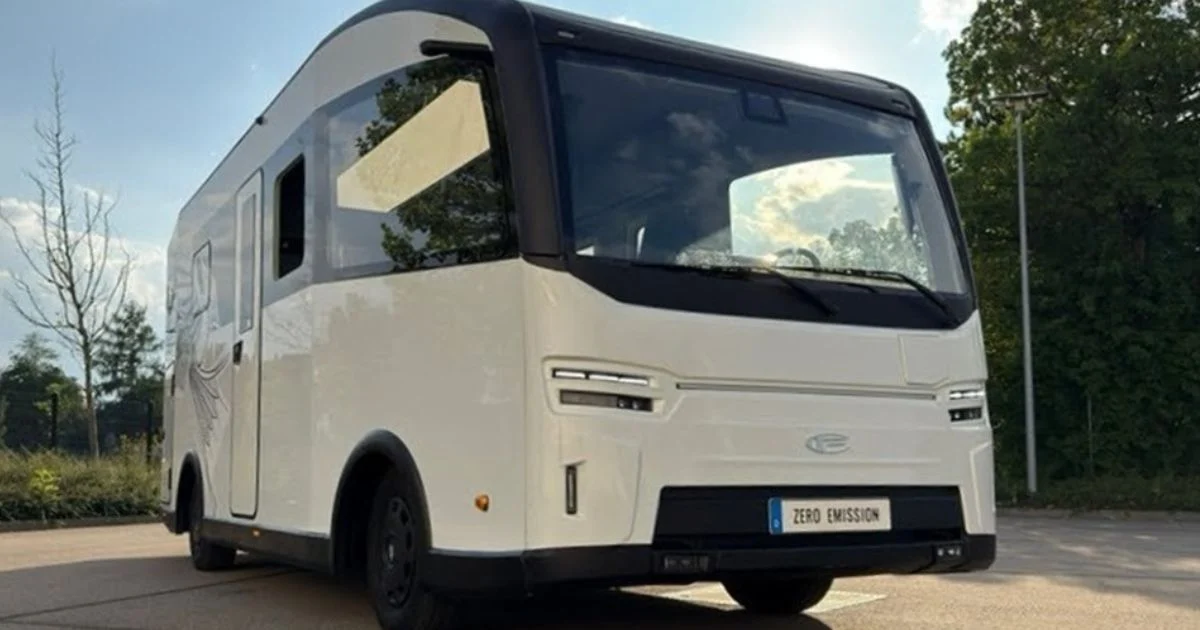
A 100% electric motorhome capable of offering a true little rolling apartment, cruising nearly 400 km between charges, and weighing less than a large American pickup: on paper, this is exactly what RV enthusiasts drawn to electric power have long demanded. Until now, manufacturers couldn’t achieve it without stuffing in gigantic batteries — heavy, pricey batteries.
In the early 2020s, the few serious attempts were limited to converted vans based on the Ford E-Transit, or to prototypes like the Winnebago eRV and eRV2, restricted to about 100 miles of range, or roughly 160 km, with price tags so steep that Winnebago abandoned production. Coachmen and Grounded RV did try to develop sizeable electric motorhomes promising more than 270 miles, but General Motors shut down the BrightDrop platform that would have powered them. And while Pebble or Lightship leaned on self-propelled trailers, a Californian entrant, CityFreighter, chose a different route: a true dedicated platform named EVOLVE, and an electric motorhome demonstrator CityFreighter Evolve unveiled at Caravan Salon 2026 in Düsseldorf… with a big caveat tied to it.
CityFreighter Evolve: an electric platform thought out first for weight and range
Behind CityFreighter lies Michael Schoening, a native of Heinsberg, Germany, now based in Santa Barbara, California. After buying his first Tesla in 2016, he was convinced that the future of transport would be electric. What followed were nearly a decade of prototypes, setbacks, and perseverance, starting with a first demonstrator in 2018, then the CF1 electric delivery van in 2021. In a footprint similar to a Mercedes eSprinter, the CF1 offered more than 20 cubic meters of volume, about 50% more, and even greater space efficiency than Rivian’s delivery van developed for Amazon.
During factory tours of truck plants in China, Michael Schoening concluded that building a commercial vehicle isn’t science fiction: in his view, making a utility vehicle isn’t “ Martian technology,” but a matter of engineering, supply chain, production, and experience. To prove it, his team built a demonstrator to its gross vehicle weight rating of 4.25 tonnes, then let it roll on highways, back roads, and up into the mountains. The announced result: more than 400 km traveled with this prototype. The decisive nudge came from Harmen Kruit, CEO of Euramax, who said, “You need to show them something they can touch and feel,” Harmen Kruit, CEO of Euramax, told The Autopian. This demonstrator evolved into the electric motorhome Evolve, built on a 100% flat, ultra-low skateboard platform, modular and described as “AI-driven.”
A real 22-foot motorhome, roughly 400 km of range… but only a demonstrator
The EVOLVE chassis accepts different battery sizes and configurations. The demonstrator motorhome carries a 128 kWh pack, which, according to CityFreighter, would deliver roughly 248 miles, or about 400 km, of range in real-world conditions. The DC fast charging would climb up to 200 kW, with a 10–80% transfer in about 20 minutes. The battery is designed to be easily repairable, serviceable, or replaceable, and can also power the living cell directly. The package is driven by a 214-horsepower electric motor. CityFreighter notes that 128 kWh does not represent the maximum capacity this chassis could handle; more batteries could be added to push beyond 280 miles (over 450 km) while staying within a weight envelope around 4.25 tonnes GVWR.
That’s where pounds-for-pounds becomes crucial. The completed Evolve motorhome measures 22.8 feet long, about 6.95 meters, 7.7 feet wide, roughly 2.35 meters, and 8.9 feet tall, around 2.7 meters. The living section provides about 17 feet of interior length, a little over 5 meters, with a flat, very low floor across the entire footprint made possible by the all-electric platform. Vöhringer supplied the furnishings in Airply, an ultralight sandwich plywood with foam core, advertised as 45% lighter than traditional RV plywood. The hull, designed by Motive Development and built by Euramax, uses composite materials with a water-drop-inspired styling. Dometic provides onboard equipment, Isringhausen the seats, Jokon and Nolden the lighting, while OPES Solar Mobility installs solar panels on the roof. The entire, fully functional setup with a bathroom, bed, and kitchen weighs just 3,500 kg empty, for 4,250 kg loaded, while staying accessible to the European B license under the electric-vehicle-specific rule.
Inside, everything runs on electricity, from the drivetrain to the living module, powered by the main battery and aided by the roof solar panels. The very low floor limits access to only a few steps, and the walls lined with felt aim to dampen road noise, a crucial detail for a vehicle meant for long journeys. On paper, this sub-3.5-ton empty motorhome, lighter than a well-equipped large electric pickup, checks many boxes: generous interior volume, contained weight, credible range, strong high-speed charging, and an architecture designed to last for decades, with a battery that can be upgraded without undoing the entire vehicle.
The problem is that the electric CityFreighter Evolve motorhome remains, at this stage, a mere demonstrator. CityFreighter currently does not produce a serial chassis, and project partners only talk about the possibility of building a handful of units around 2028. The stated goal is mainly to prove that a 100% electric Class A motorhome, with usable range and weight in the eyes of customers, is technically feasible on a dedicated platform like EVOLVE. The ball is now in the hands of Europe and America’s RV giants, who will need to decide whether to invest in this kind of electric rolling chassis, in a context where some automakers and governments are already easing up on their battery-powered vehicle ambitions. For now, Winnebago has put its electric motorhome plans on hold, Coachmen has moved away from BrightDrop, and Grounded RV has shifted its focus back to internal-combustion vans, while the CityFreighter Evolve remains this very tangible vision of a future electric motorhome… one that customers still cannot order.