In Brief
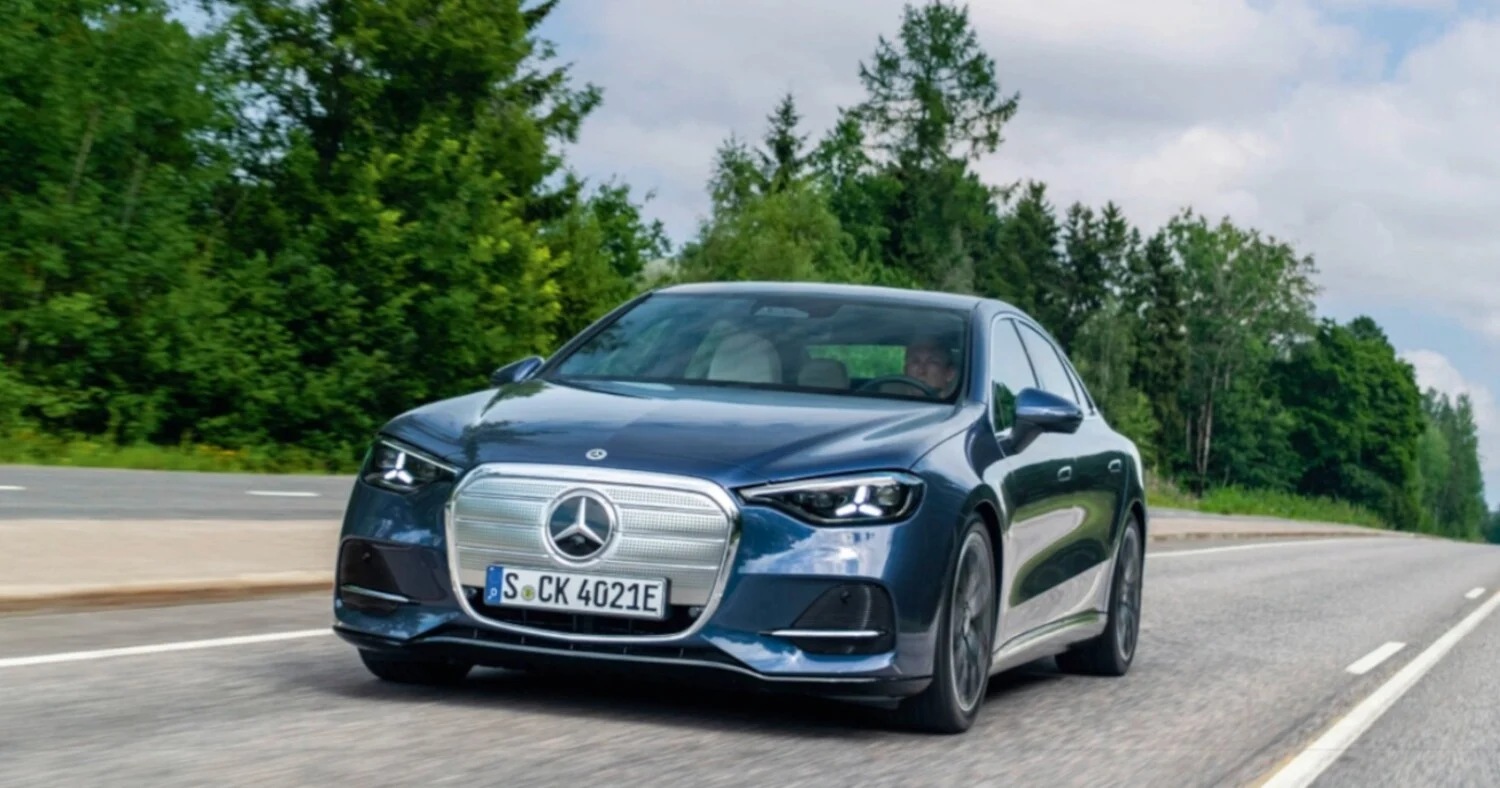
The new Mercedes-Benz C-Class 400 4Matic marks a major shift by adopting a 100% electric powertrain and a design that aligns with the brand’s most modern sedans. Its comfort, performance, and announced range will appeal to frequent travelers and business drivers, even if its overall footprint is larger and a few equipment choices invite debate. The onboard technologies, including predictive suspension and four-wheel steering, reinforce its premium orientation. It offers refinement on par with the best luxury sedans, though its price tag and how options are packaged might spark discussion.
For a long time, the C-Class sat at the entry level of Mercedes’ sedan lineup, but it has weathered many shifts since the first generation arrived in 1993. The rise of the A-Class diminished its original role, while SUVs—starting with the GLC—have gnawed away at its market share with every new generation.
Mercedes-Benz C-Class: a 100% electric, all-new generation
The star seems to acknowledge this evolution with the launch of its all-electric, 100% fresh generation, which represents a true design break from the old combustion-powered model, which will continue to live on for the time being. With six side windows (a six‑glass look) and a fastback rear, it abandons the traditional three‑volume silhouette of the C lineage. To be fair, up close the styling isn’t as radical as that of the EQE or EQS. Indeed, its drag coefficient (Cx) of 0.22 wasn’t achieved by a dramatic, split personality—long hood remains the standard. Still, one can be surprised by the car’s size: the successor to Baby-Benz now measures 4.88 meters in length (roughly 16 feet), about the size of a 2009 E-Class W212.
A size that might deter some American buyers at first glance, but the explanation lies in adopting the MB.EA platform of the electric GLC. The C-Class faithfully adopts the same core specs: 800-volt architecture, a gross 100 kWh battery, optional four-wheel steering, and the full spectrum of modern Mercedes technologies, with a strong emphasis on safety features. At launch, Mercedes pushed the all-wheel-drive 400 version as the flagship before introducing the two‑wheel-drive variants.
Mercedes-Benz C-Class: a Seven-Foot Differences Game
When the driver settles in, the differences with the GLC aren’t immediately obvious. In the “spot the seven differences” game, it’s hard to find seven, as the cabin ambiance remains consistent from the upper console to the vents, including the door panels and dashboard decor available. The finish follows Mercedes’ current trend: fewer noble materials, but lots of careful, showy detailing that guarantees a premium effect. Notably, there is the giant screen full of animations that serves as the dashboard—an option priced at $1,500. On the upside, you get the same quality as the GLC’s interior: exceptionally smooth operation, aided by an effective voice assistant and well-thought-out ergonomics.
The driving position is, of course, lower than a crossover, and sport seating isn’t easily achieved because the driver’s seat adjustment is limited by the battery pack tucked into the floor. However, in the rear, passengers aren’t faced with knee confinement like in a Tesla Model 3, and the generous space will keep Mercedes appealing to taxi drivers and other operators who rack up miles.
As expected, our test model came with every imaginable optional refinement, starting with the air suspension paired with rear‑axle steering. These features, while impressive on paper, were hard to fully test on Finland’s flat, smooth roads where speed limits drop at every intersection. Unsurprisingly, the C-Class handles corners better than the GLC and conveys fewer body motions in corners.
Mercedes-Benz C-Class: meteor-like acceleration!
In the C 400 version, the acceleration feels meteoric. That’s not new in itself, because the GLC with the same powertrain posted a 0-60 mph time around 4.5 seconds at our stopwatch. We’ll reserve full judgment for a road test on more demanding pavement, but the C-Class appears to offer luxurious ride comfort that relies on near–science-fiction tech: predictive damping uses data from other Mercedes vehicles within the preceding two weeks to anticipate bumps and adjust accordingly. It’s impressive—perhaps particularly useful in the United States, where road quality varies widely. And like the GLC, driving modes don’t radically change the car’s character; the main aim is comfort, a stance that contrasts with the performance numbers. In exchange, the silence is a standout feature: all cabin noises are thoroughly filtered and balanced, delivering a refinement level that rivals the most luxurious limousines.
Our Avantgarde spec keeps a classic look with chrome accents that other brands shy away from. Despite a price that’s €5,501 less than the GLC 400, the standard equipment is already generous, including a panoramic roof and the Superscreen—just a step below the Hyperscreen option.
As is typical for a Mercedes, the long options list includes numerous packs, but the French division curiously confines those that bundle some basic equipment, such as hands-free entry with AMG Line. A buyer should be free to skip the blacked-out grille if that presentation doesn’t suit them…
The C 400 is rated at 762 km of WLTP range, a figure that corresponds to configurations not typically the most popular. Under ideal Finnish test conditions, our sample swung from 14.4 kWh/100 km on country roads to 18.7 kWh/100 km on a 75 mph (120 km/h) highway. Those are solid numbers, but not record-setting, and we’re eager to validate them against our standard baselines. Given the GLC numbers we’ve measured, it’s reasonable to expect an overall range around 550 km. We’ll see how it plays out!
Mercedes-Benz C-Class 400 4Matic 489 hp / 100 kWh Avantgarde Line: its Pros
- Quiet operation
- Performance
- Announced range
Mercedes-Benz C-Class 400 4Matic 489 hp / 100 kWh Avantgarde Line: its Cons
- Large size
- Details of equipment
- Pricing and options
Auto-Journal verdict: 4.5/5
In France, launching a new C-Class isn’t the seismic event it once was. Still, this 100% electric generation should win over high-mileage drivers and professionals thanks to its ride comfort and its range.
Mercedes-Benz C-Class 400 4Matic 489 hp / 100 kWh Avantgarde Line: in measurements
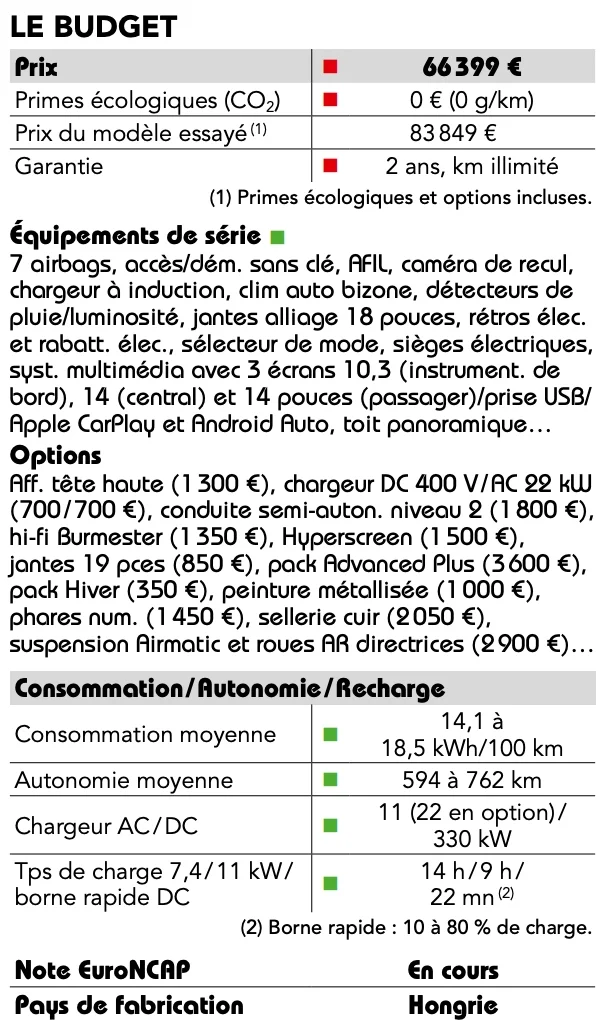
Find our first test of the Mercedes-Benz C-Class 400 4Matic 489 hp / 100 kWh Avantgarde Line in Auto-Journal No. 1215, dated August 20, 2026.
Comparative Table
| Model | Power | Battery | Length | 0-60 mph | WLTP Range | City Consumption | Highway Consumption | Standard Equipment | Price Difference vs GLC 400 |
|---|---|---|---|---|---|---|---|---|---|
| Mercedes-Benz C-Class 400 4Matic | 489 hp | 100 kWh | 4.88 m | 4.5 s* | 762 km* | 14.4 kWh/100 km | 18.7 kWh/100 km (at 75 mph) | Panoramic roof, Superscreen | -€5,501 |
| Mercedes GLC 400 | Identical (489 hp) | 100 kWh | Not specified | 4.5 s | Not specified | Not specified | Not specified | Identical to C | Reference |
Key Takeaways
- New Mercedes-Benz C-Class 400, 100% electric, built on the GLC platform.
- Impressive performance: 489 hp, 100 kWh battery, 0-60 mph in 4.5 seconds (as tested on the GLC).
- WLTP range announced at 762 km; measured consumption between 14.4 and 18.7 kWh/100 km.
- Exceptional ride comfort thanks to innovative tech (predictive damping, optional four-wheel steering).
- Price is €5,501 less than the GLC 400, with generous standard equipment.
- Imposing size and sometimes cumbersome option management.
FAQ
What is the announced range of the Mercedes-Benz C-Class 400 4Matic?
The WLTP range is 762 km, but the expected real-world average is around 550 km depending on usage conditions.
What are the strengths of the new electric C-Class?
Quiet operation, strong performance, solid range, and a high level of ride comfort backed by advanced technologies are its main advantages.
What consumptions were observed during the test?
Measured consumption ranged from 14.4 kWh/100 km on country roads to 18.7 kWh/100 km on a 75 mph highway.
Is rear-seat comfort satisfactory for passengers?
Yes. The rear space is quite generous, and the seating position is comfortable, which will suit professionals such as taxi drivers.
Is the C 400’s price competitive versus the GLC 400?
The C 400 carries a €5,501 lower price tag than the GLC 400 while offering a generous standard equipment list.