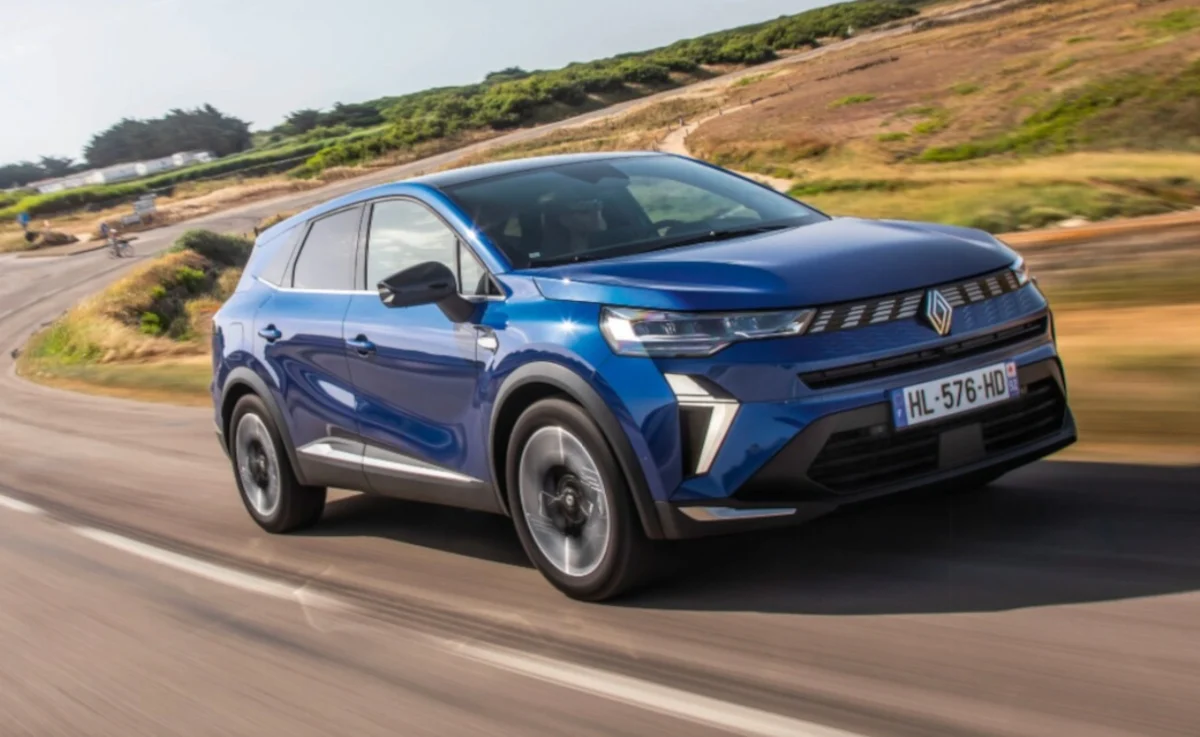
In Brief
The Renault Symbioz 1.2 Eco-G 120 hp Techno stands out with its three-cylinder bi-fuel gasoline-LPG engine, enabling a significant drop in starting price and fuel costs. Its combined range reaches 1,391 km thanks to the two tanks, offering a real advantage for heavy-mileage drivers. Despite higher LPG consumption, the cost per kilometer is very favorable compared with gasoline, delivering substantial savings. A few compromises are worth noting in engine refinement and the absence of an automatic transmission, but overall the package remains highly competitive on practicality and economy.
Right on cue, the arrival of the new 1.2 Eco-G on Renault Clio and Symbioz (already fitted on Captur earlier this year and with Dacia) comes as the price of unleaded at the pump climbs above €2 per liter. A few lines further down in the signage, LPG per liter lingers around €1, or even less off the highway. It also appears relatively immune to market fluctuations…
Renault Symbioz 1.2 Eco-G 120 hp Techno: the budget champion
Strangely, it seems only the Renault group is betting on the cheapest fuel in France (along with E85 ethanol). The 3-cylinder Eco-G therefore replaces the 140 hp micro-hybrid TCe, which carried a penalty of €1,276 since early 2026, and had represented the entry-level Symbioz up to now.
The starting price drops by €900, now set at €29,900 with the Evolution level of equipment, and the malus is reduced to €230. The E-Tech 160 hp hybrid, the sole alternative still offered under the Symbioz hood, requires an additional €4,500!
This new proposition thus becomes a true budget champion, and should reinforce the Symbioz’s enviable success: nearly 42,000 units in France since its mid-2024 launch, over 100,000 in Europe. One would expect Italy and Spain, markets where LPG recorded the strongest growth last year, to be receptive.
The bi-fuel system has little impact on the Symbioz’s practical strengths. Its large trunk is nonetheless penalized by the gas tank (50 L). Its capacity drops by only 20 dm3 compared to the hybrid and 90 dm3 less than the 140 hp TCe. Measured at 460 dm3, its volume remains respectable and even rises to 590 dm3 with the sliding rear bench (16 cm) pushed fully forward as standard.
Renault Symbioz 1.2 Eco-G 120 hp Techno: urban origins
The rear seats offer just adequate legroom and feel relatively narrow, hinting at the Symbioz’s urban origins. For memory, although it’s marketed as a compact SUV given its 4.41 m length, it borrows its platform from the Captur – which, by the way, also offers the same gasoline-LPG bi-fuel engine.
It uses the same wheelbase (2.64 m), only the rear overhang has been stretched by 17 cm. The rest of the cabin, borrowed from its little brother (which is starting to age), shows no new features. The front end is well designed and easy to grasp (the touchscreen is supported by real HVAC controls), though storage space is a bit scant.
A few clues betray the engine’s nature: a gauge at the bottom of the instrument cluster shows which fuel is being used, and to the left of the steering wheel, an LPG button allows manual switching between tanks (to preserve LPG while waiting for a station, for example).
More surprisingly, only the manual transmission is offered with Eco-G here… whereas the Clio with the same engine imposes the automatic EDC. Dacia, meanwhile, leaves the choice between the two transmissions. Simple industrial rationalization?
Renault Symbioz 1.2 Eco-G 120 hp Techno: total range?
By combining both tanks, our measurements yield a total range of 1,391 km. A true diesel substitute, now that Renault’s lineup no longer includes a diesel! That said, racking up kilometers without refueling does not hide the car’s flaws: the 1.2 three-cylinder, less pleasing at low revs than the old 1.3 TCe, shows vibrations and a characteristic rumble. Let it be said that a four-cylinder is generally more refined!
Luckily, at highway speeds, with smooth driving, the little engine becomes quieter and more agreeable. Whether it runs on LPG or unleaded makes virtually no difference to its operation. Transitions are flawlessly smooth in motion, with only a slight shudder at idle.
The stopwatch does give LPG a short edge: 10.7 seconds from 0 to 100 km/h, a half-second quicker than on gasoline. Note that the 120 hp rating is only delivered with LPG (115 hp on gasoline). Power is more than enough for peaceful family trips, especially since the weight remains fairly modest (1,366 kg).
But a hilly route with a loaded trunk will quickly require shifting through the gear selector (mounted high with somewhat long throws) to get going again. Not spectacular, the torque peaks at 200 Nm. The chassis stays in the same vein, favoring comfort and showing firmness on rough or winding roads.
Controlled movements and progressive responses are reassuring. This relative nonchalance does not prevent the Symbioz from being a pleasant travel companion… and, as promised, economically unbeatable. Admittedly, a quick look at the on-board computer reveals LPG-specific higher consumption: about a 20% premium, with an observed average of 8.1 L/100 km versus 6.2 L/100 km for petrol.
The appetite is more than offset by the price gap at the pump, virtually doubling the difference between the two fuels. The math is straightforward: traveling on gas costs around €7.70 per 100 km, versus €11.80 for gasoline. That’s over €400 in savings for every 10,000 km! Big-mile drivers will appreciate it.
Renault Symbioz 1.2 Eco-G 120 hp Techno: its pros?
- Small sacrifice to trunk space
- Fuel cost savings
- Pricing and equipment
Renault Symbioz 1.2 Eco-G 120 hp Techno: its cons?
- No automatic transmission
- Rough three-cylinder
- No spare wheel
The Auto Journal’s verdict: 4/5
This LPG-gasoline engine helps lower the Symbioz’s price without sacrificing (or barely compromising) its practicality. A three-cylinder with no pretensions in mechanical refinement, but it’s as rational as it gets. Except with Dacia…
Renault Symbioz 1.2 Eco-G 120 hp Techno: in measurements
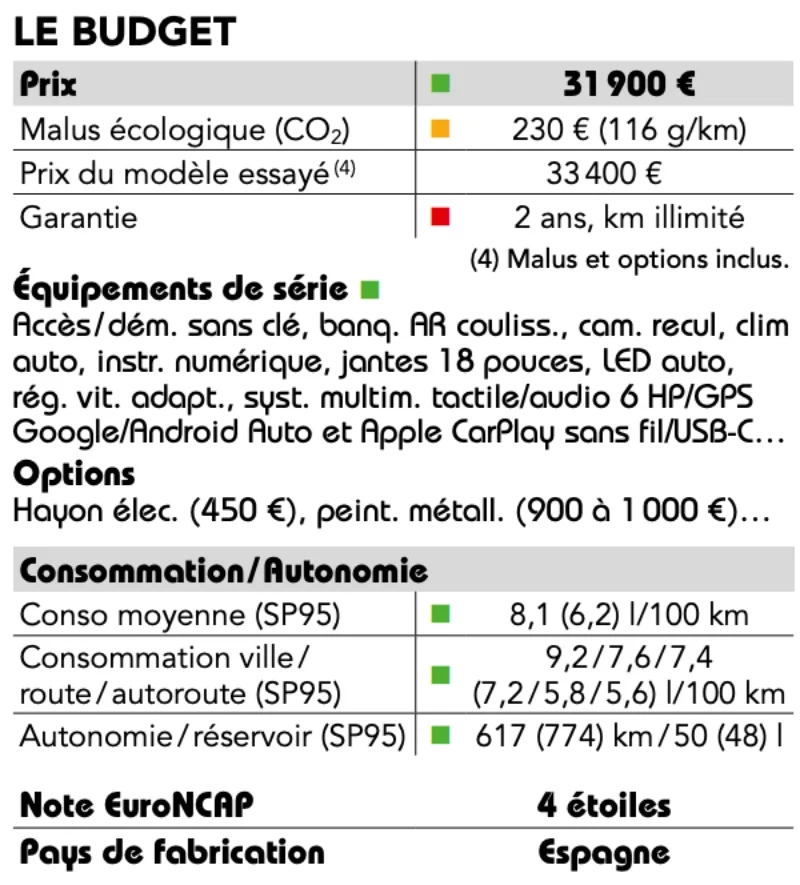
Comparison Table
| Version/Engine | Power (hp) | Transmission | Cargo space (dm3) | Total range (km) | Average consumption (L/100 km) | Starting price (€) | Malus (€) | 0-100 km/h (s) | Weight (kg) |
|---|---|---|---|---|---|---|---|---|---|
| Symbioz 1.2 Eco-G | 120 (GPL), 115 (gasoline) | Manual | 460 (590 max) | 1391 | 8.1 (GPL) / 6.2 (gasoline) | 29 900 | 230 | 10.7 (GPL) | 1366 |
| Symbioz TCe 140 hp (old) | 140 | Not specified | 550 | Not specified | Not specified | 30 800 | 1276 | Not specified | Not specified |
| Symbioz E-Tech 160 hp | 160 | Not specified | 480 | Not specified | Not specified | 34 400 | Not specified | Not specified | Not specified |
Key Takeaways
- The Renault Symbioz 1.2 Eco-G offers a bi-fuel gasoline-LPG powertrain for notable usage savings.
- With a starting price under €30,000, it becomes more accessible and benefits from a reduced malus.
- The combined LPG/gasoline range reaches nearly 1,400 km for long trips.
- The cost of use per kilometer is clearly in favor of LPG despite higher consumption (+20%).
- The trunk remains sizeable despite the gas tank integration (460 to 590 dm3).
- Among drawbacks: no automatic transmission, a three-cylinder that isn’t as refined, and no spare tire.
FAQ
What is the cost difference between running on LPG and gasoline with the Renault Symbioz?
Traveling on gas costs about €7.70 per 100 km versus €11.80 on gasoline, i.e., more than €400 in savings over 10,000 km.
What is the total range of the Symbioz 1.2 Eco-G with both tanks?
The total measured range reaches 1,391 km by combining LPG and gasoline fills.
Is the Renault Symbioz’s trunk penalized by the LPG tank?
The LPG tank reduces the trunk by 20 dm3 compared with the hybrid and by 90 dm3 compared with the 140 hp TCe, but its capacity remains respectable at 460 dm3, expandable to 590 dm3.
Is the Renault Symbioz 1.2 Eco-G performant?
It achieves 0-100 km/h in 10.7 seconds in LPG, half a second faster than on gasoline, with ample power for family use.
What are the Symbioz 1.2 Eco-G’s weaknesses?
The main drawbacks are the lack of an automatic transmission, a rough three-cylinder, and no spare wheel.