In Brief
The Volkswagen ID.Buzz California Cruise marks the brand’s official entry of its electric van into the vanlife universe. Scheduled for early 2027, it stands out with a minimalist approach—no built-in kitchenette, no pop-top roof—relying instead on a foldable bench and exterior accessories. Its 79 kWh battery promises up to 48 hours of energy when parked, making it easier to power electric amenities. Priced below the gasoline California, this model aims to democratize access to electric, road-tripping recreation, though it remains less equipped than its classic elder.
The Volkswagen ID. Buzz is indeed stepping into vanlife. Debuted at the Caravan Salon in Düsseldorf, its production-ready variant won’t stay as a concept. The German automaker plans to bring it to market before the year ends. Dubbed California Cruise, this electric van leans on a far simpler formula than a traditional California.
The Volkswagen ID.Buzz California Becomes a Reality
The idea of a Volkswagen ID.Buzz tailored for getaways and nights under the stars is coming to fruition. The model shown in Düsseldorf corresponds to a production-ready version, with first deliveries scheduled for early 2027.
Volkswagen has chosen not to overhaul the electric van’s core design. The California Cruise remains much closer to a standard ID.Buzz than to the gasoline California, as it relates to the Multivan T7 from which it derives.
This approach lets the manufacturer bring this variant to market quickly. But it also means skipping several features traditionally associated with camper vans.
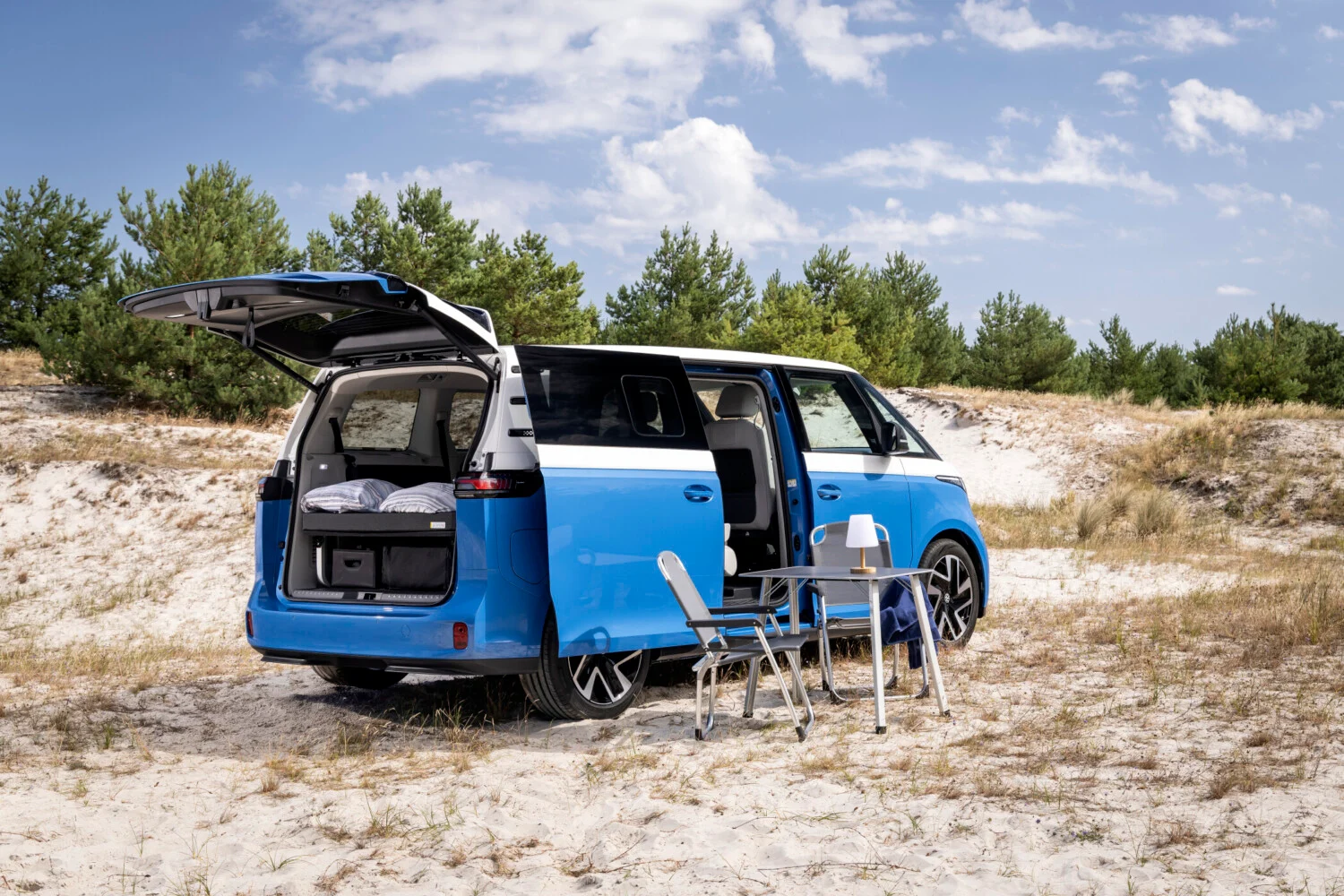
There’s no real kitchenette on board. The Volkswagen ID.Buzz California Cruise lacks a refrigerator, a sink, or a gas stove. It also does not adopt a pop-top roof and does away with fixed furniture.
Its main feature is a folding bench. Once deployed, it yields a bed 1.20 m wide by 2.03 m long. Volkswagen also adds a table and two chairs to enjoy outdoor breaks.
Up to 48 Hours of Power When Parked
The California Cruise thus leans more toward a vehicle that makes weekend getaways easy than a true electric camping coach equipped for long stays.
Electric power, however, brings a notable advantage to this leisure-focused version. The 79 kWh battery, which also powers the 286-hp electric motor, can supply energy to onboard equipment while the vehicle is parked.
VW thus announces up to 48 hours of energy autonomy. During that period, occupants can plug in various electrical devices and run the air conditioning without starting the vehicle.
That said, it’s a maximum figure. In demanding conditions, for example during very hot days with climate control running continuously, this duration could naturally be reduced. Not to mention the need to reserve enough energy to hit the road again.
A Price Lower Than the Gasoline California
This simplified design mainly allows the ID.Buzz California Cruise to carry a lower price tag than the classic California. In Germany, the newcomer is priced at €60,761. That’s nearly €13,000 less than its gasoline-powered cousin.
However, the comparison should be tempered by the equipment gap between the two models. The price for the French market hasn’t been announced yet; it is expected to be revealed as orders open in France.
The first units are set to reach customers in early 2027. VW does not seem to be stopping at this initial offering. The automaker plans to unveil additional electric California variants by 2028.
With this California Cruise, the ID.Buzz takes a new step by officially embracing vanlife. The question now is whether its deliberately minimalist setup and its ability to supply electricity on trips will persuade vanlife enthusiasts.
Comparison Table
| Model | Price (Germany) | Price Difference | Battery | Energy Autonomy When Parked | Power | Sleeping |
|---|---|---|---|---|---|---|
| ID.Buzz California Cruise | €60,761 | -€13,000 vs gasoline California | 79 kWh | up to 48 h | 286 hp | 1.20 m x 2.03 m |
| Gasoline California | €~73,761 | — | — | — | — | — |
Key Takeaways
- The ID.Buzz California Cruise is pitched as an electric van built for vanlife and will go on sale in early 2027.
- Its interior layout stays lean: no kitchenette, no pop-top, and no fixed furniture.
- The main interior asset is a folding bench that converts into a double bed (1.20 m by 2.03 m).
- It offers up to 48 hours of energy supply when parked thanks to its 79 kWh battery.
- The announced price in Germany is €60,761, about €13,000 lower than the gasoline California.
- VW plans additional electric California versions by 2028.
FAQ
When will the Volkswagen ID.Buzz California Cruise go on sale?
Sales and initial deliveries are planned for early 2027.
What equipment is missing on the California Cruise?
The vehicle has neither kitchenette, nor refrigerator, nor sink, nor gas stove, nor pop-top roof, nor fixed furniture.
What is the energy autonomy of the ID.Buzz California Cruise when parked?
The battery provides up to 48 hours of power to run appliances when parked, excluding driving.
What is the announced price in Germany?
€60,761 in Germany, about €13,000 less than the gasoline California.
What interior arrangements does the Volkswagen ID.Buzz California Cruise offer?
The main transformation is a folding bench offering a bed of 1.20 meters by 2.03 meters, with an outdoor table and chairs.