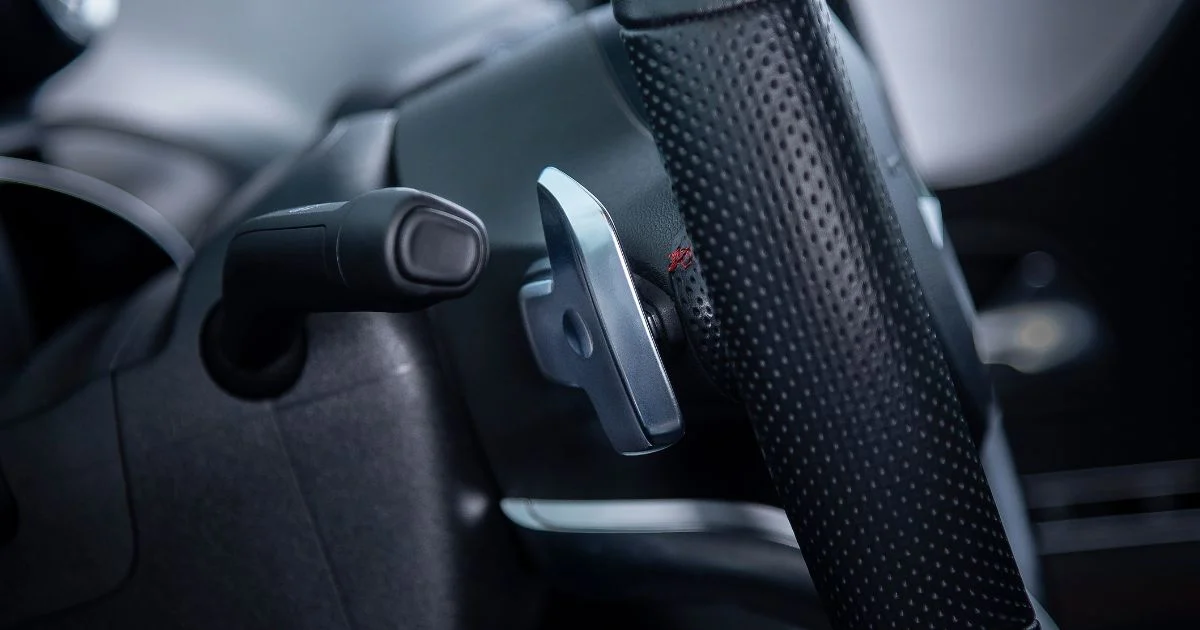
The newest generation of electric sport cars are starting to kick the shift into high gear. The tachometer climbs, and the push returns with every “clack.” It might look like a gasoline GT, but the action is governed by a virtual gearbox that is entirely software-driven.
Hyundai set the pace with the Hyundai Ioniq 5 N and its N e-Shift feature. This mode mimics an eight-speed dual-clutch transmission. Porsche followed suit with the Porsche Taycan e-Shift. Toyota, Lexus, BMW, and Maserati are each crafting their own fake gearbox for electric performance cars. Behind what looks like a gadget, these driving modes actually touch something deeply meaningful. They challenge the way we like to drive a car. We still need to understand why a few artificial jitters can sometimes make an electric car far more entertaining.
Electric Cars: What a Single-Gear Transmission Changes About the Pleasure
For decades, everything hinged on manual gearboxes and torque-converter automatics. Many drivers considered these “slush boxes” too soft and too slow at changing gears. A good mechanical box became a topic of debate among enthusiasts. Precision in guiding, a sense of engagement, the lever’s throw, every detail mattered. And then the first robotized gearboxes inspired by Formula 1 arrived. They added another way to interact with the mechanics.
Ferrari brought this technology to production in 1997 with the F355 F1. Alfa Romeo followed with the Selespeed, and BMW with the M3 equipped with the SMG gearbox. Dual-clutch gearboxes like DSG or PDK eventually eliminated almost all torque interruption. They pre-engage the next gear to keep acceleration fully loaded. We thought we had reached the pinnacle of performance. Yet the electric motor pushed the logic further, delivering instant torque and a single fixed gear ratio. The result behind the wheel is continuous, highly efficient thrust. It leaves much less “work” for the driver, which leaves some motorists craving more sensation.
How a Virtual Gearbox Works on an Electric Car
To fill this gap, several brands began recreating gear changes… without adding a single gear. These virtual gearbox systems for electric cars draw directly from video games, with virtual “stepped shifts” that chop acceleration into small steps. Practically, the software modulates the torque of the motor(s) to create a brief interruption, adds a rising engine note, and animates a tachometer on the screen. The driver pulls a paddle or pushes a lever, the car simulates a gear change, and then the surge returns, just like with a traditional automatic.
Depending on the model, this virtual gearbox takes several forms:
- A virtual automatic box of the dual-clutch type, like the N e-Shift function of the Hyundai Ioniq 5 N or the Taycan’s e-Shift mode. Eight gears are simulated. The system reproduces a virtual rev limiter around 7,400 rpm in first gear and a speed of roughly 66 km/h in that “gear,” with jolts calibrated to evoke a DCT transmission.
- A fake manual gearbox, with a real shifter and sometimes a clutch pedal, used by Toyota and Lexus, or Maserati for the electric supercar MC20 Folgore. The driver selects their “gears,” but the car’s actual gear ratio remains unique; everything hinges on electronic torque management.
- Torque steps controlled by paddles, tested by other performance brands. The driver then selects a level of shove as if changing gears, without the software recreating a complete eight-gear system with a simulated limiter.
Why a Virtual Gearbox Can Make an Electric Car More Fun
With an electric motor, torque arrives without a break from zero rpm to maximum speed. On paper, that’s ideal for performance. In reality, this absence of breathing can make the experience less engaging for some drivers. The simulated gearbox systems reintroduce micro interruptions in torque. They create a brief pause, then the push returns when the next “gear” engages. Engineers note that these short cut-offs foster a sense of anticipation and excitement that many car enthusiasts associate with the joy of driving.
In the Hyundai Ioniq 5 N, for example, the N e-Shift mode reproduces an eight-speed gearbox with very pronounced jolts. Tests show that these dramatic torque breaks can add about 0.5 seconds to the 0–100 km/h sprint, but they markedly reinforce the sense of gear changes. The Porsche Taycan e-Shift heads in the same direction, with a virtual eight-speed PDK, a needle-style tachometer, a simulated limiter around 7,400 rpm in first, and vibrations generated by brief current bursts in the motors. Porsche says this mode does not cost acceleration time versus normal operation. At Maserati, engineer Davide Danesin speaks of a “functional advantage in terms of experience and controllability” for this type of setup, cited by Sport Auto. Porsche had stated in 2024 that there was “no reason to simulate the past” and that a fake gearbox had “no interest” on an electric, as reported by Automobile Propre, before later offering an e-Shift mode on the Taycan. Between those who love reviving a lever and tachometer and those who prefer absolute smoothness, these virtual gearboxes are carving out a new playground at the heart of electric performance cars and rekindling a debate that is far from settled.