
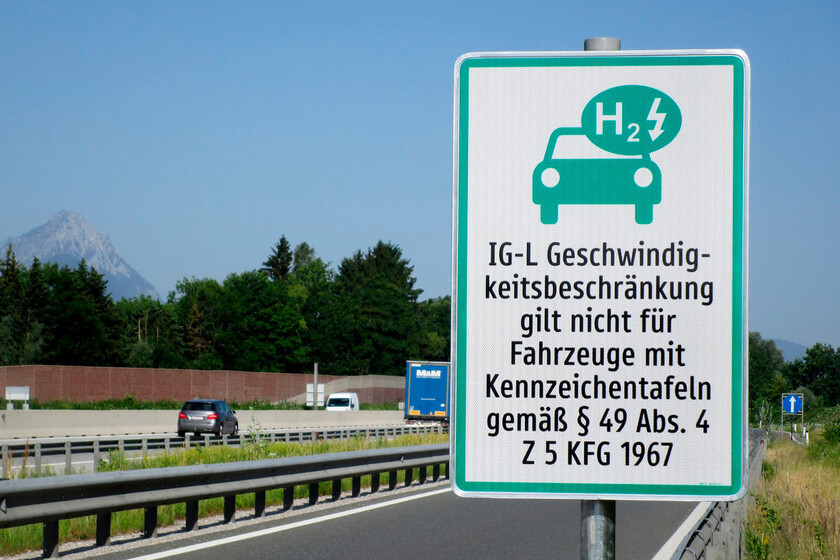
The same highway, but two different speeds: electric cars can go 130 km/h while everyone else stays at 100 km/h. This happens in Austria, where not only traffic rules determine the maximum speed. The environmental law lowers the limit in certain areas to reduce emissions. But in these stretches, electric vehicles are exempt and may travel faster.
Does this also apply to foreign electric vehicles? Can I travel at 130 km/h on these sections with a CERO plate registered in Spain without fear of a fine?
Rewarding EVs to encourage you to buy an electric car
In Austria, the traffic rules set the highway speed limit at 130 km/h. Nevertheless, the Air Emission Control Act (IG-L) boosts the limit to 100 km/h on certain stretches of motorways and expressways. A measure based on the premise that lower speed means lower emissions.
To stimulate the purchase of electric cars, the Austrian government opted for the strategy of “reward rather than prohibition,” and the IG-L was amended in July 2019 by applying an exception: electric cars may circulate at 130 km/h in zones limited to 100 km/h. In total there are more than 400 km where EVs can go faster than the rest of the traffic.

This exception applies to any car or vehicle that is 100% electric, whether battery-powered or hydrogen fuel cell. But it does not apply to plug-in hybrids, nor to hybrids that are not plug-in. The stretches that enjoy this exemption are indicated by a specific sign. Among the highways that have them are the A12 (Inntal in Tyrol), the A10 (Tauern in Salzburg), the A1 (West), the A2 or the A9 (Carinthia and Styria).
Also for Spanish EVs, though with fine print
Beyond the mechanics of the car, there is another condition Austria requires to be able to drive at 130 km/h on these sections without a fine: only vehicles with the green license plates in accordance with Article 49 of the Austrian Motor Vehicle Act. These plates can be requested for electric cars, featuring a white background with green lettering.
And what about foreign electric cars? ASFINAG, the Austrian public company that manages the motorways and expressways, states on its website that for cars from other European Union countries the equivalence applies under section 4a of Article 82 as amended of the Austrian Motor Vehicle Act.
In that paragraph, the equivalents contemplated are the license plates or identifiers established by other countries that allow identifying the vehicle as electric. Thus, for example, German cars can go to 130 km/h without issue, since they can also request a plate that marks them as electric with an E at the end of the designation.
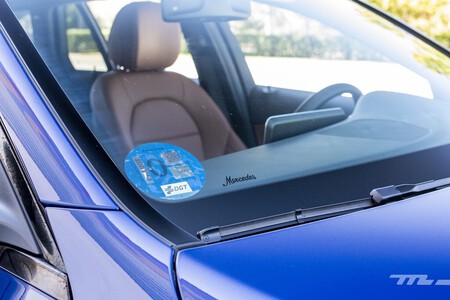
The DGT sticker isn’t enough, but… In the case of Spanish cars there is no specific badge or plate for electric cars: we only have the ZERO label from the DGT, which covers pure EVs but also PHEVs. Therefore, on its own, it isn’t enough to identify a car as electric.
But in that same section of the regulation it also states that the condition of being an electric car can be proven with the documentation. Which is valid for showing to a traffic officer, for example with the vehicle’s technical data sheet. And it could also be used later to prove it to authorities if our car is captured by a camera driving at 130 km/h and the system cannot identify it as a pure electric.
Find your ideal electric car
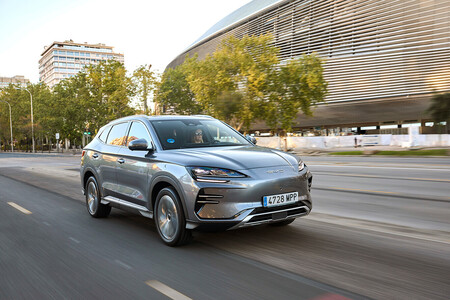
If you’ve considered buying an electric car, this will interest you. We’ve created the Personalized Electric Car Recommender, where in addition to seeing the models that fit your needs you’ll also get answers to the questions that worry you most, such as price, range, or nearby charging points.

Looking for your next electric car and overwhelmed by so many options? It’s normal.
More than 45,000 readers have already tried it. And you?
Advice offered by the brand