Drivers in many cities around the world can thank Singapore for the pain and frustration of having to pay tolls to enter the city.
In the 1960s and 70s, transportation took a backseat as the government focused on more urgent issues like housing, defense, and jobs. The public transit system of that era was chaotic and lamentable. And to make matters worse, at a time when car ownership restrictions were not yet in place, the city-state filled with cars, which amplified traffic.
No es pagar por entrar, es ponerle precio al tráfico
However, with a territory that barely exceeded 700 square kilometers, the government of the time quickly understood that space was the country’s scarcest resource, and that no infrastructure policy could rely on endlessly expanding roads. This physical constraint would ultimately turn Singapore into the most influential urban lab of the past half-century.
By the early seventies, the vehicle fleet was growing rapidly and the classic model of widening roads was not viable on an island with little room to expand. Other cities would have chosen more asphalt. Singapore chose to price the asphalt it already possessed.

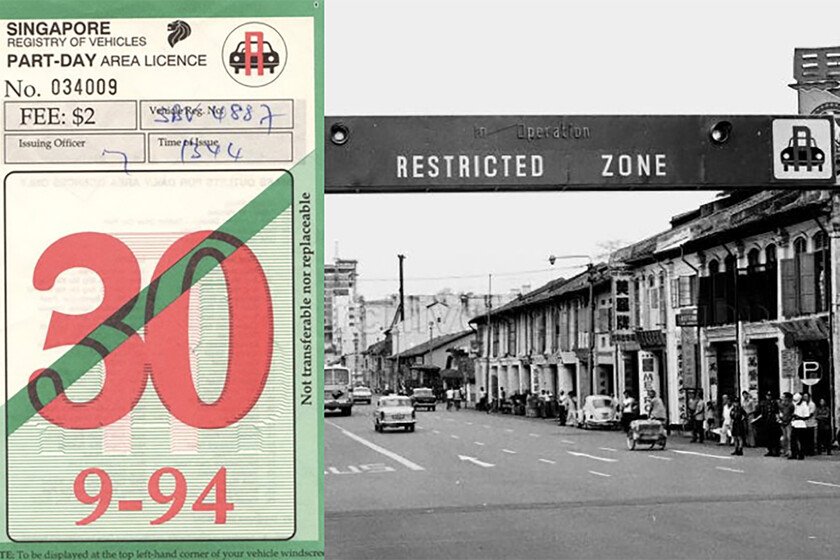
The access control to the financial district was done manually.
On June 2, 1975, the Area Licensing Scheme was enacted, the world’s first successful urban congestion pricing system. The rule was straightforward: any driver who wanted to enter the so‑called Restricted Zone, covering roughly 6 square kilometers of the financial district, had to purchase and display a visible license on the windshield during peak hours, from 7:30 to 9:30 in the morning.
There were no cameras or tolling. The enforcement relied on traffic wardens stationed at the approaches to the restricted zone, who could identify at a glance who carried the permit and who did not.
Entry without a license resulted in a penalty. Over time, a network of park-and-ride facilities on the periphery and campaigns to encourage car sharing were added, because the measure was never considered in isolation but as part of a package that included public transport and demand management.
The effect was immediate. In June 1975, before the ALS took effect, 32,500 vehicles entered the restricted zone during the peak window. As soon as the charge was implemented, the figure dropped to 7,700, a 76% decrease. Simultaneously, the use of public transit for commuting rose from about 33% before ALS to nearly 70% by 1983. Singapore hadn’t reduced traffic by convincing people; it did so by putting a price on it.
The system, initially conceived as a temporary fix, remained in operation for more than two decades and was gradually expanded. In 1994 it was extended to operate all day, with a further 9.3% reduction in inbound and outbound traffic in the zone.
The manual management, with more than a hundred officers deployed daily, was effective but costly and rigid. Since the mid-1980s, Singapore had been studying electronic alternatives, including an experimental automatic tolling system in Hong Kong, and in 1998 the ALS was replaced by the Electronic Road Pricing, the world’s first fully electronic road pricing system, featuring gantries that automatically charge per passage depending on the time and level of congestion.
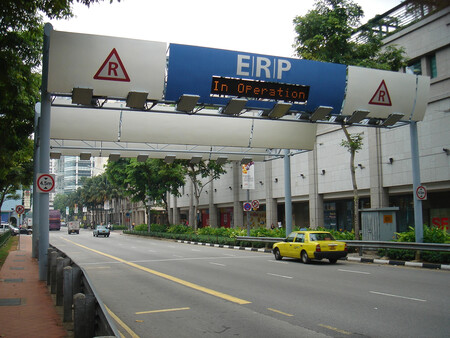
Pórtico del sistema ERP actual (Electronic Road Pricing), donde el cobro es automatizado y se factura por cada acceso a una carretera, en lugar de un único pago diario de acceso ilimitado.
Today, Singapore is in the midst of a transition to ERP 2.0, a satellite-based system that replaces the physical gantries with onboard units and charges by distance traveled rather than per individual entry. The rollout has been gradual since late 2023, and throughout 2026 the decommissioning of gantries that have already gone inactive is underway, from around 95 originally installed.
What began as an emergency measure for a space-strapped city became the blueprint later adopted by others decades after, when the problem ceased to be confined to a single Asian island and became an issue for any Western metropolis.
London introduced its Congestion Charge in February 2003 and achieved a central-area traffic reduction of about 15 to 18%, with an even larger drop in congestion delays. Stockholm tested the model from January to July 2006 and made it permanent in 2007 after a referendum that overturned much of the initial opposition from residents.
Milan transformed its former Ecopass, a policy focused on emissions, into Area C, a congestion toll that reduced zone traffic by 28% within two years. And more recently, New York became in January 2025 the first American city to apply a similar toll to enter southern Manhattan.
Each city adapted the model to its traffic patterns, its technology, and its political climate, but all started from the same premise Singapore first articulated half a century ago: urban space is not an unlimited resource, and treating it as free merely guarantees its exhaustion.
What in 1975 seemed like an extraordinary measure for an island with few alternatives has turned into the go-to manual for managing traffic in any major city.
Images | Basile Morin, National Archives of Singapore, Mailer_diablo