
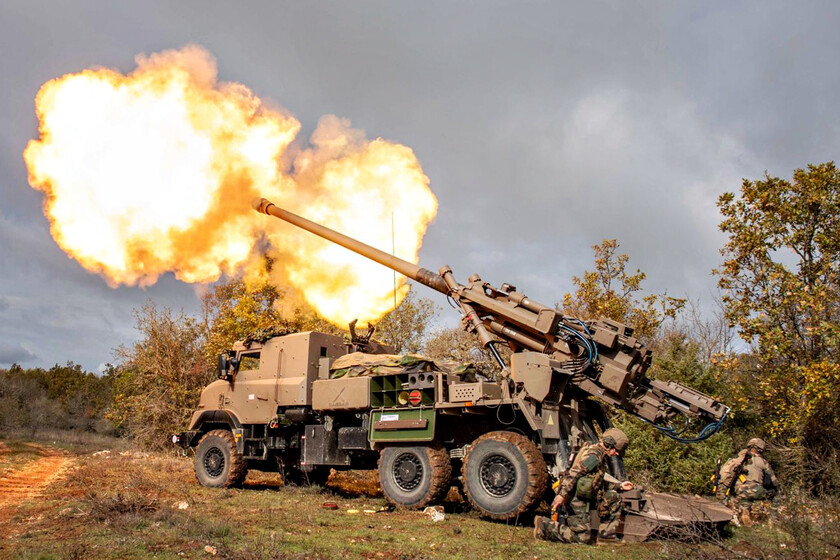
When the Cold War ended, Europe disarmed slowly but steadily. France’s military-industrial complex, like many others, was left without orders. It was in that vacuum that the Caesar (pronounced “Caesar”) cannon that today Ukraine has turned into Russia’s nightmare emerged, and which the United States watches with envy.
The Caesar was not designed by the French state; it was conceived by an engineer from Giat Industries, Philippe Girard, practically in secret from the company. With a simple idea, but one that public enterprises forget in boom times: to build a cheaper cannon.
The Cannon Nobody Wanted
Promoted to head of the artillery line in 1988, Girard, who also held an MBA from Wharton (the same university where Elon Musk earned his MBA), looked at the business side of the matter. How to sell more cannons when countries no longer buy them. At the same time, NATO recommended equipping with 52-caliber guns instead of 39-caliber ones. That means moving from 6-meter-long guns with a range of 30 km to 8-meter-long guns with ranges beyond 40 km.
He saw there would be a market, and for development he started from what they already had in the factory: the TRF-1 gun. A 6-meter-long piece mounted on a motorized trailer that can be moved a few meters and towed by a truck. Girard saw that the truck cost as much as the trailer. So, why not put the cannon directly on the truck? It is cheaper and smaller and therefore easier to transport to the theater of operations.

Primera versión del cañón Caesar sobre camión Unimog.
A cannon mounted on a truck isn’t feasible, they used to say. Trucks with cannons have existed since World War I, but never with heavy artillery pieces because the trucks they are mounted on cannot bear the weight of the gun and even less the recoil when fired. That is why the public sector and the general staff did not see the interest.
To convince them he mounted a 6-meter cannon camouflaged as an 8-meter one on the truck for tests. It worked, but he and his team knew that an 8-meter cannon would shred the truck.
But because it was so cheap to make, he managed to camouflage in the overall development budget the design of a totally new recoil-damping system. And no one noticed. The development was later coordinated by engineer Pierre-André Moreau, considered the true technical father of the system.
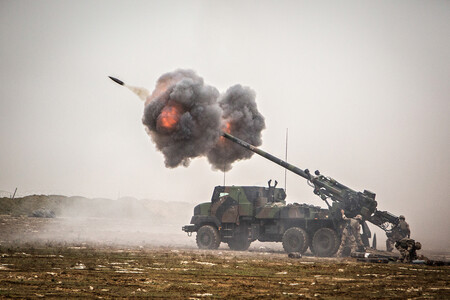
Caesar del ejército de tierra francés en Irak en 2018.
The concept had no precedent. A tube over eight meters long and 52 calibers, capable of firing beyond 40 kilometers, mounted on a wheeled all-terrain vehicle under 18 tons (typically Mercedes Unimog, Renault Sherpa 5 or Tatra 815), transportable as a whole on a C-130 Hercules. It was presented in 1994 at Eurosatory under the name Caesar, using the English spelling, with export in mind. But no country bought it. Not even France.
The resistance came from within. The artillerymen had spent two decades thinking about armor and tracks, and the CAESAR didn’t fit that logic. In 2000, the then defense minister approved the purchase of five Caesar units. The tests were conclusive and France ultimately acquired 77 more units.
The real boost arrived with the early-2000s wars, in Iraq and Afghanistan, where it proved its effectiveness. But what turned the Caesar into a commercial phenomenon was the war in Ukraine.
From Donation to Ukraine to Commercial Success
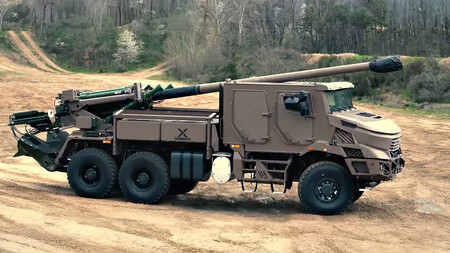
Compared with classic systems, weighing 40 or 50 tons and hard to project outside Europe, the Caesar weighs between 18 and 27 tons and is deployed by a crew of five. That lightness fits the shoot and scoot doctrine: fire and move before the enemy can confirm the position.
And above all, it is very, very precise. And that is an economic advantage, simply because you need to buy less ammunition. Here lies the economic key that explains its success against the drone threat.
An attack drone with a reach of 40 or 50 kilometers, the Caesar’s typical engagement radius, costs between $30,000 and $40,000, and of every five launches only one tends to hit its target. Against a multi-million-euro cannon that almost always hits the target, the cost-per-impact equation remains favorable to traditional artillery.
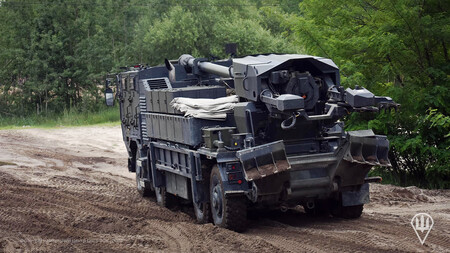
Caesar 8×8 of the Ukrainian Air Force.
According to KNDS’s own figures, 548 Caesars have been sold to twelve countries, although other outlets raise the figure to nearly 800 if orders not yet delivered are counted.
France has ordered 109 Mark II units for 350 million euros, with deliveries starting in 2026, and plans to have 120 cannons in service by 2030 and 150 units by 2035. Ukraine, meanwhile, has received 154 units since 2022, through direct French donations and production specifically intended for Kyiv.
Ukraine, meanwhile, has developed its own version, the Bogdana, and Israel has the Atmos. Neither has managed to wrest the CAESAR’s unofficial world-standard status for wheeled self-propelled artillery, a prestige that thirty years ago no one, not even the French Army, was willing to assign to it.
Images | Armée de Terre (Sgt Julien Hubert), Daniel Steger, US Army (Sgt. 1st Class Mikki Sprenkle), KNDS, Ukrainian Air Forces