
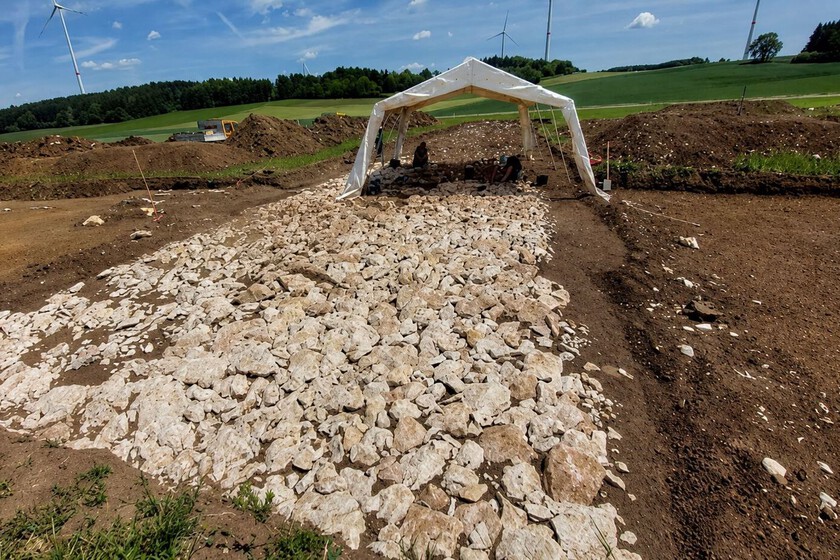
About 2,000 years ago, when the Germany we know today and its famous Autobahns did not yet exist, the Romans had already discovered one of the best locations to build a road through what is now the state of Baden-Wurttemberg… And it turns out that 21st-century engineers have arrived at a very similar conclusion.
Pre-construction excavations for the new ascent section of the A8 motorway south of Stuttgart have uncovered around 90 meters of the “Alblimes Road,” one of the oldest and most important Roman roads known in this region. The coincidence is particularly striking: the future motorway will run through territory that was already strategic for movement two millennia ago.
The Romans needed to move soldiers. Today Germany needs a new connection
The State Office for Heritage Conservation of Baden-Wurtemberg (LAD) has been supervising since August 2025 the archaeological excavations carried out before the works on the new variant of the A8. Near Drackenstein, the teams from fodilus and ArchaeoBW have found this stretch of the ancient road that linked Rottweil (the Roman Arae Flaviae) with Heidenheim an der Brenz (formerly known as Aquileia).

The Alblimes Road probably dates back to the reign of Emperor Vespasian, in the 1st century AD, and it was no ordinary route. It connected forts, settlements and military positions in Germania Superior, enabling the movement of troops, goods and communications through one of the Empire’s strategic territories. This connection helped delineate the border between the territory controlled by Rome and the Germania that remained outside its domain for more than a century, alongside fortifications such as Urspring and Donnstetten.
But why did the Romans choose this place? In essence, the answer lies in the maps. The so-called “Jura of Suabia” forms a natural corridor of about 200 km in length and 45 km in width from the Rhine Falls (near Schaffhausen) to the Ries of Nördlingen, along which the new variant of the A8 will now run.
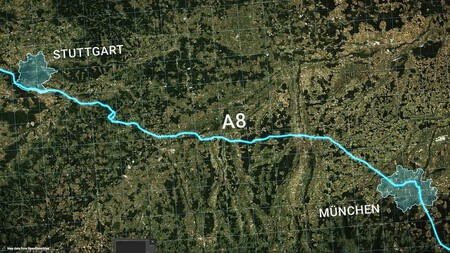
For an expanding empire, it was a perfect area to communicate positions and organize its frontier. For today’s engineers it remains a key step for communications and the connection to Stuttgart: machines have changed, as has the way the population travels and its needs, but geography continues to impose its rules.
A road that was also a border
The existence of the Alblimes had long been suspected for strategic reasons, but it was the excavations of the 19th and 20th centuries that allowed it to be demonstrated. Now, the Drackenstein discovery adds another important piece because it enables researchers to study physically the route of that infrastructure just before the landscape is transformed again by a major transport project.
“The findings allow us to better understand the origin, importance and use of one of Baden-Württemberg’s oldest roads,” explains René Wollenweber, head of linear projects at the LAD. The archaeologist also notes that this type of work allows new infrastructures not only to transform the territory, but also to help understand how it was used centuries earlier.
The excavations, commissioned by Autobahn GmbH’s Southwest division, are expected to continue until the end of this year. Two thousand years later, one of Europe’s most important roads will cross again a place where Rome had already decided it was worth building.
Images | Beteiligungsportal, @electrostatic