
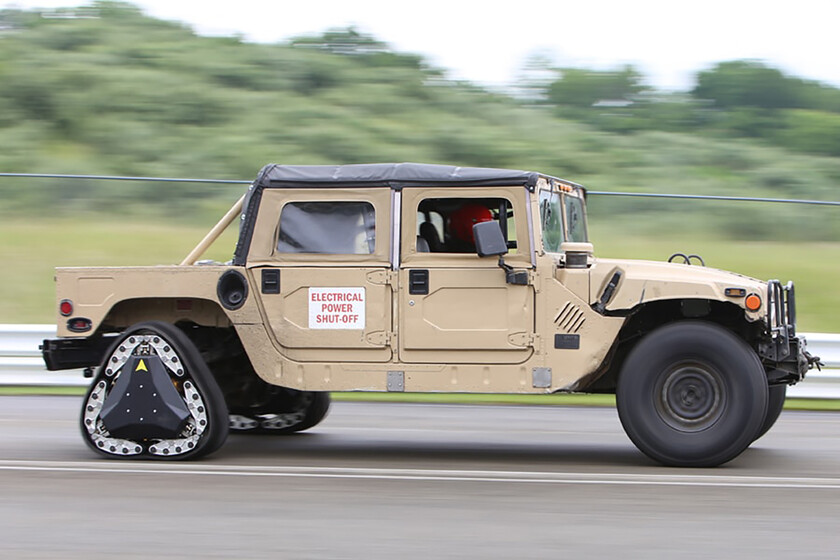
Every so often, a company or inventor tries to reinvent the wheel with their product. Tesla is known for that, but until now no one, not even Elon Musk, has attempted to reinvent the wheel in the literal sense. Until 2018, when the U.S. military’s research and development agency, DARPA, unveiled a wheel that can instantly turn into a caterpillar track.
The Defense Advanced Research Projects Agency, or DARPA, solved a problem that had haunted armies for a century: how to make one vehicle move quickly on roads and not get bogged down in the mud. The answer was called Reconfigurable Wheel-Track (RWT), a wheel that morphs from circular to triangular with tracks in less than two seconds, even with the vehicle in motion.
They’ve reinvented the wheel
It won an award, appeared in dozens of specialized outlets, and then, simply, vanished from the public radar. Seven years later, there is no trace that the technology has reached a single production vehicle.
The wheel was developed by Carnegie Mellon University’s National Robotics Engineering Center, within DARPA’s Ground X-Vehicle Technologies program, known as GXV-T. The underlying idea was to replace armor with mobility; if a vehicle can move faster and better on any terrain, it needs less armor to survive, and therefore it weighs less and costs less.
The mechanism worked flawlessly, and with impressive numbers. In wheel mode, the prototypes reached about 80 km/h on hard surfaces. In track mode, speed dropped to around 48 km/h, consistent with a configuration designed for traction. The transition from wheel to track was achieved while traveling at 40 km/h, and the reverse at 19 km/h. It was tested mounted on Hummers.
The wheel-track’s tread carries a rubber surface that rests on a chassis with a variable shape. By extending a Y-shaped support, the rotating wheel morphs into a track by deforming the chassis to take on a triangular form. At the same time, by applying the brake to stop the wheel’s rotation, the transmission automatically shifts from turning the wheel to driving a set of gears that propel the track.
Although other research groups have developed devices similar to the reconfigurable wheel-track system, earlier designs required stopping the vehicle to switch modes. The ability to perform these transformations while in motion is a critical requirement for vehicles that must adapt to changing terrain at high speed.
In 2018, Carnegie Mellon won with this technology Popular Science’s “Best of What’s New” award. Dimi Apostolopoulos, the head of development at the Robotics Institute, already pointed out potential civil uses beyond the military, such as in the forestry, mining, and construction industries, sectors where alternating between asphalt and mud is the norm. The ambition wasn’t limited to military applications.
And since then nothing more has been heard about the brilliant system. There is no specific announcement or cancellation report for the RWT, nor has it been announced that the Army or Marines decided to adopt the system. It simply disappeared.
DARPA does not usually explain publicly why it shelves a technology, so there is no official confirmed reason for this particular case. One possible reason is its cost or the lack of demand. Or both. And because DARPA demonstrates what is technically possible, not what is viable to manufacture at scale. It limits itself to inventing, proving the technical feasibility of a technology or system, regardless of cost.
A GAO report to Congress already noted that DARPA’s method for tracking the “technology transition” of its programs was unreliable, and that a good portion of its developments fall into what the agency itself calls the “valley of death,” the gap between proving a concept and getting a military to adopt it and finance its move to production.
The Reconfigurable Wheel-Track fell into that valley of death, not because of mechanical failure, but because no budgeted actor chose to foot the bill to move it into production. DARPA has acknowledged the problem and is exploring new models, such as the so-called X Prime programs, to shorten that distance in the future. The wheel that stopped being round did work. What it didn’t find was someone willing to manufacture it at scale.
Images | Popular Science