
There is an enemy that all armies in the world have faced for thousands of years when advancing over land in the midst of a military campaign: the terrain. No matter how fast the troops move, if there is a river that cannot be crossed or a wide gap in the ground that cannot be traversed, the advance is brought to a sudden halt.
There are three solutions to address this problem: go around to find a passable route, build or use an existing bridge, and, third, resort to a bridge-laying vehicle.
Developed and Manufactured in Spain
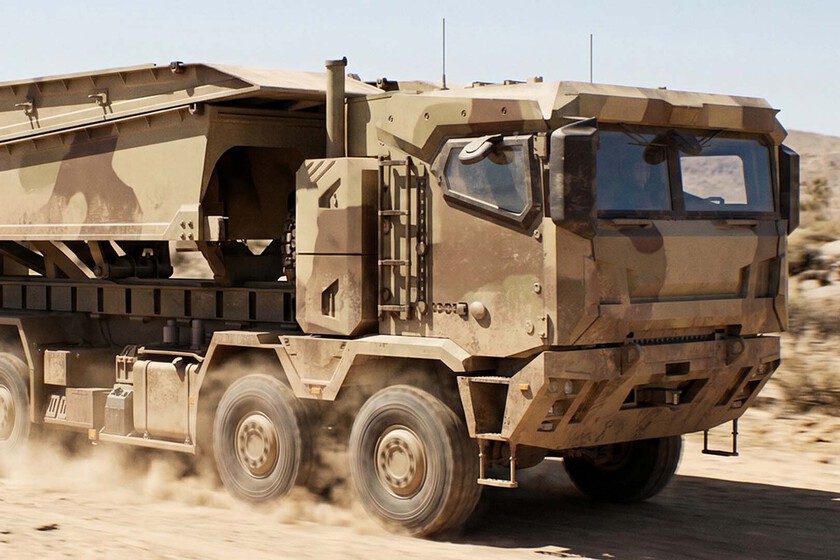
The Spanish Indra considers that the latter solution is key, which is why it is developing a wheeled bridge-launching system that promises to become one of the most useful, rugged, and innovative tactical vehicles of the moment.
It is the VLP-R and one of its advantages is its enormous payload capacity, specifically it reaches the MLC80 class for wheels and tracks, meaning it can bear 80 tons.

To give you an idea, most civilian bridges do not support more than 60 tons, so this system can easily allow a Leopard 2E battle tank weighing 62.5 tons to cross obstacles and gaps of up to 24 meters quickly.
The estimated time for launching and recovering the bridge is under 20 minutes, two operators handle the vehicle and it can move across all kinds of terrain thanks to its high-mobility tactical wheel platform, which can be 10×10 or 6×6.
Thus, Indra defines it: “A critical system to equip the Armed Forces with a modern bridge-launching capability that guarantees the safe mobility of forces and vehicles (MLC 80 CLASS) in rapid breaching of gaps and overcoming obstacles, whether in river channels or streams (wet gaps) or in pits or openings in terrain (dry gaps).”
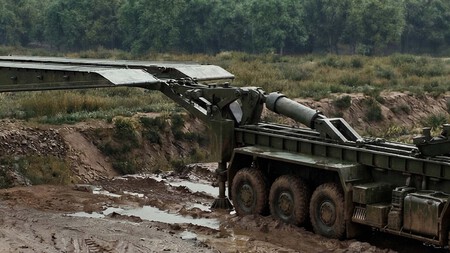
The cabin is armored to remain protected against threats, it can operate by day or by night, also in extreme weather conditions, and it has a dual-use capacity, that is, military and civilian, in the latter case, as a response to natural disasters.
In addition, it can move on roads by itself, but it is also designed to be transported by road, rail, and sea. According to Defensa.com, the first prototype should be ready before the end of the year, and, beware, because the design and manufacture are 100% Spanish.
It is planned that Indra will manufacture 32 units of this system by the end of 2030, all of them for the Ministry of Defense, which has reserved more than 315 million euros for its development, its procurement, and its long-term maintenance and logistical support.

“The Vehicle-launched Bridge on Wheels Program aims to provide 32 VLPRs to support units equipped with Wheeled Combat Vehicles (8×8) ‘Dragon,’ supplying the necessary crossing capability across breaches, with or without water, always with the aim of facilitating their own maneuver.”
“The new transportable and launchable bridge from a wheeled-drive vehicle is set to be the new Vanguard Bridge (PV) for units with wheeled platforms. Its operational framework contemplates all types of operations,” explains Royal Decree 915/2025, of October 14, published in the BOE on October 17, 2025.
Images | Indra