
We are facing one of the worst wildfires in recent years in terms of fires, yet we do not have enough resources to fight the blaze.
The Government has confirmed that only seven amphibious aircraft are available and soon there will be six, despite having promised 14 units to the autonomous communities.
The fleet is very old, but the new units will take years to arrive
Summer arrives and the pattern repeats every year: fires are a huge problem in Spain. Beyond the economic and natural losses, which are gravely serious year after year, the worst part is the loss of lives, such as the at least 12 people who died this Thursday in a forest fire in Los Gallardos, Almería.
We know that prevention during winter is essential to avoid these fires as much as possible and, if they occur, to minimize their consequences.

We also know that resources are fundamental to fighting these fires; however, according to El Mundo, the Government has acknowledged that there are only seven high-capacity amphibious aircraft (between 5,500 and 6,000 liters) operating to combat the fires, despite promising 14 units.
The same outlet asserts that three of these aircraft are not available because “they have suffered some kind of accident,” said the Secretary of State for the Environment, Hugo Morán, who also indicated that one of the seven FOCA amphibious aircraft in service will not be in service for long because it has only 10 flight hours left before retirement for maintenance.
When those 10 flight hours are completed, there will be six FOCA aircraft operational in Spain, at the time of year when they are most needed. And this year we are experiencing more fires than ever, as Morán told the media yesterday: “This year we have carried out 193 operations in support of the autonomous communities, compared to 88 last year, and the flight hours are 2,086: last year they were 764 hours.”
🟩 @Moran_Fernandez attends the media from the Center for Coordination of Forest Fires in Madrid
«This year we have carried out 193 operations in support of the autonomous communities, compared to 88 last year, and the flight hours are 2,086: last year they were 764 hours» pic.twitter.com/SDKInpjv8K— Transición Ecológica y Reto Demográfico (@mitecogob) July 9, 2026
As Infobae reports, in light of this scenario, Morán has called for rationing the use of these aircraft: the operation is under “enormous stress” since the start of summer, so “the capacity to respond must be dosed much more.” The problem is that this is not easy, and meanwhile, we continue waiting for the seven new high-capacity amphibious aircraft to join the national fleet, but they will not begin arriving until 2028. That year only one aircraft will be delivered, and the entire batch will be delivered by April 2031.
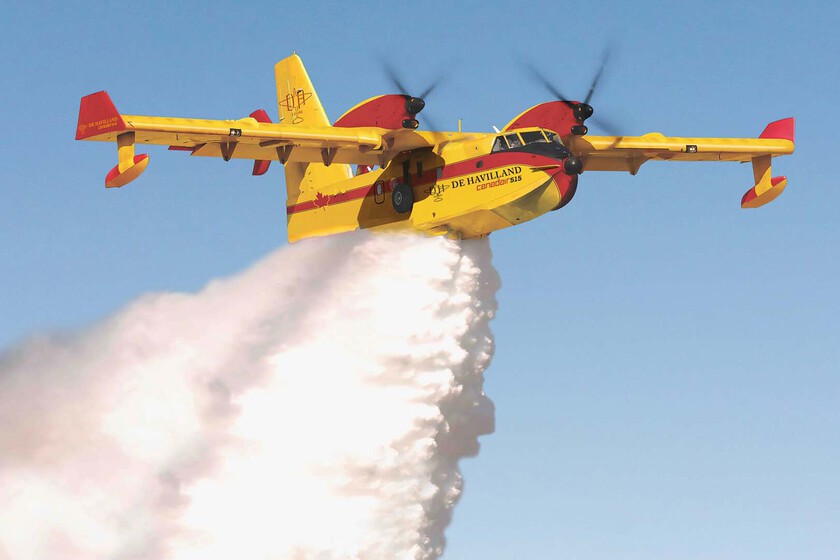
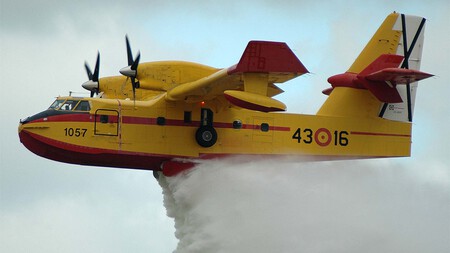
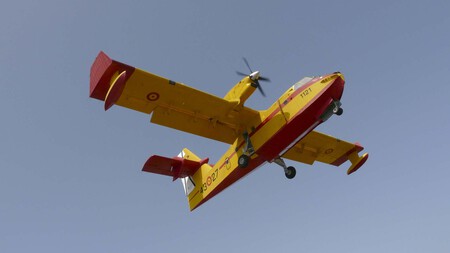
The few Canadair CL-215T and CL-415 we have are very old (hence several are out of service), and production ceased a long time ago. The aircraft that will begin arriving in 2028 are the new DHC-515s built by De Havilland Canada, and production did not start until a few months ago because the factory has suffered delays for years.
De Havilland Canada is the only company that manufactures these aircraft, so it has a global monopoly, and that is a major drawback. Since 2015 no planes of this type have been produced, and production has only now resumed, but all countries that want one, including Spain, are at the back of the line and must wait. No matter how much the Government wants to expand the elite amphibious fleet, it cannot do so now. Not France, nor any other country.
Other companies have noticed the niche opportunity, but they will take time to have their amphibious aircraft ready, as La Dépêche notes: the French Positive Aviation could have its FF72 operational with a capacity of 8,000 liters of water by the end of 2028, and Kepplair should put the Kepplair 72 into service in 2027, but it will not be an amphibious water bomber, although it is not strictly necessary, at least in the case of Spain.
Aerotec is also working on converting an Airbus A319 into a water bomber, but it is not ready yet. There are also plans for Hynaero to have a water bomber capable of 10 tons of water, but that would be by summer 2032.
In Spain we have the company Construcciones Aeronáuticas S.A. (CASA), now part of Airbus Military as Airbus Defence and Space, and it could take charge of producing aircraft of this type to reduce dependence on De Havilland Canada.
Moreover, these aircraft could be sold to other countries, as with the CASA C-295 (now Airbus C295) since it was introduced in 2000, but it seems that this will not happen, so we will continue to depend on De Havilland Canada while suffering a shortage of amphibious aircraft and fires multiplying each year, in number and severity.
And what about helicopters?
Be careful, large-capacity water bombing aircraft are no longer the only main players in the fight against large fires. In recent times, heavy and medium-heavy helicopters, such as the Super Puma or the Kamovs, have gained prominence, especially now that fires have evolved and are faster and more unpredictable because these helicopters take less time to re-arm and can be more useful, as they do not need to fly to a swamp, but can re-arm at cattle-water ponds or portable depots set up by soil crews.
The downside is that having your own fleet of helicopters is frankly complicated for a country like Spain and does not make a lot of sense either. The use of these aircraft to fight fires is completely seasonal in our country because the fire season lasts about four months; if the Government bought them, they would have to be idle for most of the year, though they would have to be stored and maintained, with the cost that entails.
The private companies that rent their helicopters keep them here for four months and then take them to other countries, usually in the southern hemisphere, to keep using them and not leave them idle. The advantage of renting them from these companies is that they handle maintenance and must respond to any technical issue. If the helicopters were owned by the Government and one suffered a breakdown, repairing it would be very costly and time-consuming.
It would also not be profitable for pilots specialized in flying these aircraft to be part of a military structure of a country, as is the case with the pilots of the 43rd Group of the Air Forces who fly the Government FOCA amphibious aircraft. There are very few people in the world trained for this, so it is a highly demanded and very well-paid job. The salaries of a pilot specialized in Public Administration could not compare.
Images | Wikipedia and De Havilland Canada