
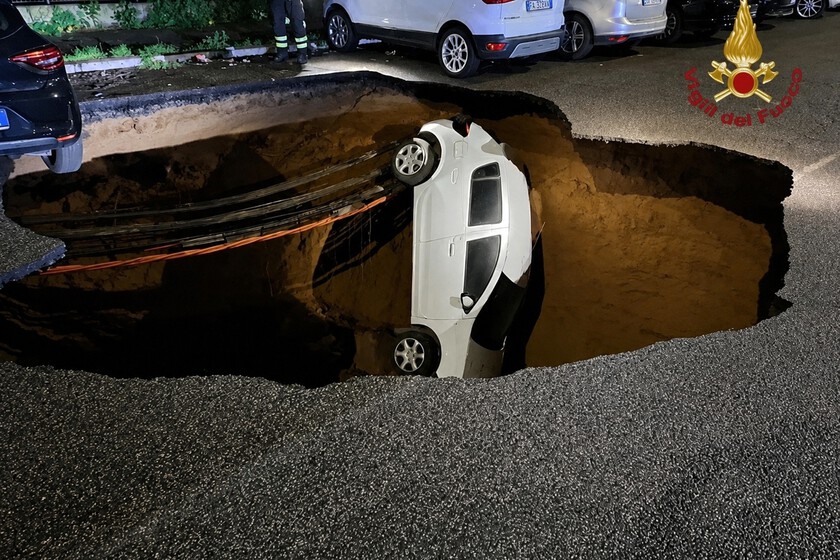
Imagine leaving your car parked and waking up the next day to find that it has been swallowed by a huge hole. That happened two years ago to two neighbors on Via Sestio Menas, in eastern Rome, when a sinkhole about ten meters deep opened beneath the roadway in the middle of the night. Far from being an isolated incident, that event ended up exposing a problem that has been hidden under the city for centuries.
Studies in the area have revealed a maze of underground galleries that already exceeds 15 km in length beneath Municipio V of Rome. The latest geotechnical reports produced this year confirm that this network continues to spread beneath streets and buildings, necessitating constant monitoring of zones with the highest risk of subsidence.
The quarries that built the Colosseum are now testing engineers
The reconstruction of Via Sestio extended for more than a year: in order to reopen it to traffic in April 2025, engineers carried out three geophysical investigation campaigns, 40 reconnaissance boreholes, and reinforced the ground by injecting about 2,600 cubic meters of concrete (the equivalent of around 200 concrete mixers). That intervention allowed them to grasp the true scale of the problem.
It is not a matter of old sewers or modern tunnels, but these cavities are the ancient puzolana quarries excavated by the Romans almost two millennia ago and they hold extraordinary value. This volcanic material, mixed with lime, enabled the production of the highly advanced Roman concrete with which monuments like the Colosseum, the Pantheon, and much of the aqueducts that still stand were built.
When mining ceased in many of those galleries, they were left empty and, over the centuries, they served as shelters during World War II and even became spaces for curious uses such as mushroom farming. Then came Rome’s urban expansion in the 20th century, and streets, buildings, and roads were constructed atop a subsurface filled with cavities excavated in volcanic rock.

Via Sestio Menas
Now the main enemy of these galleries is no longer time, but the heavy traffic of a big metropolis: according to specialists from the Rome City Hall, the constant vibrations caused by buses, trucks, and cars much heavier than those from a few decades ago accelerate the deterioration of these cavities and increase the risk of new sinkholes.
The eternal project that keeps a part of Rome split
The most complex example is currently on Via degli Angeli, the artery that connects the Torpignattara and Quadraro neighborhoods and which has been closed since February 2025. There, what began as a repair of a rainwater drainage line ended up uncovering a new network of Roman galleries about nine meters deep.
The investigations uncovered a serious problem with a main water pipe belonging to Acea, at roughly eight meters depth. To replace it, engineers must stabilize the ancient Roman galleries by excavating a second vertical access shaft that will allow filling the cavities safely and prevent a possible collapse of the roadway: thus, delays to the works were inevitable and the street remains divided in two in this eastern part of the Italian capital.
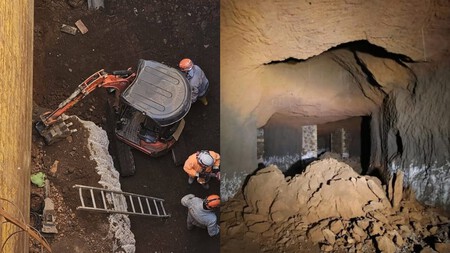
Via Buie d’Istria
But the most extreme example is, without a doubt, Via Buie d’Istria: after remaining closed for 11 years due to a major sinkhole, the street officially reopened to traffic on May 15 after a complex operation that combined geophysical studies, laser scanning, and filling the cavities for which 150 cement trucks were necessary.
Meanwhile, Civil Protection keeps permanent watch over the labyrinth discovered beneath Via Tor de’ Schiavi and continues mapping the streets with the highest risk of subsidence to anticipate new sinkholes. And two thousand years later, the galleries that helped build the Roman Empire are also one of the city’s greatest engineering challenges.
Images | Polizia Roma Capitale/dpa, Corriere, Roma Today