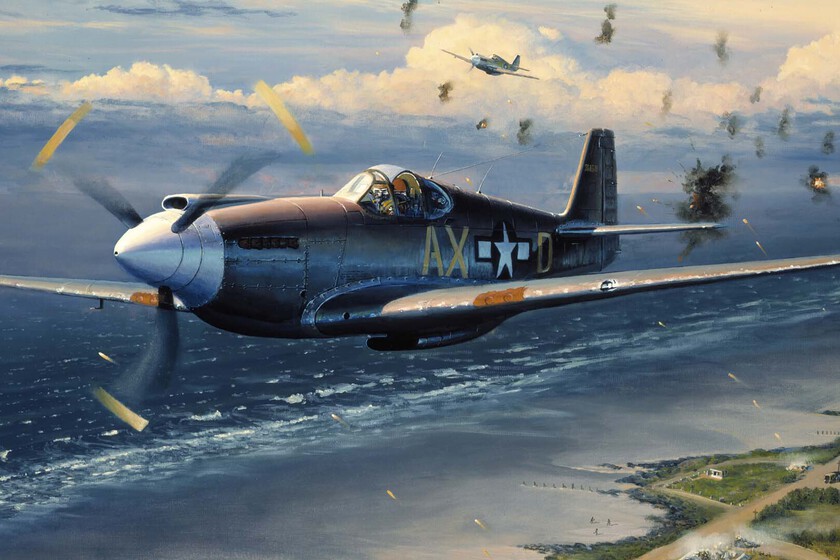
As in all modern wars, technology played a decisive role in World War II in tipping the balance in favor of the Allies. One of the keys that led them to win the conflict was the North American P-51 Mustang, an aircraft that many historians regard as the most decisive fighter of World War II.
North American Aviation designed it in 1940, and the United States Army Air Forces (USAAF) introduced it into combat in January 1942. From then on, it became the nightmare of Nazi pilots in the Luftwaffe.
When Aerodynamics Began to Determine the Outcome
Any enthusiast of the military realm, of airplanes, or simply of vehicles, knows that the North American P-51 Mustang is one of the most remarkable airplanes in history.
North American Aviation developed it in record time and from the outset impressed with its design: the fuselage was entirely metal, like the Messerschmitt, but the aerodynamic work was far more modern than that of any other combat aircraft.

Its standout feature was the laminar-flow wings. Unlike conventional wings, they featured a thicker section located far back, almost at the center of the wing, ensuring that air slid more smoothly and orderly for a longer period over the wing surface.
The advantage of this was twofold: it reduced aerodynamic drag, allowing the aircraft to reach higher speeds, while also making it more efficient and reducing fuel consumption.
The result was an extremely fast aircraft with a tremendous range. Thanks to that range, it was perfect for escort missions for which other contemporaries, such as the P-47, were not suitable, highlighting its role in Europe in protecting the B-17 and B-24 bombers.
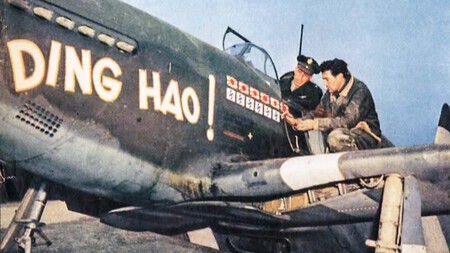
Unlike what happened in World War I, in World War II aerial combat evolved to move away from acrobatic skills and toward high-speed attacks in which fire was exchanged and altitude was gained repeatedly and rapidly.
The fastest aircraft with the most armament is the one that stood out, and the P-51 Mustang possessed both, especially as it evolved and its variants arrived, notably the P-51D Mustang.
Another key factor was the British Rolls-Royce Merlin engine, which was built in the United States under license by Packard. Early P-51s used Allison engines that performed well at low altitude but not so much at the altitude at which the bombers the Mustang had to escort flew, so the engine was changed to the legendary Merlin, allowing the P-51 to gain speed and performance at high altitude, surpassing Luftwaffe fighters.
The Secret of the Sheet Metal and Paint That Made It So Fast
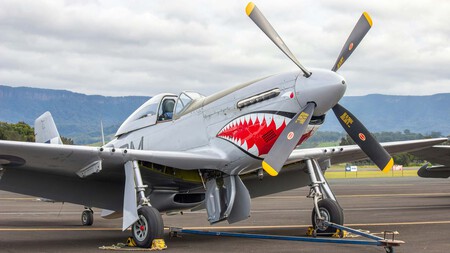
It also contributed to its ease of handling, especially after adopting a bubble canopy in the P-51D to improve the pilot’s visibility. Another advantage was that it was not too expensive to produce, at least by American standards; in fact, 15,875 units were built, and it was retired in 1984. The downside was that its production involved a process as intricate as it was decisive.
To make the most of its aerodynamics, the wing surface had to be extraordinarily smooth and that was the factory’s responsibility. Any imperfection, rivet head, or seam in the metal could disrupt the airflow and generate turbulence.
To achieve this, each unit underwent an exhaustive treatment in which the joints of the panels and the wing rivets were filled with putty. That putty was hand-sanded until the transition from one metal panel to another was completely imperceptible.
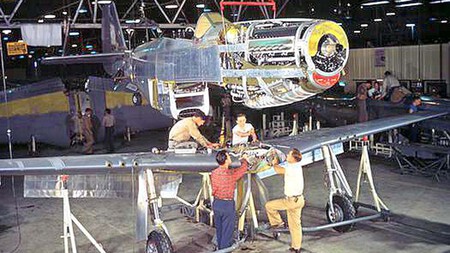
P-51 Mustang on the assembly line.
Finally, a coat of primer was applied and then it was painted with silver lacquer to seal everything and smooth the surface to the maximum. The remainder of the fuselage was left in bare metal.
During the war, on frontline airstrips, mechanics would check the wings whenever possible. Since any accumulation of dirt or even a glued-on insect could break the airflow and reduce aerodynamic efficiency, the wings were thoroughly cleaned and waxed to restore the smoothness they had when the aircraft left the factory.
Images | Unsplash and Wikipedia