
Turning the roof of electric vehicles into a small solar power plant full of panels to gain range (more or less like many camper vans do today) had its heyday some time ago. There were dozens of startups and manufacturers like Lightyear trying their luck with little success, although the idea isn’t dead yet.
Today, technology has advanced a lot: in recent years batteries have almost doubled their usable capacity and the most efficient electric cars now approach 800 real kilometers. But solar panels remain reserved for very specific applications, as we recently saw in Cuba, amid the country’s fuel crisis.
Another example is a German experiment that at the time managed to increase the range of a delivery van by about 30%, although this case had caveats.
The trick of solar panels integrated into the bodywork
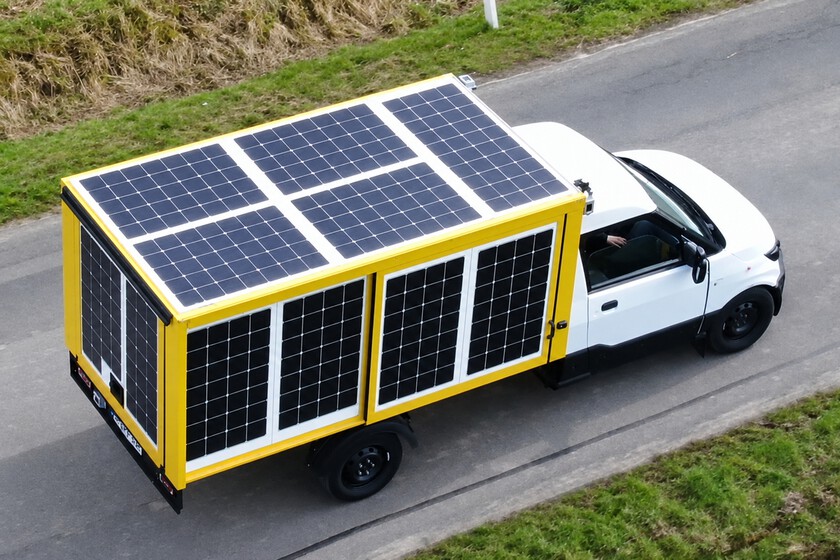
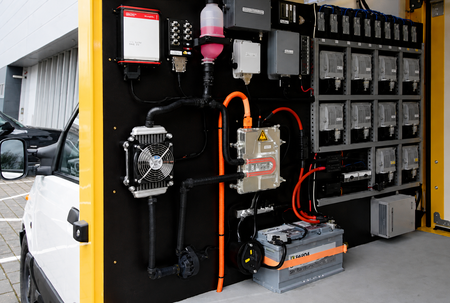
The study, conducted by researchers from the Gauss Centre for Supercomputing, the Institute for Solar Energy Research Hamelin (ISFH) and the German Ministry of Economy, turned a StreetScooter delivery EV into a lab on wheels. The van carried around 15 m2 of solar panels spread across the roof and the sides, with a combined power of 2.18 kW.
After four months of testing, from April to July 2021, the system generated about 129 kWh usable for the traction battery: that is, around 530 km of additional range or roughly 30% of the 1,750 kilometers covered during the trial. It was, in theory, a very promising demonstration of the potential of photovoltaic energy applied to an electric vehicle.

However, the researchers themselves made clear that “the result depended on very specific conditions.” The van spent a large part of the day completely idle (stayed parked about 93% of the analyzed time), always oriented toward the sun to receive maximum radiation and during the sunniest months of the year.
A scenario very different from that of any passenger car or even from most commercial vehicles, which spend much of the day on the move.
While the sun advanced little, the batteries made a huge leap
Nevertheless, perhaps the biggest difference compared to 2021 is not the solar panels, but the cars themselves: when that experiment was conducted, the StreetScooter used a battery of only 40 kWh. Today, in addition to much more evolved batteries, electric cars also consume far less energy.
The best test arrived last May with independent tests by the Norwegian automotive association, NAF: in real driving conditions, the BMW iX3 covered 781 km before coming to a complete stop, even slightly exceeding its WLTP-rated range. Several Chinese manufacturers also demonstrated that improvements in batteries, power electronics and aerodynamics are enabling hundreds of kilometers to be gained without needing solar panels.
In other words, integrating photovoltaic plates continues to add complexity, cost and a limited surface for energy harvesting, so the industry has chosen a far more effective way to extend range: building increasingly efficient cars. Today it is more profitable to shave a couple of kWh per 100 km from consumption than to try to recover that energy from the sun.
Solar panels still make sense, but depends where
That doesn’t mean solar energy applied to cars has failed: manufacturers like Mercedes keep researching solutions such as photovoltaic paints and new materials capable of generating electricity from the bodywork itself, while various European projects continue to explore its application in industrial vehicles.
And right there seems to be its greatest potential: vans, trucks, buses or vehicles that stay outdoors for long hours, which have much more surface area available and can use that energy to power auxiliary systems or reduce part of daily consumption.

Are you looking for your next electric car and feeling overwhelmed by so many options? It’s normal.
More than 45,000 readers have already tried it. And you?
Advice offered by the brand