
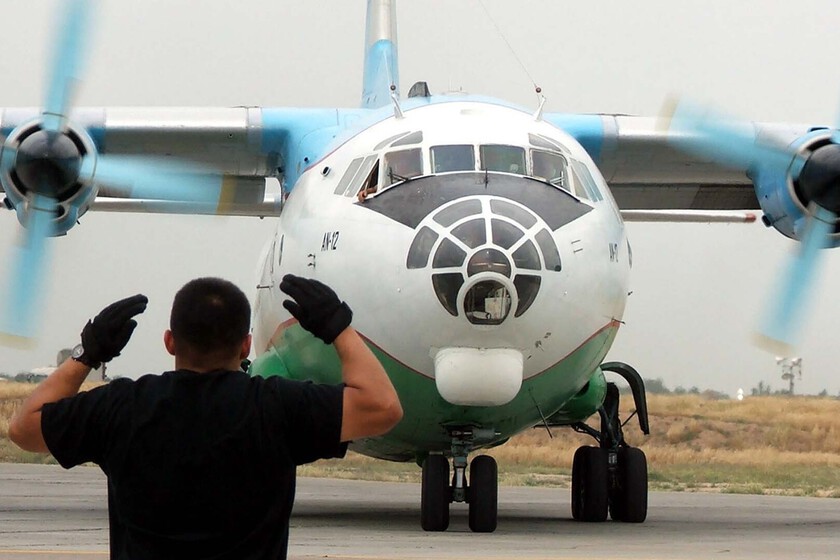
The Soviet military transport aircraft had a distinctive glass nose that made a lot of sense, especially in regions like the Arctic or Siberia.
Today, Russian aircraft are still built with this glass nose. It has much to do with the importance of redundancy in aviation.
A Design Driven by Pure Survival
In the thick of the and with the Soviet Union developing military transport aircraft to carry out logistical tasks across its vast territory. There were no advanced GPS systems as we have today, and in the Arctic or Siberia there were thousands of kilometers without radio aids, without ground-based control towers, or signals from ground radar to help pilots position themselves over those immense territories almost completely depopulated.
The solution was very simple: install a glass nose on the aircraft to gain a panoramic view from the ground and visually identify geographic features, such as rivers or mountains, that could serve as references to position themselves on a map in real time.

Inside that glass nose the pilots were not located: the cockpit was higher up. The person looking through the glass was an operator, and this part of the aircraft was called the navigator’s office (the operator was the navigator).
In addition to serving for navigation (hence its name), this glass nose fulfilled a key Soviet requirement: all their military aircraft had to be ready to land anywhere under wartime conditions, whether at a bombed airfield, a field in the middle of nowhere, snow, or ice.
From the glass nose, the navigator could see with panoramic precision to assess the state of the place where the aircraft would land and guide the pilots during the final approach, even in poor visibility.
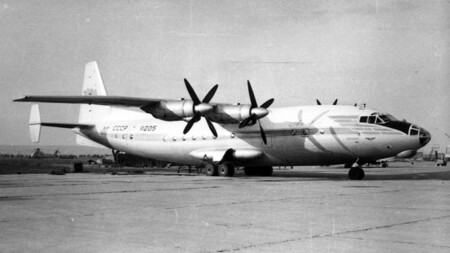
Although some of these aircraft also served civilian roles, they were conceived for military use, and that explains another function of the navigator’s office. To airdrop logistics or troops by parachute, everything had to be calculated with great precision: from the glass nose one could quickly locate the drop zone with accuracy to issue the jump or release order.
Some of the airplanes that featured this nose included the Antonov An-12 designed in the 1950s and 60s, the Ilyushin Il-76 from the 1970s, and the Antonov An-24- An-26 and An-30. The latter had an especially large glass nose because it was designed to carry out aerial mapping and topographic photography missions. Commercial passenger aircraft, such as the Tupolev Tu-104, the Tu-124 and the Tu-134, also had glass noses because they derived from military aircraft.
Note that this wasn’t exclusive to the Soviet Union. The first bombers with this type of nose appeared during World War II, and there were Western models, such as the Boeing B-17 Flying Fortress and B-29 Superfortress of the United States, or the Heinkel He 111 and Junkers Ju 88 of the German Luftwaffe.
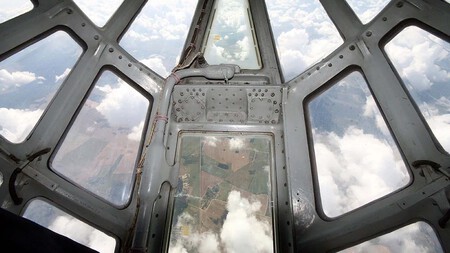
View from inside a glass-nosed aircraft.
Outside the Soviet Union, when GPS systems and weather radars appeared and spread, some of these aircraft were modified to replace the glass nose with the conventional radar nose found on modern planes. Many of the redesigned models were developed to carry this latter nose, but not all.
It’s Not Just A Matter of Saving Money
The Soviet Union also built planes without a glass nose, but it continued to manufacture several navigator’s office models, and Russia still does so with the modern Ilyushin Il-76MD-90A, introduced less than ten years ago. It is assumed that this aircraft carries a glass nose because the Russian military is obsessed with redundancy, and this nose offers unparalleled visual redundancy.
There is another explanation: in the event of electronic warfare, the first thing that would disappear would be satellite signals and the Western GPS, and Russia’s GLONASS would stop functioning. Additionally, ground radar stations would quickly be destroyed.
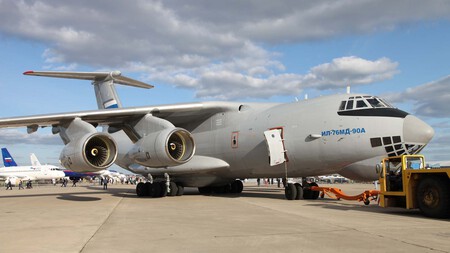
New Ilyushin Il-76MD-90A
The aircraft would be blinded, but it wouldn’t be as dire with a glass nose: as long as someone has direct line-of-sight to the terrain from inside the aircraft, navigation could continue. Let’s say this cockpit guarantees that it is possible to fly even if modern technology fails.
Moreover, Russia still dominates vast stretches of harsh and sparsely populated terrain. In these areas, contact with the ground is not guaranteed, and fierce snowstorms can blind the aircraft’s weather radars, making the navigator’s role essential.
And there is another reason Russia continues to use these noses: removing them would require reworking the original aircraft’s structural design, resulting in enormous costs for development, aerodynamics testing, and certifications. It is cheaper to keep this component in place.
Images | Wikipedia and Reddit