
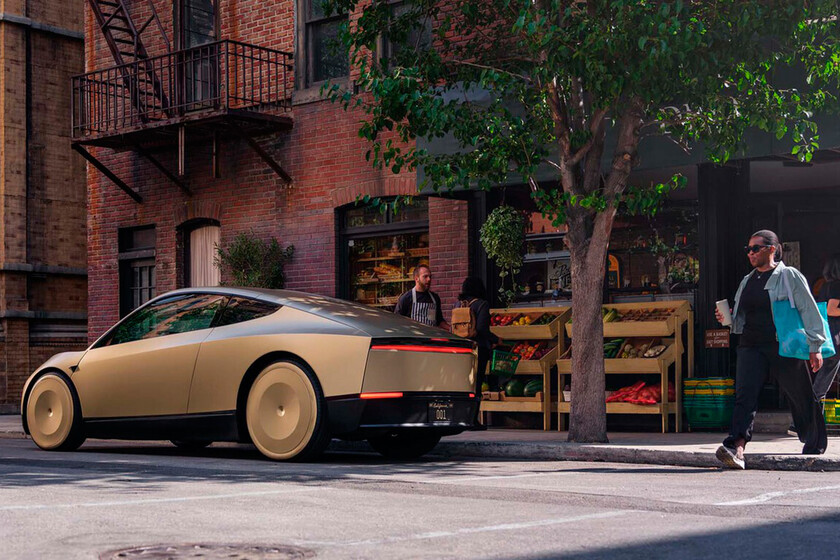
Tesla continues on the path to its new era: moving away from traditional electric cars to focus on autonomous robotaxi services and AI. The leading exponent of this shift is the Tesla Cybercab, unveiled in late 2024 and nearing the start of mass production. The company has just taken a crucial step: it has submitted the documentation for this car to the EPA, the United States Environmental Protection Agency, whose homologation cycle is the equivalent of WLTP.
The leaked documents have finally allowed us to learn several of its figures. Among them its range: 673 km between charges. The figure is striking given that its battery is small, typical of a small urban electric (similar to the Citroën ë-C3). But it is not the EPA’s final homologation figure. And it also raises a fundamental question: will it be operatively viable and profitable for a robotaxi?
Range of 673 km… but, in the laboratory
Until now, we knew relatively little about the Tesla Cybercab. It is a coupé-styled electric, somewhat smaller than the Model 3 and Model Y, with two seats and gull-wing doors. The trunk is fairly spacious and its main feature is that it lacks pedals and a steering wheel (although the test units did have these controls installed). In addition, its Full Self-Driving (FSD) autonomous system does not rely on LiDAR sensors but purely on cameras.
But thanks to this leak we now have relevant details. For example, it has a front-mounted permanent-magnet motor of 163 kW (222 HP). Or that its curb weight is 1,412 kg, which would make it the lightest electric vehicle among those sold in the US. And its maximum payload is 280 kg, distributed between passengers in the cabin and luggage in the trunk.
As with any electric, the most important component is the battery: lithium-ion, with a capacity of 146 ampere-hours and a voltage of 326 volts, which simplifies to 48 kWh. And we come to the autonomy: its combined range between charges is about 673 km and on highways around 604 km. Quite generous, and pointing to an efficient system managing those 222 HP of output. But this is not the figure that will actually be homologated.

The real figure: 470 km between charges. The data are provided by Tesla to the EPA, derived from laboratory testing and therefore under ideal conditions (temperature, speed, driving, no passengers, no wind or external factors…). The EPA homologation cycle, more demanding than the European WLTP, applies a correction factor to the laboratory result from the manufacturer. According to its official guide, it is common to apply a “factor of 0.7” to adjust all test parameters, including range. Therefore its homologated figure rounds to about 70% of the manufacturer’s claim.
That is, the 673.2 km of the mixed cycle translate into a range of around 471 km once corrected with the 0.7. In fact, a few days ago Tesla hinted that the Cybercab’s range would be around 480 km, so it is not off from the expected EPA-cycle range. It was also noted that, according to the EPA cycle, it would have a consumption of 10.25 kWh/100 km, which would elevate it as a record-setting vehicle for efficiency among EVs.
Will the Cybercab be viable as an autonomous taxi?
The Tesla Cybercab will essentially be an autonomous taxi, aimed at fleets and companies that offer this service, and which Tesla itself intends to capitalize on. And although it also aims to offer it to private individuals, letting them rent it as a kind of Airbnb for driverless taxi service, essentially it will be that: a taxi with no one at the wheel. Therefore its per-kilometer energy consumption and operating cost, as well as its payload capacity to transport people, are crucial.
On this last point, we have the announced maximum payload in weight and luggage: 280 kg. It is fairly tight when you compare it to a compact like the Dacia Sandero, which ranges between 400 and 480 kg depending on version and finish. But the Cybercab really only fits two passengers, plus their possible luggage. Even with two people around 90 kg each, there would be almost 100 kg left for suitcases. In this respect, it’s reasonable.
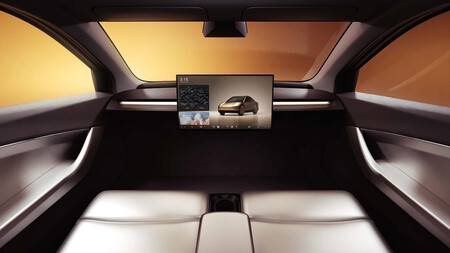
Small and inexpensive battery, but… Regarding the range, and even taking the EPA correction factor into account, with 471 km we would have a decent range for an urban robotaxi. While it is quite distant from the more than 530–750 km of, for example, the Model 3, it could cover many trips in a single day given its weight and transport capacity (people, luggage). And it is good efficiency for a 48 kWh battery, which will be cheaper than a large unit, and therefore key to reducing cost per kilometer.
Nevertheless, and even with the correction factor, the figure could be lower in real-world and heavy-use scenarios: traffic, air conditioning usage, and battery wear, etc. On the other hand, a battery so small in capacity depends heavily on the efficiency of the Full Self-Driving (FSD) in real conditions; any increase in consumption due to various factors would leave little margin, impacting the range.
In short, many questions remain unresolved, adding to the usual uncertainties with Tesla’s autonomous taxi: from its price at launch to whether its FSD is truly safe to operate among other cars, pedestrians, and rail or tram lines.

¿Buscas tu próximo coche eléctrico y estás sobrepasado con tanta opción? Es normal.
Más de 45.000 lectores ya lo han probado. ¿Y tú?
Consejo ofrecido por la marca