
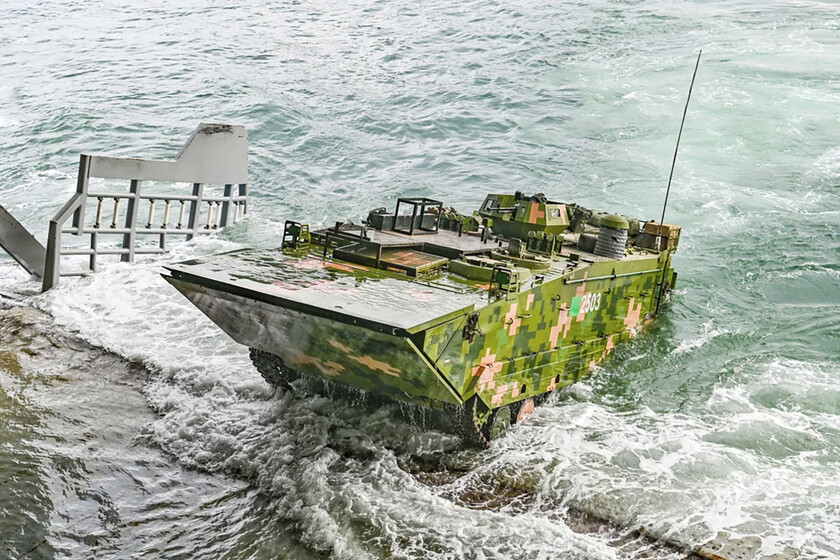
Dawn has just broken. The cargo hatch of the assault ship opens and light begins to flood in, but so do the waves. In the distance, the shore and, from the ship’s innards, tanks begin to emerge. Yes, armored with tracks that plunge into the sea, riding waves over two meters high.
They skim across the waves at nearly 45 km/h — an enormous speed for any vessel — and in the blink of an eye they have landed on the beach. They are the Type 05, ZBD-05 and ZTD-05, from the People’s Republic of China landing on Taiwan.
A Tank That Moves Like a Jet Ski
Armies design — or buy — their weapons to suit the most probable enemy. For the United States, that’s roughly any non-Western nation. For Europe, the most likely adversary is Russia. That’s why heavy tanks remain considered a core component of our defense, or why Saab designed its Gripen jets to repel a Russian invasion, capable of operating from even a small stretch of road if necessary. China designed the Type 05 with one objective: to be the first on Taiwan’s shores.
The Type 05 is arguably the most advanced family of amphibious combat vehicles in the world, and the weapon the People’s Liberation Army has spent years refining with a clearly defined goal in mind.

The Type 05 exists in two main variants. The ZBD-05 is an infantry fighting vehicle armed with a 30 mm autocannon and anti-tank missiles, capable of carrying up to eight fully equipped soldiers. The ZTD-05 is its larger brother: the same hull, but with a 105 mm cannon (the same caliber used by many light tanks) and, most impressively, it can fire accurately while the vehicle is moving.
What makes this family unique isn’t just the armament. It’s the speed on the water. A conventional armored vehicle moves at sea between 8 and 12 km/h, just enough to stay afloat. The Type 05 could reach 45 km/h (officially 30 km/h) thanks to a hull design based on hydroplaning.
The principle is the same as that of speed boats and competition sailboats: they employ submerged fins or wings beneath the hull. As speed increases, these fins generate lift and raise the hull entirely out of the water. This technology avoids the impact of waves. Two water-jet turbines, like those on jet skis, but delivering 1,475 hp mounted on the stern, allow it to reach 45 km/h. On land, it can exceed 65 km/h thanks to a 550 hp engine.
The design includes engineering solutions unusual for armored vehicles. The hydrofoils located on the bow and stern are extendable, to enable sea travel, and retractable once on land so it can operate as an infantry fighting vehicle.
No other country in the world manufactures something like this in series. The United States attempted to develop a similar concept — the Expeditionary Fighting Vehicle — but cancelled the program in 2011 after years of delays and cost overruns. Its current replacement, the Amphibious Combat Vehicle, gives up high-speed water travel. China not only did not cancel its program, but pushed it into mass production and is now working on the next generation.
In March 2025, leaked images showed prototypes of a successor to the Type 05 with an unmanned turret, that is, no visible crew positions, and what appears to be an active protection system capable of intercepting projectiles before they strike. The hull also incorporates changes in the wheel arrangement and in the rear flap aimed at further improving water performance.
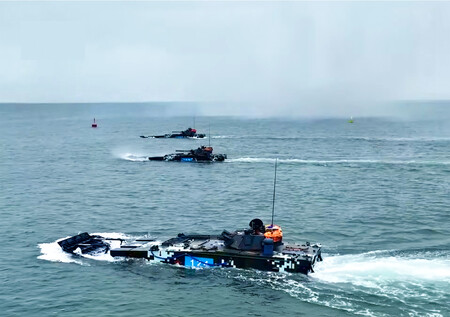
【Video】Charging through the waves—recently, an amphibious armored unit of the Chinese People’s Liberation Army (#PLA) conducted a naval formation training at sea. . pic.twitter.com/Lc2j8WI7D1
— Global Times (@globaltimesnews) July 10, 2025
The context in which all this unfolds is fairly clear: an invasion of Taiwan. The People’s Liberation Army has spent years intensifying amphibious assault drills. In May 2025, units from the Eastern Theater Command (the unit responsible for any operation across the strait separating China from Taiwan) carried out amphibious landing maneuvers using ZBD-05s in which coordination with aviation and naval forces was practiced.
On July 10, 2025, Global Times released images of a PLA Type 05 amphibious armored formation maneuvering at sea off the coast of Taiwan, which analysts described as a signal of escalation in amphibious readiness in the Taiwan Strait.
To increase transport capacity, China has begun integrating civilian ferries into its plans, capable of loading a significant number of vehicles and additional troops. A tactic that is part of its doctrine of using civilian vessels for military purposes, such as merchant ships that can launch missiles.
The Type 05 has not yet fired in real combat. But every exercise and every prototype leaked along the coast opposite Taiwan is a calculated demonstration that China has decided to build the capacity to do something no other army in the world can do: cross a sea strait at high speed with armored forces and reach the shore ready to engage.
Images | Mil.ru, China News Agency, eng.chinamil.com.cn