
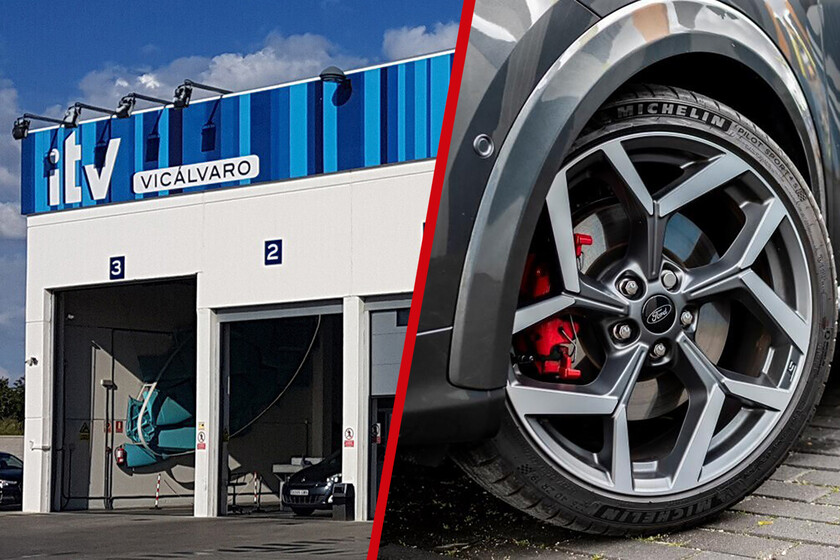
The ITV has long been measuring what comes out of the exhaust, but there is another type of pollution that cars generate while in motion and that is not controlled at ITV stations: the particles shed by tires as they roll and the brake pad dust every time we press the pedal.
And Europe has decided that the ITV could check to what extent our car releases those particles and that dust.
Europe Opens the Door for ITV to Monitor Tire and Brake Particles
The Euro 7 regulation, which comes into force in 2027, is the first European rule that requires homologating tires and brakes taking into account their wear emissions, not only their mechanical performance. This regulation will require, for example, braking emission limits (PM10 particles) of up to 7 mg/km for petrol, diesel, and hybrid cars and of 3 mg/km for pure electric vehicles.
That requirement is set in the type-approval phase, i.e., it is the responsibility of the manufacturer, both of the car and of the tire, so that they can be legally sold, not during its service life at the ITV.

What the regulation does contemplate is that these measurement methods, whether rollers, laser sensors, particle sampling, etc., could be used in the future for periodic technical inspections. What is the point of checking after the fact whether the tires meet the standard or not once installed on a car?
In the case of aftermarket tires, for example, outside those recommended by the car’s brand, one could proceed with such checks to ensure they align with the car manufacturer’s intended specifications. It could also help detect non-homologated tires.
For now, it’s only that, a technical possibility and not an obligation. And even less so with a date. In fact, no official Spanish body has announced when or how this possibility would be implemented at ITV stations.
And of course, if the inspection were to be applied at ITV, it would not be retroactive. Cars registered before 2027 would not have to undergo any such test at any point in their lifetime. Vehicles homologated under Euro 7 will not pass their first ITV until 2030 or 2031 at the earliest, which is when the regulatory timelines for the first inspection are met.
That ITV will monitor the particles released by our tires or brakes in all cars is not for tomorrow, if ever implemented. However, there is a very real underlying problem. The micro-particles of rubber and brake pad residues are small enough to penetrate the respiratory system and, according to some studies, could reach the bloodstream.
The brake pad dust can be more harmful than diesel particles, especially when the pads contain copper, an element that disrupts the normal functioning of lung tissue cells and is associated with diseases such as pulmonary fibrosis, lung cancer, or an adenocarcinoma.
Only in a country like France, the brake pads generate around 20,000 tons of airborne dust annually, of which 9,000 remain in the atmosphere, according to the National Institute of Applied Sciences in Lyon.