
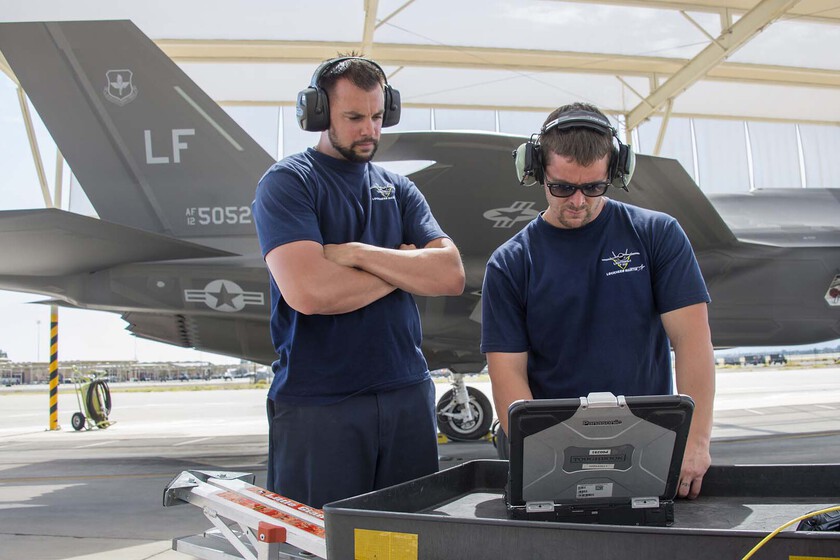
Today, the most advanced, modern, and expensive fighter jet in the world is the Lockheed Martin F-35 Lightning II, a single-seat fifth-generation fighter that comes in three variants: the F-35A for conventional takeoff and landing, the F-35B for short takeoffs and vertical landings, and the F-35C for carrier-based operations.
Each unit costs between 78 and 95 million dollars (depending on the variant) and the United States possesses the largest fleet of these aircraft in the world, with roughly 800 units. The problem is that most of them spend more time in the workshop than in the air.
A bottomless pit for the U.S. public coffers
It is estimated that the U.S. has spent so far more than 100 billion dollars to purchase the roughly 800 F-35 Lightning II aircraft from Lockheed Martin. But that is the cheap part of what is already the most expensive military program in history.
In addition, billions have been spent on the design and development of this model since the 1990s and, above all, the maintenance costs: about 1.6 trillion dollars in fuel, workshops, software, and spare parts. Each flight hour of an F-35 costs American taxpayers between $34,000 and $42,000.

But, beyond the maintenance spending, which is massive, the United States has a problem with this aircraft: its partial mission capability has fallen from 67% in 2021 to 44% in 2025.
What does this mean? Well, partial mission capability is the rate that determines whether the aircraft is ready for something, that is, it can fly and perform at least one of its tasks, but not all. With a 44% rate, it means more than half of the fleet cannot even perform a single basic task.
If we look at the full mission capability, that is, the rate that determines whether the aircraft is fully ready to perform all the missions it was designed for, the figures are more worrying: barely 25% of the U.S. F-35s are ready for full missions, whereas in 2021 that rate stood at 38%.
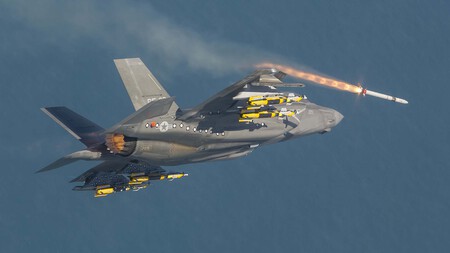
These are data from the GAO, the U.S. Government Accountability Office, which acts as a kind of public funds auditor. What these figures reveal is that, even though the U.S. has a large fleet of the world’s best fighter aircraft, most units are not ready to fly.
This is due to delays in the software that prevent many units from operating correctly, but also to a shortage of spare parts. The U.S. relies on private manufacturers for these replacements, mainly Lockheed Martin, which has admitted that there are 48 critical parts that its suppliers cannot produce at the required pace.
Among these parts are cockpit canopies: there is a constant stock shortage, and without this piece the aircraft cannot fly, so they stay on the ground.
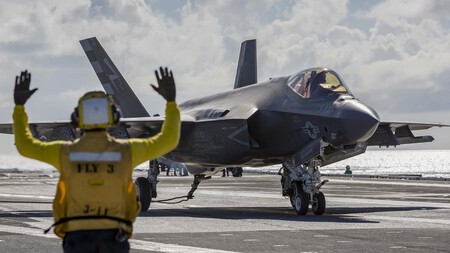
And there is another problem: corrosion. Because of the climate and the aircraft’s own use, some materials of this plane wear down and affect its structure, so they must be replaced with new ones. And that brings back the previous issue: the lack of parts.
“The F-35 is the most expensive weapons system in the Department of Defense, but it has not met performance targets, and the costs to maintain the aircraft keep rising,” notes the GAO.
To tackle this enormous and costly problem, the Department of Defense has launched a new strategy to improve the F-35 program ahead of 2030. It will cost another $13.7 billion and its aim is to “address the challenges we’ve identified, such as the shortfall of spare parts,” according to the GAO.
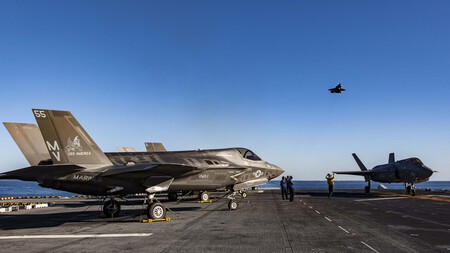
Beyond the logistical problem, there is also a financial issue because the GAO asserts that the Department of Defense has paid private companies handling the F-35 hundreds of millions since 2020 to improve the F-35’s readiness.
The point is that that money has gone to waste because it has not yielded any improvement. The most striking part is that the United States plans to buy around 1,700 more F-35s by the middle of the next decade.
Images | Lockheed Martin