In the 1960s, French carmakers began to build models that embodied freedom and, to some extent, the adventurous spirit with their open-top bodies. The most successful model was the Citroën Mehari, but there was another Renault-based approach with a similar concept that remains largely unknown today because its commercial success was very limited: the Renault 4 Plein Air.
Reviving the spirit of that original 1968 model, and also of all Renault 4 variants with canvas roof or glass double roofs that were launched over the years, now comes the Renault 4 E-Tech Plein Sud, an almost convertible version of the Renault 4 E-Tech electric that went on sale last year.
A Huge Fabric Roof

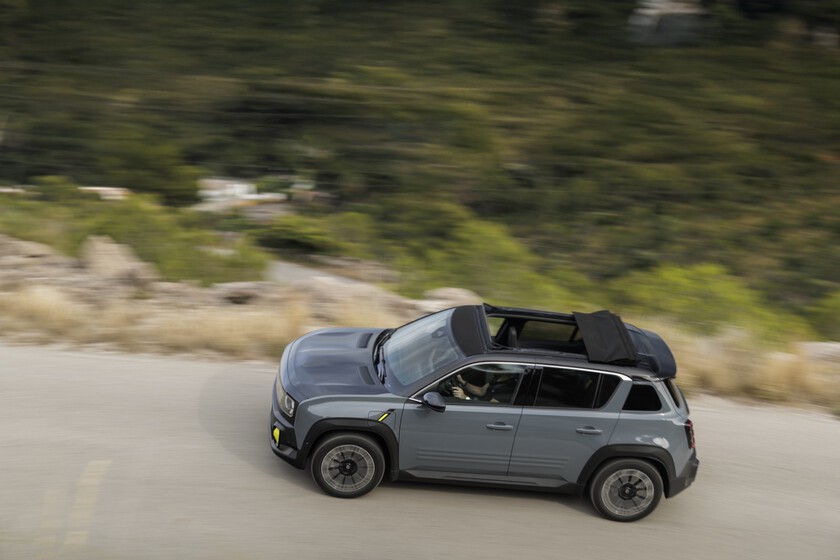
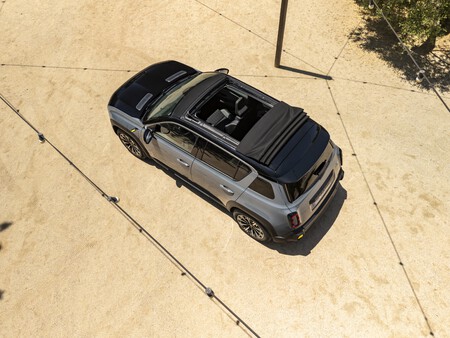
The principal novelty of this Plein Sud version is that its minivan-type body now incorporates a retractable fabric roof. With an opening that allows it to open 92 cm toward the rear and 80 cm in width so that occupants in both the front and rear seats can enjoy driving as if they were in a convertible, it is fair to refer to it as a standalone version apart from the standard model.
It represents the largest opening surface for a roof of this type in A- or B-segment cars, since others like the Fiat 500 Cabrio that also adopt a similar solution have a smaller opening. This is not the case with the MINI Convertible, which still opens completely.
Additionally, it should be noted that the convertibles segment is becoming increasingly smaller, and the offering is shrinking year after year. Gone are the days when all manufacturers, from premium to mainstream and even those in the luxury segment, had in their portfolios multiple models with a canvas roof (and even the dull hard tops), offering two or three options for those who wanted to enjoy open air.
That is why this R4 Plein Sud will enter the market as an alternative to cars like the Fiat 500 C or the Volkswagen T-Roc Cabrio.
City and Highway Driving
When driving it with the roof closed, the interior sound level is very low, something that is also helped by its electric nature. There is no greater aerodynamic noise than in the closed version, nor, of course, any mechanical roar that would spoil the on-board experience.
One potential tendency, however, is that the fabric roof may make the cabin more sensitive to extreme temperatures, since when we tested the car the outside temperature was 36 degrees and the cabin became somewhat warm after being left in the sun for an hour. We will need to test this more thoroughly, although to be fair that also happens in a closed car.
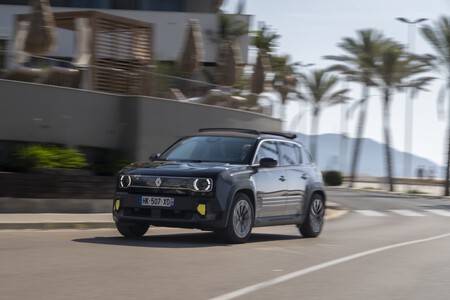
To open the roof, you can do it while stationary, as expected, or while driving, provided you do not exceed 90 km/h. There are two main ways to open it: by pressing the button on the roof or via a voice command. If we opt for the first option, a quick press on the button will activate the automatic opening, in which the roof folds back. It does not fully open on its own, because if we want to open the full 92 cm that is advertised, you must press the button a second time so that the rear-seat occupants also enjoy the open roof.
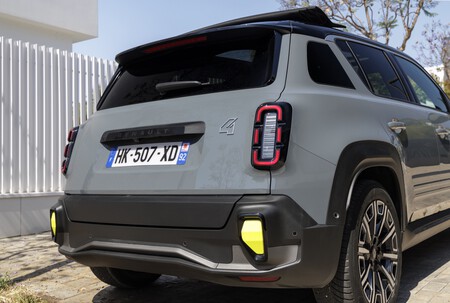
The other option is to give a voice command to the car to open the roof. When the fabric begins to retract, an arch with a plastic profile and fabric rises, a key element to prevent turbulence and excessive air from rushing into the cabin.
When the roof is retracted, it forms only three folds at the rear and hardly increases the car’s height.
At low speeds, the experience aboard with the roof open is pleasant. You feel the air, but you are not exposed as you would be in a conventional convertible.
We tested it through the streets of Sitges and the experience was positive. Oh, and people turned their heads as we passed, and many of the tourists there, some of them French, clearly recognized it as an R4.
We also took it onto the highway, and at higher speeds the experience remains more than satisfactory. Until 120 km/h the aerodynamic noise is more than acceptable, and only beyond that does it start to cloud the experience a bit, making it a little harder to hold a normal conversation with our companion.
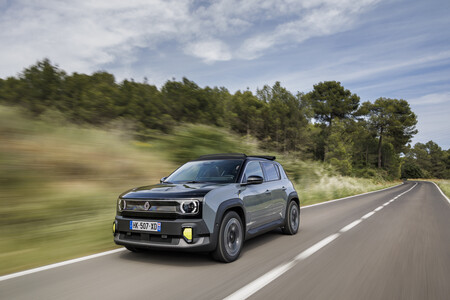
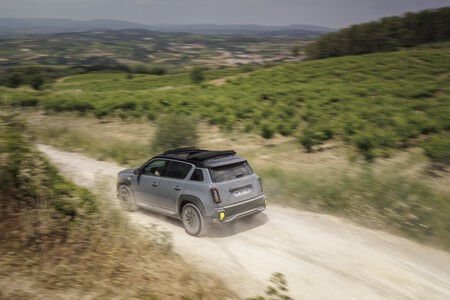
We also tested the car on winding roads and even on a dirt track. We did this to evaluate the Extended Grip feature, which helps improve traction in low-grip situations. The system basically consists of two new driving modes that can be selected from the control to the right of the steering wheel: Snow and All-Terrain. In each of them, power and torque delivery are slightly adjusted to favor grip in areas where you need a softer, finer driving style for the car to move forward properly.
Additionally, it adds a very interesting option when equipped with 20-inch wheels and all-season tires; in the unit we tested, superb Goodyear Vector 4Season. After a 15 km run on a dirt track, it became clear to me that, although not its main purpose, the R4 E-Tech Plein Sud can handle small forays into the countryside without issue.
A single version with a 7% lower range and the same performance
Otherwise, the Renault 4 E-Tech Plein Sud is marketed with a single motor-and-battery combination. The 52 kWh battery is paired with the 110 kW motor and achieves a WLTP range of up to 392 km (−7%), as the main car data remain almost unchanged in terms of weight (+19 kilograms) and aerodynamic coefficient, which suffers a slight increase in CdA (from 0.762 to 0.778).
The same goes for the performance, which are identical to those of the closed version with this powertrain: 0–100 km/h in 8.2 seconds, 80–120 km/h in 6.4 seconds and an electronically limited top speed of 150 km/h.
€1,800 premium
With all this, Renault brings to market an interesting version for a car—the R4—that has the lowest commercial performance among these revivals of iconic models launched recently, alongside the R5 and Twingo E-Tech.
I dare say that the Renault 4 E-Tech Plein Sud, with its premium of only €1,800—barely equivalent to what a panoramic roof costs as an option on any other car—will be a choice that enjoys good market reception and, hopefully, gives the R4 a commercial push, since its size, practicality and concept make it even more sensible than some of its siblings in the range.

Looking for your next electric car and feeling overwhelmed by so many options? It’s normal.
More than 45,000 readers have already tried it. And you?
Advice offered by the brand