
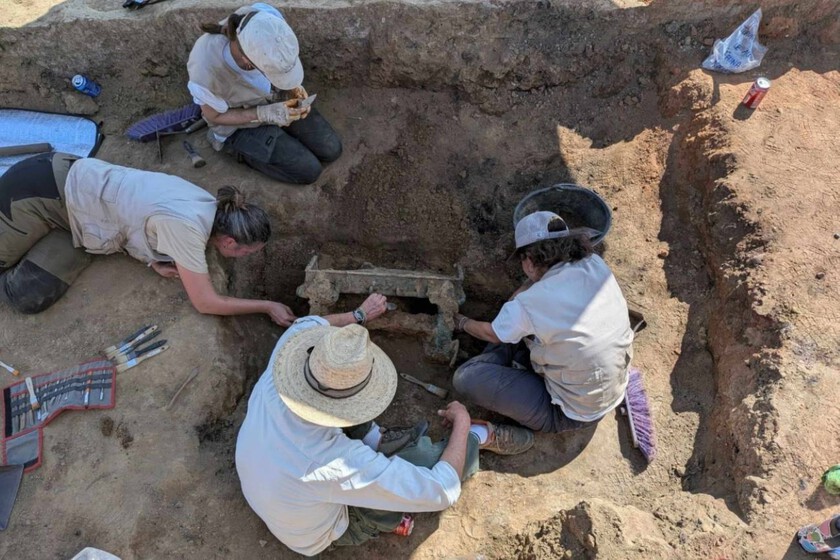
One might think that importing an exclusive vehicle from Italy is a very modern habit, but it turns out that about 2,500 years ago the elites of the Iberian Peninsula were already seeking to distinguish themselves with pieces arriving from across the Mediterranean. And in the end these pieces symbolized exactly the same thing: power, wealth, and prestige.
The eighth campaign of excavations at the Tartessian site of Casas del Turuñuelo, in Guareña (Badajoz), has brought to light a spectacular bronze ceremonial cart whose structure and decoration have no precedent on the Iberian Peninsula. The find not only adds an exceptional piece to the archaeological heritage: it also confirms that Tartessos actively participated in the major Mediterranean trade networks during the 5th century BCE.
A jewel of 5th-century BCE engineering arriving from Etruscan Italy
The discovery, made by the Institute of Archaeology of Mérida (a mixed CSIC-Junta de Extremadura center), dates to roughly half of a ceremonial cart. Specifically, two wheels and much of the main body have been preserved, enough to appreciate a sophisticated manufacturing technology based on the assembly of numerous bronze elements using iron components, a technical solution quite unusual for the period.

Its artistic richness is equally striking, for on the front is depicted Achelous: a river deity well known in Greek and Etruscan cultures and linked to the underworld. The sides are headed by two griffins with eagle heads and lion bodies, while two male figures of Atlantean type support the structure. “It is one of the most relevant finds made to date at this Tartessian site,” emphasized Esther Rodríguez, co-director of the excavations.
The only comparable wagons known to date come from ancient Etruria, in central Italy, so that parallel reinforces the hypothesis that the piece reached Tartessos as an item reserved for elites. In doing so, it undermines the image of an isolated civilization and confirms that the southwestern Iberian Peninsula maintained stable commercial contacts with some of the major economic and cultural centers of the Mediterranean.

And the cart did not appear alone: alongside it were recovered ceramics imported from the Attica region of Greece, an alabaster vessel manufactured in Egypt, and Oriental ivories decorated with warriors, animals and vegetal motifs. According to Esther Rodríguez, “this ensemble is providing extraordinary information” to reconstruct the trade relations between the East and the Iberian Peninsula and understand how luxury objects circulated 2,500 years ago.
The place where it was found also helps to understand its function, for the cart stood next to the so-called “banquet room,” a ceremonial space where years earlier an altar in the shape of a bull hide had already been discovered. Sebastián Celestino, co-director of the project, believes the cart was linked to ritual activities and that it formed part of the grand banquet held by the community before sealing the building deliberately under a tumulus of about 90 meters in diameter and six meters high.

This finding at Casas del Turuñuelo is surely not going to be the last, as the site has been surprising archaeology for more than a decade. There, the greatest ritual animal sacrifice documented in the western Mediterranean, the earliest known human representations of Tartessos, a slate plaque with southern paleohispanic writing, and the oldest Greek marble altar found in this part of the Mediterranean have already emerged.
This new ceremonial cart confirms that the site remains an inexhaustible source of discoveries capable of changing our view of one of the most fascinating civilizations of Antiquity.
Images | CSIC