
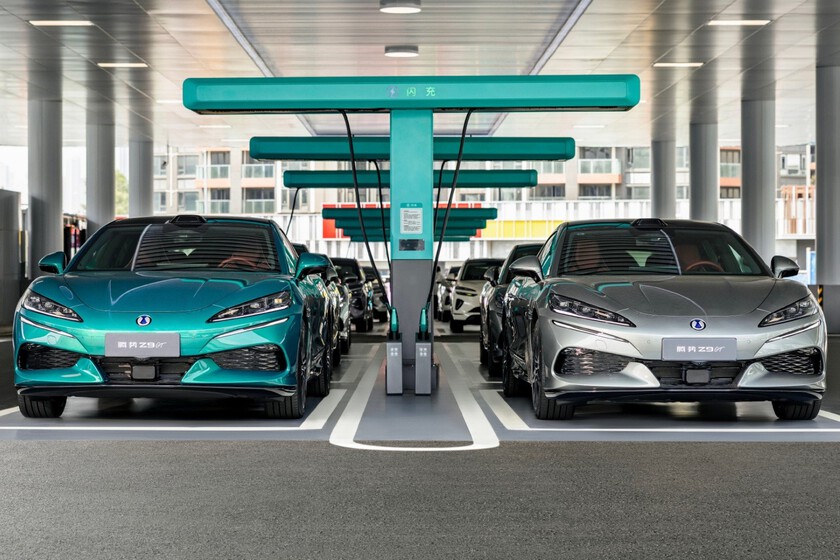
One of the major psychological barriers to taking the leap into an electric car has always been range anxiety. The obsession with avoiding a breakdown has pushed many drivers to demand gigantic 100 kWh or larger batteries, falling into what the industry now wryly calls “hot dog anxiety”: getting stuck in the service area, eating more than necessary and wasting time while charging energy that isn’t really needed.
It is the price of the “just in case,” a fairly irrational toll if we consider that in Spain most everyday journeys are already more than covered by current electric vehicles. But the real problem was never the range, but the charging time: in an attempt to match these times with those of a gasoline-powered car, the industry has just entered a new era with ultra-fast chargers of up to one megawatt (MW), capable of filling the cells in a matter of minutes.
A revolution that, however, is being cooked at two very different speeds depending on the market: while in the US the infrastructure is progressing much faster than its own cars, Europe is achieving a more synchronized pace, preparing its grids and manufacturers to take advantage of this energy surge from day one.
Europe begins to approach the Chinese model of ultra-fast charging
In the US, chargers between 600 kW and 1.2 MW are being deployed by companies such as ChargePoint, ABB, Kempower or Alpitronic, but the problem is that virtually no current electric car sold there can take advantage of such power (even flagship models barely exceed 400 kW in real terms). As Seth Cutler, CEO of the Ionna network, told InsideEVs: “To dance a tango you need two.” The infrastructure exists, but the cars are not yet ready.
Europe, by contrast, is following a somewhat more synchronized strategy and increasingly moving closer to the Chinese model, while saving the differences. Networks such as IONITY have already begun deploying chargers up to 600 kW based on Alpitronic HYC1000 technology, first in France and soon in other European corridors. And here, cars prepared to take advantage of part of that power are beginning to arrive.

BYD, Mercedes-Benz, BMW and several premium Chinese brands such as Denza (BYD Group) are already working with electrical architectures of 800 and up to 1,000 volts capable of surpassing 400 kW of charging. That changes the travel experience completely: instead of compensating waits with enormous batteries, the key becomes recovering hundreds of kilometers in a very short time.
Moreover, these next-generation stations also solve another major historical problem of fast charging: saturation. Thanks to what is called dynamic balancing, power is distributed intelligently among multiple cars, so that a basic city car can charge at its modest 50 kW while a state-of-the-art electric vehicle continues to absorb more than 350 kW without slowing down the entire station.
Spain’s paradox: record ultrafast chargers, but one in four still off
The case of Spain perfectly reflects this transition toward high power, though it still carries a significant burden compared to the European average. According to data from ANFAC’s latest Barometer of Electromobility, one in four charging points installed in the country remains out of service due to administrative slowness and lack of interoperability.
Nevertheless, the quality of the network that does work is delivering a spectacular turnaround: in the first quarter of 2026 alone, 309 new chargers of more than 250 kW have been inaugurated, a brutal figure that nearly accounts for half of all those deployed during the previous year.

This massive deployment will make real sense with the rise of electric trucks, and for this Europe is already accelerating the rollout of the MCS (Megawatt Charging System) standard for electric trucks, especially on logistics corridors and highways. The goal is to ensure that a semi-trailer recovers enough autonomy to continue its route within the driver’s mandatory 45-minute rest break; a goal that now seemed like science fiction.
The race for the electric car is no longer won by stuffing gigantic, heavy batteries under the vehicle to calm our fears; now the real triumph lies in slashing the waiting time at the plug so that stopping to recharge is simply identical to stopping to refuel. And for the first time in a long while, Europe has the right cards to lead that game.
Find your ideal electric car

If you have considered buying an electric car, this will interest you. We have created the Personalized Electric Car Recommender, in which, in addition to seeing models that fit your needs, you will also get answers to questions that worry you the most, such as price, range, or nearby charging points.

Are you looking for your next electric car and overwhelmed by so many options? It’s normal.
More than 45,000 readers have already tried it. What about you?
Advice offered by the brand