
Australia has spent almost a decade immersed in the construction of one of the largest energy projects in its history. Named Snowy 2.0, it intends to connect two reservoirs separated by nearly 30 km through a network of tunnels, and in turn with an underground power station almost 1 km beneath the surface. Its aim: to serve as a gigantic water battery to manage renewable energy.
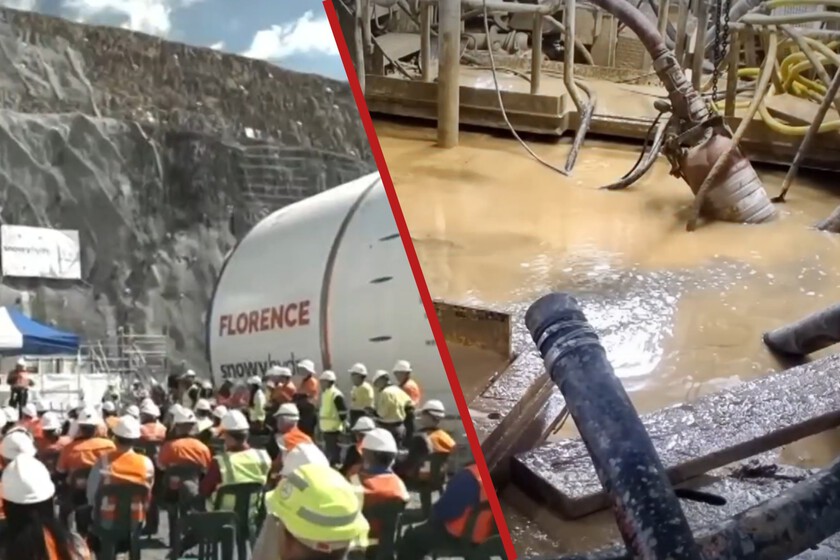
Cost overruns and delays have been the hallmark of this ambitious renewable energy plan: the initial price tag hovered around AUD 2,000 million, but it is estimated to exceed AUD 40,000 million. Its great Achilles’ heel: the Florence tunnel-boring machine, which got trapped in the mud for a year and a half.
A water battery as ambitious as it is complicated
The idea lingered for nearly three decades, but it was in 2017 when the Australian government announced the Snowy Hydro 2.0 project, under the management of Snowy Hydro. It is located in the Snowy Mountains (Snowy Mountains – New South Wales), and it aspires to be one of the world’s largest underground pumped storage hydroelectric systems.
It is as ambitious as it is complex: this megaproject for pumped hydro will connect two reservoirs, the upper Tantangara and the lower Talbingo. They are 27 km apart, beneath the mountains. Its third component is a power station, 800 m underground. The long network of tunnels runs beneath Kosciuszko National Park.

Its aim is to operate as a colossal “water battery” to balance the intermittent production inherent to renewables. When there is a surplus due to high solar or wind generation, the water will be pumped up to the upper reservoir to store it. When electricity demand rises, the process is reversed, letting water descend to the lower reservoir, driving the turbines of the underground plant and generating electricity. When completed, it is expected to provide up to 2,200 MW to the national grid. Sufficient, they promise, to take on around 10% of Australian peak demand.
The Florence drama: the tunnel-boring machine that couldn’t handle rock and mud
Poor planning has been the major problem for this project: the geological conditions of the excavation ground for the tunnels were not properly assessed. In 2021, after years of site preparation and tenders, the three TBMs (Tunnel Boring Machines) began operating to make the tunnels a reality. Among them Florence.
This enormous TBM, more than 11 m in diameter, began digging in March 2022, but got stuck two months later after encountering soft and clayey ground. The recovery operations were complex, extending for months: Florence spent most of 2023 jammed in the mud, also causing a subsidence in Kosciuszko National Park. It regained momentum in December 2023, drilling about six meters per day, until May 2024 when it got stuck again. This time it encountered hard rock. It ended damaged, and work had to be paused once more. To free it, they used high-pressure jets.
The solution finally was to buy a fourth tunnel-boring machine: Monica. More advanced, it is designed to overcome the most complex geological zone of the route. The decision was made in 2024, following Florence’s futile efforts. But it wasn’t until February of this year that this new TBM, 178 m long, was unveiled, and it has begun drilling. It cost around AUD 75 million.
From 1.2 billion to 7.3 billion euros, and rising
Snowy Hydro 2.0 has been marked by multiple delays and a bill that has kept climbing relative to the initial budget. Not only due to Florence, the project has faced safety issues: from toxic gases found in the tunnels to the explosion of an industrial fan. It has also confronted a strike: at the end of January 2025, workers protested because shelter chambers, essential for safety in case of emergency, were not operational. And it has undergone audits for multiple breaches of requirements.
The estimated cost when the project was announced in 2017 was around AUD 2,000 million (about EUR 1.2 billion at the current exchange rate). But cost overruns are now around AUD 10,000 million, approaching AUD 12,000 million (about EUR 7.3 billion).
Although the final amount will be higher. The most critical voices estimate total project expenditures at around AUD 42,000 million. This figure includes AUD 20,000 million in direct costs, AUD 8,000 million in interest after years of construction, and another AUD 12,000 million corresponding to the portion of the project in the new transmission lines associated, such as Humelink and VNI West, originally tied to this project.
The new schedule is set for this enormous water battery to come into operation in 2028, provided it does not suffer further delays along the way. It is currently completed to about 70%.
Images | MegaBuilds on YouTube / Skynews Australia on YouTube, Snowy 2.0