
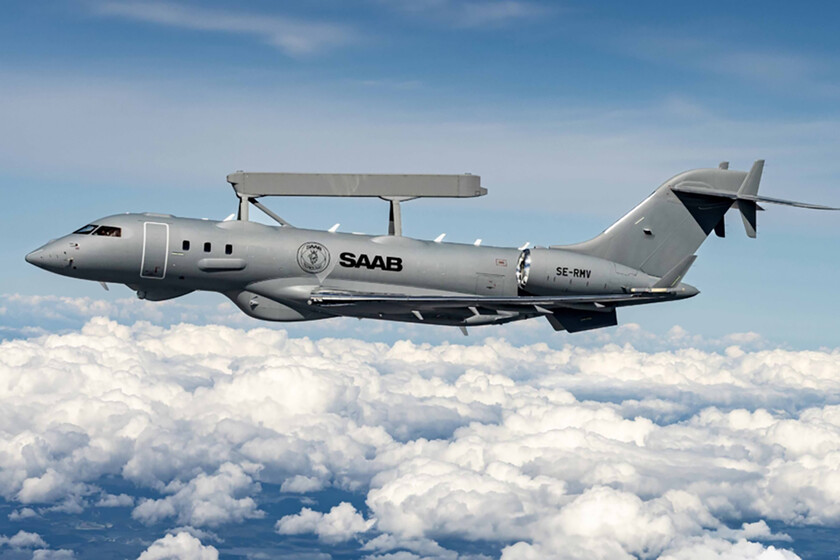
After rethinking its purchase of F-35 fighters, Canada moves away from the US again and chooses a European company for its defense. It has picked SAAB for its new spy aircraft, thereby increasing its strategic distance from the United States.
The North American country joins a growing list of nations that do not trust American aircraft and seek to shed their dependence on the US.
SAAB overtakes Boeing
Everyone understands the importance of fighters and bombers in an air force, but few grasp how essential radar aircraft are, for air traffic control, communications, and electronic warfare. From these aircraft, attacks or the defense of airspace are coordinated.
Until now, the United States’ allies have always relied on the Boeing E-3 Sentry, popularly known as AWACS (Airborne Warning and Control System), a Boeing 707 topped with a large dish. Now, most are turning to the SAAB GlobalEye for their radar aircraft.

Boeing E-3 Sentry, conocido como AWACS
Canada’s selection of the GlobalEye is not an isolated event. It is the latest link in a chain that in less than 18 months has made SAAB the reference supplier for NATO air surveillance, displacing Boeing from a segment it had controlled since the 1980s.
The GlobalEye is not a aircraft wholly built by SAAB. It began as a Bombardier Global 6000 or 6500, a private jet manufactured in Montreal, Canada, which SAAB acquired without equipment and subsequently transformed at its facilities in Sweden. There it installs the Erieye ER radar, maritime sensors, electronic intelligence, and a multi-domain command-and-control architecture capable of detecting threats at more than 650 kilometers.
The result is technically a Canadian aircraft with a Swedish mission system, which in the context of the sale to Canada carries an evident political reading. Ottawa thus funds domestic aerospace employment while reducing its dependence on American suppliers.

Until two years ago, the GlobalEye was operated only by the United Arab Emirates (five units) and Sweden, which ordered three in 2022. The turning point came in June 2025, when the U.S. Air Force dropped the E-7 Wedgetail, the successor to the E-3 Sentry, from its 2026 budget, opting for space surveillance and the E-2D Hawkeye (the radar aircraft carried aboard aircraft carriers).
Without U.S. financial and industrial backing, the E-7 became unviable for NATO. In November 2025, European allies formally canceled their joint purchase of the Wedgetail.
The gap left by Boeing was quickly filled by SAAB. France signed in December 2025 a contract for two GlobalEye valued at 1.1 billion euros, with an option for two more and deliveries planned between 2029 and 2032. The aircraft will replace the four Boeing E-3F operated by the French Air Force since the 1990s.
In April 2026, publications La Lettre and Hartpunkt, together with the DPA agency, reported that NATO’s procurement agency, the NSPA, had selected the GlobalEye to replace the fleet of 14 Boeing E-3 Sentry aircraft at Geilenkirchen (Germany), in service since 1982. The program would comprise between 10 and 12 aircraft at a unit cost of around 550 million euros, with a total value exceeding 5 billion euros.
Saab has confirmed that it has provided information to NATO, but notes that no contract has yet been signed. In addition, Canada is involved. Saab’s CEO, Micael Johansson, also pointed to solid interest from Poland and Germany in that aircraft during the first-quarter 2026 results presentation.
Images | Senior Airman Roslyn Ward (usaf.mil), GlobalEye, SAAB