
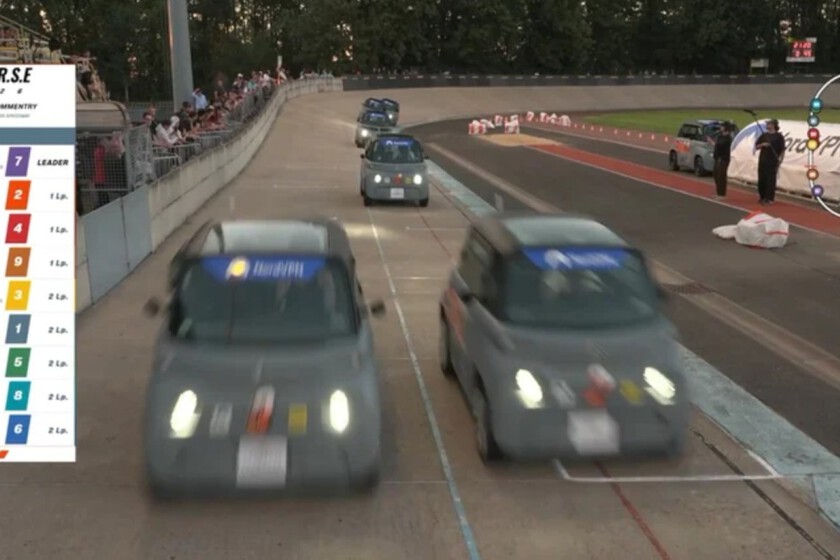
A Citroën Ami race has become one of the weekend’s viral phenomena in France. The person responsible has been Sylvain Lyve, a journalist and content creator specializing in motors who was part of ‘Vilebrequin’, the YouTube channel that for years stood as a reference for enthusiasts in the country.
Lyve brought together nine streamers and YouTubers at a velodrome to face a challenge that seemed much simpler than it really was: to complete 100 laps with modified Citroën Ami without letting the battery drop below 10%.
And what seemed absurd at first, in the end became a race marked by strategy, drafting, and a finish that kept the outcome in doubt until the last laps: his live stream ended up gathering about 150,000 live viewers on Twitch and racking up more than a million views in just a few days.
A race where strategy mattered more than speed
Dubbed L.A.C.O.U.R.S.E. (“L’Ami Challenge Original Ultra Racing Sport Event”), the event took place at the Stade Isidore Thivrier velodrome in Commentry, a 445-meter oval that proved perfect for the dimensions of the small French electric vehicle. On the track gathered well-known names from the French streaming scene such as Maxime Biaggi, Étoiles, Baghera, LittleBigWhale, or LeBouseuh.

Although the Citroën Ami is factory-limited to 45 km/h, for this competition the electronic restriction was removed and some cars reached nearly 60 km/h. Yet, speed was not the real challenge: the participants had to complete about 45 kilometers without the battery dropping below 10%, the moment when the car activates the well-known “turtle mode” and drastically reduces its performance.
That transformed the race into a constant exercise of calculation and triggered very different strategies: some tried to break away from the start, others opted to conserve energy and unleash the final attack. They also heavily leveraged drafting. Just as happens in other oval competitions like NASCAR (though greatly scaled down, of course), the drivers discovered that staying nose-to-tail with another Ami helped maintain speed and save energy.
The theory seemed simple, but in practice it proved far more chaotic and entertaining: the cars accumulated varying levels of wear and some units proved more efficient than others. Additionally, the banking of the velodrome and the deteriorated state of the track added an extra difficulty that no one had anticipated.
The finish arrived in the final laps, when several cars began to show worrying warnings on their dashboards. Against all odds, the nine Citroën Ami crossed the line. And the race also left a curiosity hard to imagine in any other context: one of the podium finishers didn’t even have a driving license.
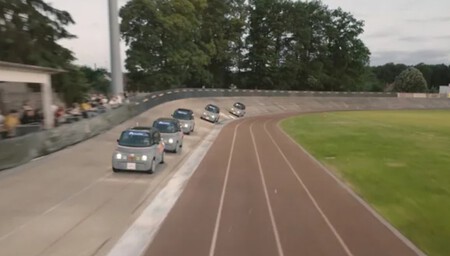
The victory went to Maxime Biaggi, followed by Étoiles and LittleBigWhale, but the real winner was the spectacle: a seemingly ridiculous idea that proved that to engage thousands of fans you don’t always need extreme supercars, but a good story and a challenge crazy enough to make people want to see how it ends.

Looking for your next electric car and overwhelmed by so many options? It’s normal.
More than 45,000 readers have already tried it. What about you?
Advice offered by the brand