
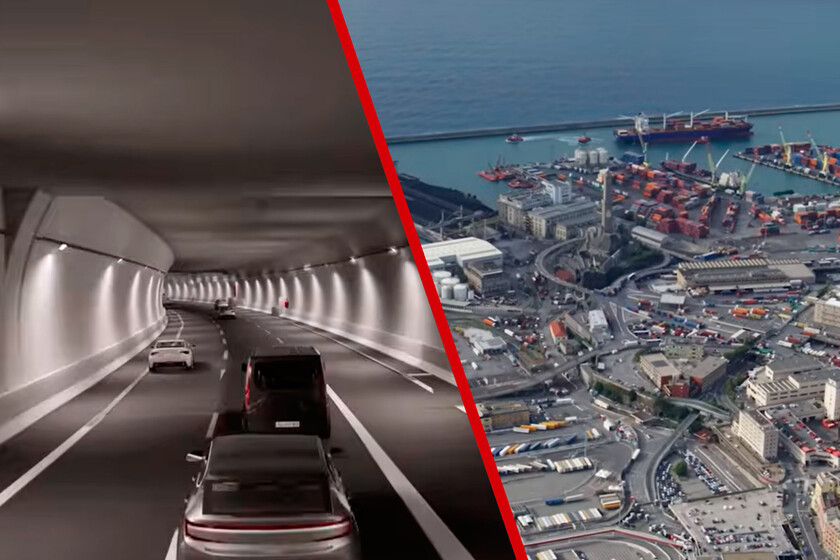
In Genoa a colossal tunnel is being built beneath the seabed, one of the longest of its kind in Europe. It crosses the sprawling port of this Italian city. The full bidding for the project was approved this year, 2026, although preparatory work began two years earlier. A massive and advanced tunnel-boring machine excavates it while it constructs the tunnel: as if it were the metro, but up to 45 meters below the sea.
The budget for this titanic and complex submarine Genoese tunnel has been set at around €1 billion, which will be borne entirely by Autostrade per l’Italia (Aspi). It was the builder of the Morandi bridge, which collapsed in 2018 leaving 43 dead. This tunnel is, in effect, the compensation to Genoa from this company after the tragedy.
Digging Under Italy’s Largest Port
The Tunnel Subportuale di Genova is one of the most ambitious civil works Italy currently has underway. It will connect the western Genoa port with the eastern Genoa port. In total its submerged length under the seabed is 3.4 km, with a total route of 4.2 km. It will consist of two separate galleries for each direction with a diameter of 16 m. Its main uniqueness is not so much its span, but that it is being conceived over a prolific active port, which is the largest in all of Italy. This port extends over more than 22 kilometers of coastline.
The preparatory works for this underground under-sea and port crossing began in 2024. In January 2026 the full tender for constructing the entire project was approved, estimated at 75 months: a little over 6 years. In theory it will be open to traffic in 2029. The western zone (San Benigno) is already underway, while the development of the eastern zone (Foce) is slated for 2027.
A giant tunnel-boring machine to keep the port functioning. Unlike the Fehmarn Belt project, which is being built using the immersed-tunnel method with colossal concrete blocks, Genoa’s Subport Tunnel relies on a mastodon of a tunnel-boring machine to open it beneath the seabed: a TBM (Tunnel Boring Machine). This technique allows boring the seabed so that the works do not interfere with port activity.
The TBM advances by excavating the ground while simultaneously installing the tunnel’s structural lining with prefabricated concrete rings. Although this is a common technique, it is a complex undertaking, since it will bore even at a depth of 45 m below sea level.

The TBM works under controlled pressure, preventing water inflows and ensuring stability in a heterogeneous ground where port sediments, rock and water mix. This solution was chosen for being the least invasive to the operation of this essential port, but in exchange it is slower in its initial phase.
Advancing from the western end, it has required preparing access routes, diverting services and coordinating its urban phases. Consequently it has advanced little since excavation began in the spring of 2024. The drilling start is carried out from attack shafts, serving as the gateway to the TBM’s subsoil entry.
A pharaonic project, compensation for a tragedy. Autostrade per l’Italia (Aspi) has been at the center of controversy for years after the Morandi bridge collapse, whose responsible parties were tried four years after the disaster, accused of involuntary manslaughter among other charges. In addition to the conviction of technicians and executives, Aspi committed to carrying out compensation works in Genoa.
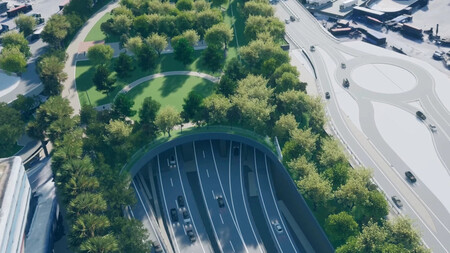
The flagship compensation project for this is the submarine tunnel beneath the port, valued at €1,000 million. It will also include expansive green areas at the entrances and the creation of bicycle lanes.
Fewer traffic jams. This Tunnel Subportuale di Genova will absorb a large share of the city’s west-to-east traffic, and vice versa: a core urban axis where some 80,000 vehicles pass each day. This corridor is among Genoa’s most congested, so the submarine tunnel will separate metropolitan traffic from transit traffic, improving travel times while reducing surface congestion.
Images | Autostrade per l’Italia (Aspi), Shipmag on Youtube, Archive image