
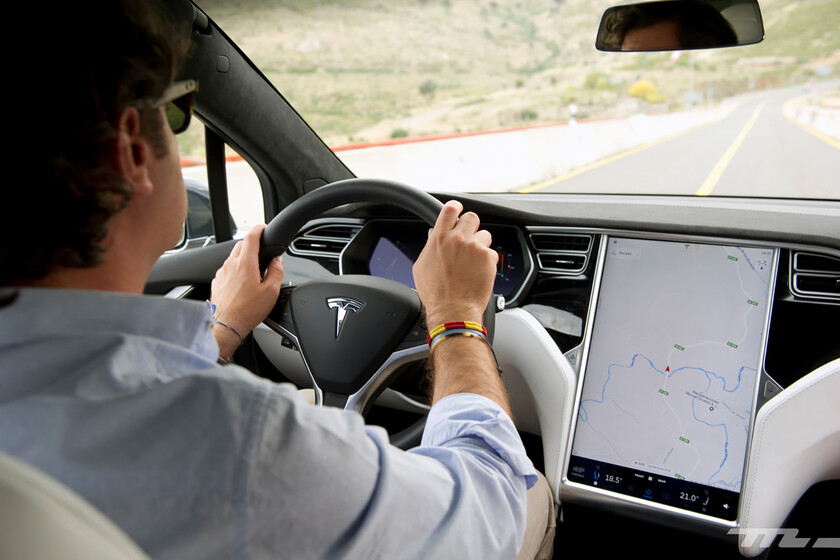
Silence on board and the absence of engine noise are among the advantages of the electric car, or of premium models where comfort is paramount. In daily use or on a trip, it’s something you can get used to quickly. Almost too quickly. And that can be a problem.
And silent cars can be more dangerous than we think, while louder cars are safer, because they prevent us from slipping into the “sensorial bubble.”
Sensorial Bubble: when comfort becomes a trap
Every time you get into a modern car and enjoy that deathly silence at 120 km/h, your brain receives a very clear signal: “everything is under control, you can relax.” And that message, paradoxically, may be the problem.
The trend in modern automobiles is clear: generally, all manufacturers push to offer more isolation, less noise and greater refinement. Engineers have spent decades working to make their cars sound as little as possible, pursuing that ideal of being a comfortable living room insulated from the outside world and floating above the asphalt.

Brands like Lexus, for example, built their brand image on that premise. And now with the rise of the electric car, everyone tends to greater refinement than in the past. The result is a quiet, comfortable interior and, according to psychology, potentially misleading.
The researchers Guy Walker and Neville Stanton describe it with a very evocative term: sensorium bubble. A state in which the driver is isolated from the auditory and tactile cues that normally inform him about what is happening around him. And when that information disappears, the brain simply trusts less than it should.
You drive faster without realizing it. The most striking part of the matter has a scientific basis. A study by Horswill and McKenna (1999) demonstrated something counterintuitive: drivers who received less interior noise tended to circulate faster unconsciously than those driving louder cars. The engine isn’t needed to run, but you do need it to calibrate your speed.
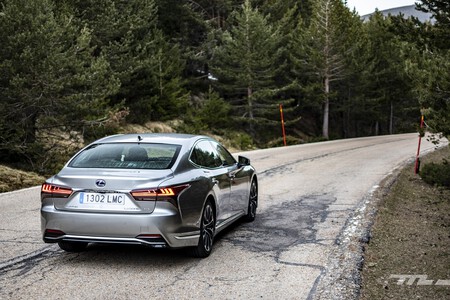
The reason lies in how our perception works. The auditory and tactile feedback from the car, such as the roar of the engine, the vibrations of the steering wheel, or the road noise, acts as a constant indicator of speed and effort. When those signals are dampened, the brain undervalues the actual speed. The result is a right foot that presses a bit harder.
The paradox of ABS and airbags. There is another equally fascinating phenomenon that psychologists call risk compensation (or behavioural adaptation). The idea is that when a driver perceives that their car is safer, some of them unconsciously compensate for that extra margin by taking more risks.
The studies compiled in Traffic and Transport Psychology (Rothengatter and Huguenin) show that this affects especially thrill-seeking drivers, according to the study authors. If you tell them their car has ABS, they are more likely to admit driving faster in wet conditions, shortening the following distance or even driving after drinking. Be careful, not all drivers react the same, and the magnitude of the effect varies. But the pattern exists.
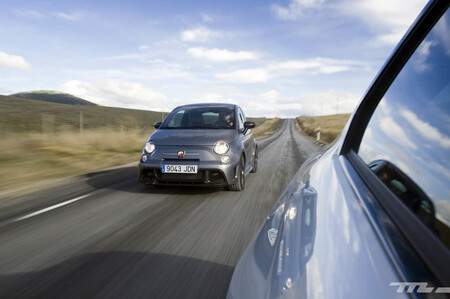
The good news from the same study is that passive safety systems, such as airbags, generate less compensation, precisely because the driver doesn’t “feel” them. There’s no direct feedback, so the brain doesn’t register them as a cushion to lean on.
The brain needs information to drive well. All this points to a broader conclusion about the “Situational Awareness” (SA): our ability to perceive the environment, understand it and anticipate what is going to happen. To know what we are doing and what the car is doing, the brain needs continuous data, and many of them arrive via auditory and tactile channels.
This is something racing drivers know very well; they have to know what the car is doing. Allan McNish, who won the 24 Hours of Le Mans with Audi, recalled the first time he drove the Audi R10 TDI. Coming from deafening petrol engines, the V10 diesel was very quiet: “We had to enlarge the indicator in the instrument cluster to show which gear the car was in, because we had no idea, especially when downshifting: you couldn’t hear the revolutions.”
Paul Frère, a well-known racer (winner of the 24 Hours of Le Mans in 1960), engineer and Belgian journalist, was famous for his technical approach and his ability to describe the physical connection between the driver and the vehicle, especially in his books and articles on sport driving where he always stressed the need to “feel the car” or to “drive with the body.” If you don’t know what your car is doing, you cannot drive well.
When vehicle design filters out that information, SA suffers. And as cars gain in automation and isolation (the rise of the quiet electric car, increasingly many driving assistants and now active noise cancellation), the question researchers ask becomes relevant: are we designing vehicles that disconnect us just when we need to be more attentive?
All this is not a case against technological progress. It is a wake-up call about how technology and human psychology sometimes pull in opposite directions. And a reason not to rest on the laurels of comfort.
Find your ideal electric car
If you are thinking about buying an electric car, this will interest you. We have created the Personalized Electric Car Recommender, in which, in addition to seeing models that fit your needs, you will also get answers to the questions that worry you most, such as price, range, or nearby charging points.