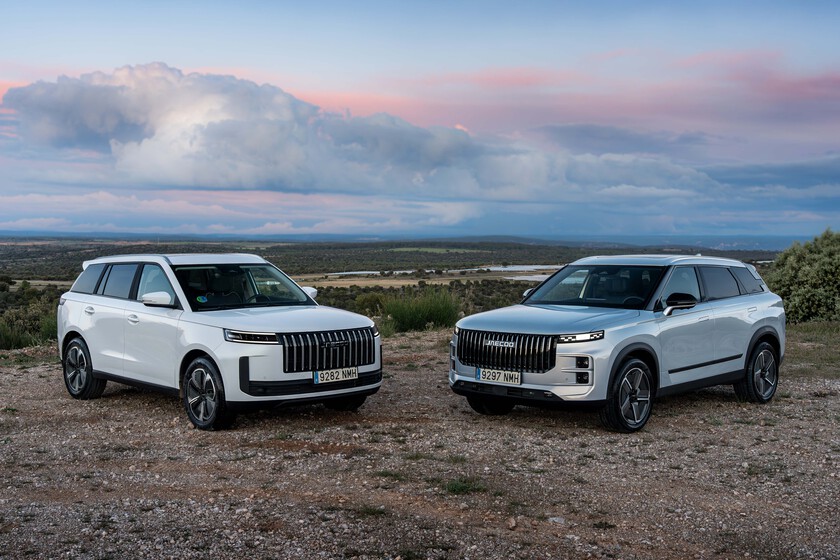
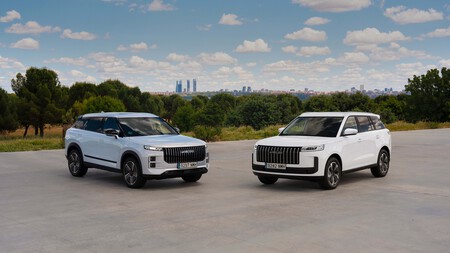
Aware of the pull and demand for conventional hybrids (HEVs) in Spain, Jaecoo has decided to expand its range with the HEV versions of the Jaecoo 5 and Jaecoo 7.
They are called Jaecoo 5 SHS Hybrid and Jaecoo 7 SHS Hybrid and both are already on sale with a non-plug-in hybrid system of 224 HP.
The market asks for hybrids and China brings hybrids
Chinese brands are proving to be very smart. Part of that intelligence lies in reading the market and adapting to give the market what it wants.
It seems obvious, but it is not common because to have that adaptability you need flexibility, and traditional manufacturers are not usually known for being very flexible—let’s say they are “stubborn” and struggle to modify their strategies.

Just look at the current European market situation. While some companies are doing quite badly because they bet everything (too early) on electric cars and now it is catching up with them, Chinese brands have managed to carve out a space in Europe in record time, and in fact some are succeeding so much that they have become the worst nightmare for traditional firms.
It is the case of Omoda and Jaecoo in the Spanish market. They arrived in our country less than three years ago and you will have noticed that the streets are full of these cars. It is not just your perception, it is true: so far this year, Omoda has increased its sales by 146.46% year-on-year, reaching 8,291 registrations, while its sister, Jaecoo, with 3,211 units, has grown 21.35% between January and May 2026.
Those figures would be impossible without the ability to adapt of both brands. When they arrived in Spain they bet on petrol cars and very timidly on electrics, but they realized that the Spanish market wants hybrids, both plug-in (PHEV) and conventional (HEV), so they are adapting their range to offer this type of powertrains.
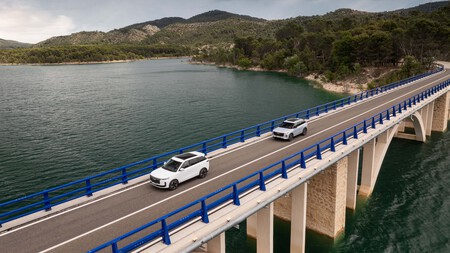
In passing, in this way, these two brands of the Chinese giant Chery will try to steal a slice of the pie from Toyota, which has been the “queen” of hybrids for decades and is no longer alone, so for the first time its reign is at risk.
Omoda was the first to bet on hybrids and now it is Jaecoo’s turn, which debuts the hybrid (HEV) variants of the Jaecoo 5 and Jaecoo 7. In the case of the Jaecoo 5, until now, you could choose between gasoline and electric, to which this new Jaecoo 5 SHS Hybrid is added.
For its part, the arrival of the Jaecoo 7 SHS Hybrid has caused this compact SUV to stop offering the gasoline engine with which it debuted, so now it is only available with the PHEV setup that we already knew and with this new hybrid system.
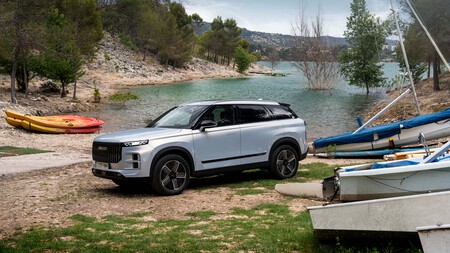
It is the same powertrain for the Jaecoo 5 and the Jaecoo 7: a HEV system formed by a 1.5-liter turbo four-cylinder gasoline engine, two electric motors, a single-gear automatic transmission and an 1.8 kWh NMC battery, always front-wheel drive. It develops a combined maximum output of 224 HP and, of course, it carries the DGT ECO badge.
The blue and green badge is one of the advantages of this version that the two SUVs launch, but it is not the only one. Much of its appeal also lies in ease of use and not having to rely on charging.
Today, many drivers are reluctant to switch to electrification because charging is perceived as complicated and because they do not have the possibility to charge at home. With conventional hybridization, these two drawbacks are mitigated to some extent, hence non-plug-in hybrids have a market share of 40.09% in Spain so far this year.
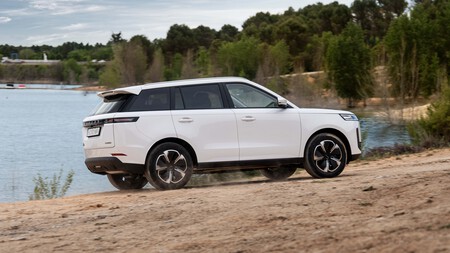
What’s true is that, indeed, part of the charm of these two cars is that they are very easy to drive and don’t complicate things, as I found in a first-hand drive where I could get behind the wheel of both models.
In terms of design there is no change compared to the rest of the range and inside they are exactly the same as well, and that is good, first because both “look good,” both outside and inside.
Second, it is positive because it means they are well-built: they use materials of good quality and, in general, the fit and finish is solid. The Jaecoo 7 comes out a little better than its younger brother thanks to slightly more careful finishing details and because it is better insulated, but keep in mind that it is a higher-segment model and also more expensive.
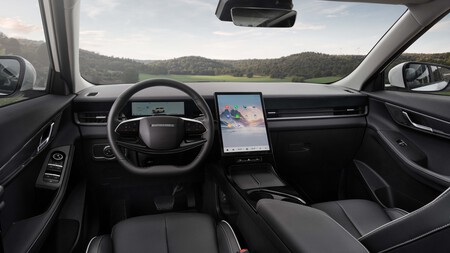
Interior of the Jaeco 5 SHS Hybrid.
La cuestión es que los dos cumplen con creces en este apartado y, como no cambian respecto a otras versiones, también destacan por lo bien equipados que están de serie, especialmente en su acabado más alto (Exclusive), pero también en sus respectivas terminaciones de acceso (Pure).
En términos de espacio tampoco hay cambios, ni para los pasajeros ni en el maletero. Destaca la amplitud que ofrece el Jaecoo 7 en las plazas traseras porque hay sitio de sobra en todas las cotas, aunque las del Jaecoo 5 tampoco desmerecen porque, a pesar de medir 4,38 metros de largo, sirve perfectamente para que dos adultos viajen cómodamente en la parte posterior.
En cambio, ninguno de los dos sale tan bien parado al hablar del maletero porque el Jaecoo 5 SHS Híbrido se sigue conformando con 314 litros de capacidad hasta la bandeja y el Jaecoo 7 SHS Híbrido no es mucho más capaz: tiene 340 litros de capacidad, por lo que, con sus 4,50 metros de largo, está por debajo de la media del segmento.

Lo notas desde la primera vez: pasarse a un coche eléctrico cambia muchas cosas a la hora de conducir. Más allá de decir adiós a ideas preconcebidas poco justificadas, das la bienvenida a una experiencia de conducción cómoda, sencilla y relajada. Los que lo han probado lo saben.
Consejo ofrecido por la marca
Así van los Jaecoo 5 SHS Híbrido y Jaecoo 7 SHS Híbrido
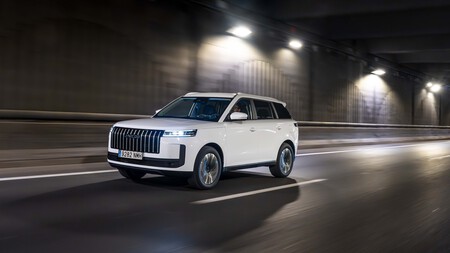
The changes arrive when you’re at the wheel. In quick summary: they are easy to drive, not a “rocket,” they have more than enough punch for the vast majority of drivers, they’re pleasant, and they sip fuel.
The hybrid system has a certain complexity because it can operate in four modes: in 100% electric mode up to 40 km/h and with charging, in series hybrid mode (the internal combustion engine charges the battery), in parallel hybrid mode (both the internal combustion engine and the electric side move the car) and in thermal mode (when the battery is depleted, the only engine moving the car is the gasoline one).
The good news is that this complexity does not affect the driver, or rather it does not involve the driver at all. In other words: at the wheel there is nothing special to do, no need to manage energy, no need to play with hybrid and electric driving modes; just drive and let the car do its job to extract the most from this hybrid system because the car automatically decides how to operate at every moment and does so to seek maximum efficiency in all conditions. Does it succeed? The answer is yes.
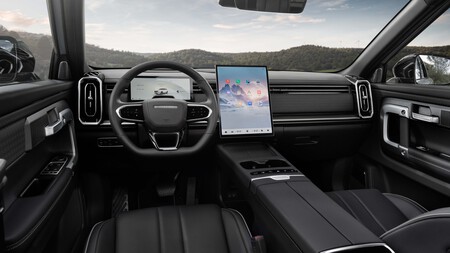
Interior of the Jaeco 7 SHS Hybrid.
On a test drive I drove through city traffic, on the highway, and on secondary roads, always at the pace of traffic and within speed limits: the average consumption never exceeded 5.5 l/100 km, in both the Jaecoo 5 SHS Hybrid and the Jaecoo 7 SHS Hybrid.
I can’t provide an exact figure because the onboard computer only shows the average consumption for the last 50 km. Jaecoo says they are working on changing it to show a more informative figure, i.e., the average consumption since departure, since refueling and since reset.
In any case, it has become clear to me that this hybrid system, besides being pleasant and very quiet, consumes little. And best of all, that low consumption is combined with a 51-liter fuel tank in both cars, so total range is very good: you can do more than 850 km with a single tank without effort, making them cars that you can travel long distances in because they are also comfortable.
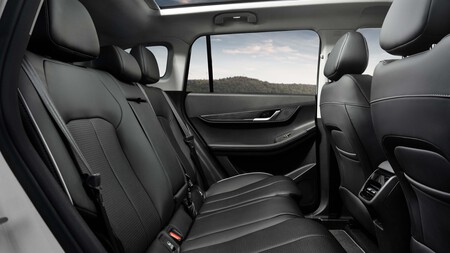
Interior of the Jaeco 5 SHS Hybrid.
Nobody would call either of them the most comfortable in its class, but both prioritize comfort over other aspects, such as dynamics. Not that they are slow; after all, with 224 HP they have plenty of muscle to be capable in any situation and move better than most drivers need, especially the Jaecoo 5 SHS Hybrid because it is a bit faster than its elder brother (0-100 km/h in 7.9 seconds and the Jaecoo 7 SHS Hybrid needs 8.3 seconds).
What happens is that their setup invites you to drive calmly, hence I say they prioritize comfort, and Jaecoo took advantage of the launch of this hybrid version to adjust the Jaecoo 7’s suspension and make it a bit firmer so the car has a more European driving feel and less Chinese.
Do you notice it? Yep: the Jaecoo 7 is more enjoyable than before, but it still has room for improvement, especially due to the steering, which is too filtered and has too artificial a feel.
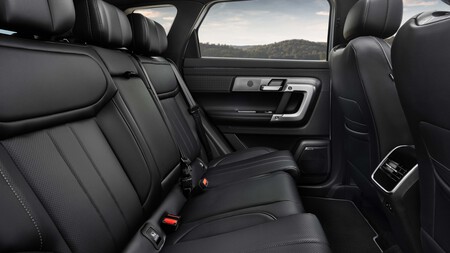
Interior of the Jaeco 7 SHS Hybrid.
The Jaecoo 5 scores better in this regard: overall, it conveys better driving sensations. The interior isn’t as well insulated as the Jaecoo 7, but its behavior aligns better with European tastes and I find it a more pleasant car to drive overall.
As the Jaecoo 5 can also be very well equipped, it moves a bit better, it consumes the same, it has very usable rear seats and the boot is almost as large as that of the Jaecoo 7, so I consider that the smaller of these two SUVs is the smarter buy. It is also 12 cm shorter on the outside, which is noticeable when maneuvering in the city. And it has another major advantage: the price.
Price of the Jaeco 5 SHS Hybrid and the Jaecoo 7 SHS Hybrid
The Jaecoo 5 SHS Hybrid is on sale from 30,000 euros (MSRP) with the base Pure finish and from 33,000 euros (MSRP) with the top Exclusive finish. Meanwhile, the Jaecoo 7 SHS Hybrid starts from 34,400 euros (MSRP) in the Pure version and from 38,400 euros (MSRP) for the Exclusive.
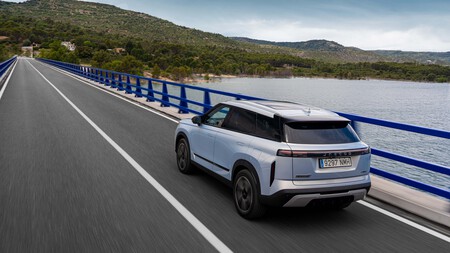
With the minimum brand discount (they give it to you when you walk into the dealership) and paying upfront, the Jaecoo 5 SHS Hybrid Pure costs 28,300 euros and the Exclusive 31,100 euros, while the Jaecoo 7 SHS Hybrid Pure costs 32,750 euros and the Jaecoo 7 SHS Hybrid Exclusive is priced at 36,550 euros. Both are already on sale.
With the minimum discount, they are very competitive prices because both cars are very balanced at all levels and gain points with this hybrid combination, especially the Jaecoo 5 because, unlike the Jaecoo 7, it did not have a plug-in hybrid version previously.
In the case of the Jaecoo 7, the PHEV variant we tested last year is very interesting and I find it more advisable than this hybrid version if you have a home charging point because that way it offers a lot of flexibility and, moreover, it has the DGT ZERO badge.
On the other hand, the new Jaecoo 5 SHS Hybrid is a well-rounded purchase for anyone because it offers a value-for-money that far exceeds that of a Toyota Corolla Cross or a Renault Symbioz E-Tech Full Hybrid; it does not depend on plugging in, the hybrid system works really well, and it is a very versatile car: it works perfectly as a single-family car (though on long trips you may have to limit luggage or consider a roof box).