
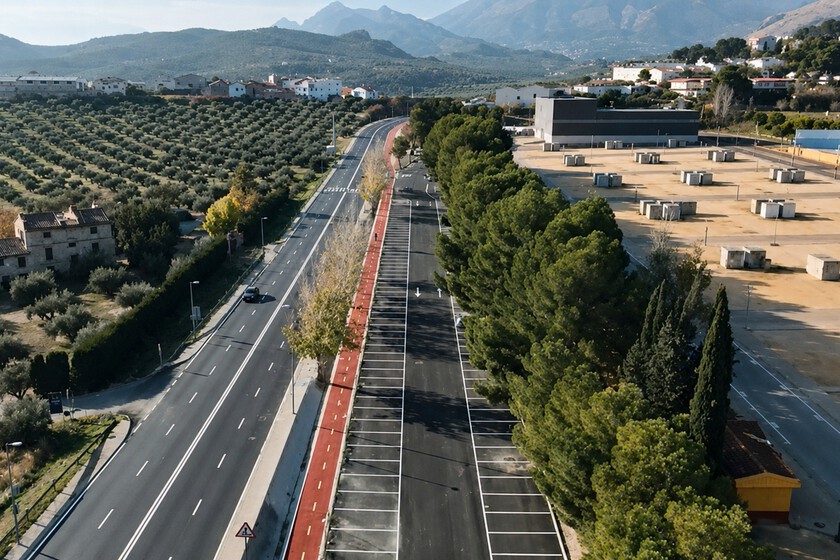
Imagine you’re calmly pedaling along a city bike lane and, without realizing it, you ride over a Roman-era industrial zone that produced oil 1,700 years ago. That is exactly what happens in Jaén, where 21st-century mobility has come face to face with the city’s deepest past.
Modern infrastructures and archaeology sometimes cannot coexist… Or not at the same level. In this case, the conflict was resolved by burying the treasure again to protect it, allowing the works to proceed without compromising the preservation of the heritage. And so they continue.
From Roman oil to bicycles: a route shaped by history
In April 2024, while machines were at work along the Córdoba road to connect La Granja with Jaén’s urban core, the first remains appeared. Delving a bit deeper, workers uncovered a large Roman site dating from the 3rd and 4th centuries AD, featuring a powerful production area for oil and pottery.
But beneath these Roman remains slept an Iberian settlement and, in upper layers, Muslim structures dating from the 9th to the 11th centuries. Archaeologists documented a necropolis with graves of children and adolescents, as well as ceramics and utensils that were removed for study and cataloging.

According to the then Minister of Development, Rocío Díaz, this discovery was of great interest and conditioned the entire project to avoid laying foundations directly on the Roman structures and thus prevent irreparable damage. It is fascinating to think that this site was occupied for almost uninterrupted more than a thousand years.
Why cover it again instead of leaving it on view? The Development delegate, Miguel Contreras, explained at the time that “it is a common practice in urban archaeology: if it cannot be museumized due to costs or logistics, the best option is to protect it, georeference it, and leave it underground” so that future generations can study it without erosion destroying it. Thus, the decision to preserve the buried remains received the approval of the Ministry of Culture, and they have been protected and left in place under constant technical supervision.
This project has entailed a total investment of 2.5 million euros, co-financed with European funds to expand the cycling network by 3.5 kilometers. From a road-planning perspective, the question arises as to why the route runs precisely through this point. The answer is purely technical: the Córdoba road offered the required width to ensure cyclists’ safety without resorting to massive expropriations that would have driven up the budget and the legal timelines of the project.
Today, as of May 2026, the bike lane is fully operational and has become a fundamental route for the capital’s mobility. Although externally we only see asphalt and signage, beneath the wheels lies the testimony of centuries of civilization, preserved under the pavement with a sealing that guarantees its future integrity. The next time you pass by, remember that you are not just exerting yourself; you are traversing a temporal line that extends from the Iberians to the era of micromobility.
Images | Diario de Jaén, Consejería de Fomento, Junta de Andalucía